
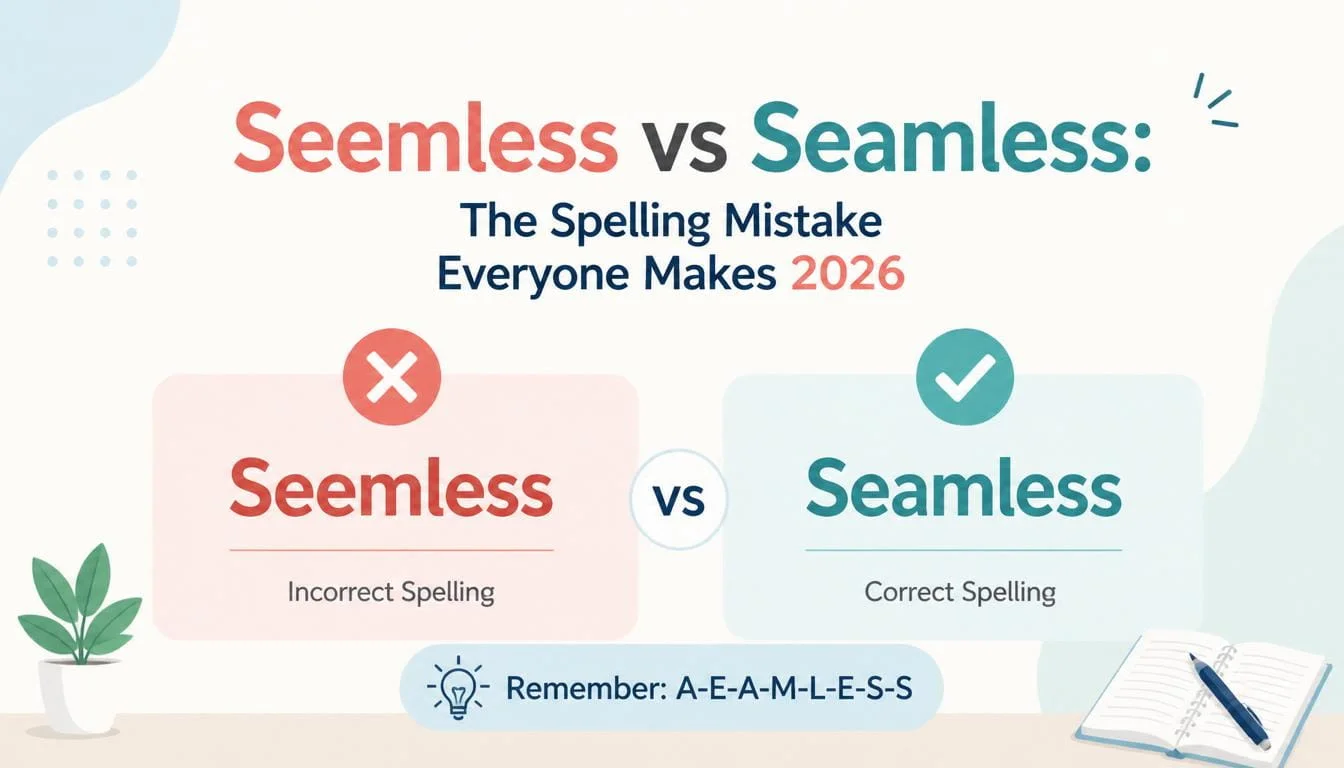
If you’ve ever typed “seemless vs seamless” and paused for a second, you’re not alone. This is one of those English word pairs that looks like it could go either way but only one is actually correct.
And here’s the thing… most people only learn the answer, but never understand why the mistake happens in the first place. That’s where confusion keeps coming back.
Let’s fix that permanently.
Quick Answer
Which is correct: seemless or seamless?
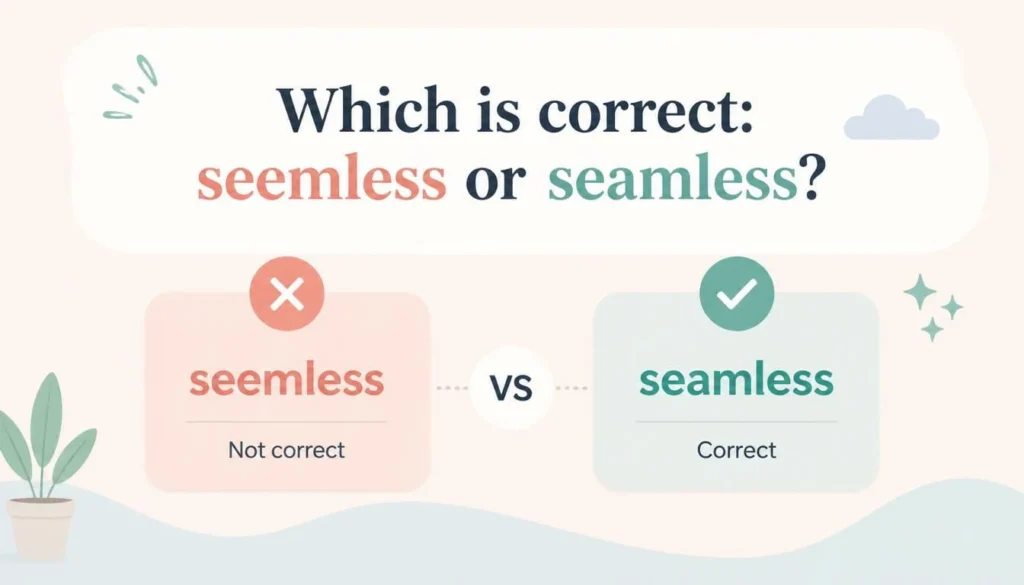
“Seamless” is the correct spelling. “Seemless” is a common misspelling caused by pronunciation confusion and the familiarity of the word “seem.” The word comes from “seam,” meaning a stitched connection in fabric, and now describes anything smooth, continuous, or without interruption. “Seemless” has no meaning in standard English.
AI Overview Summary
Seemless vs Seamless Explained Simply
- Correct spelling: Seamless
- Incorrect spelling: Seemless
- Meaning: Smooth, uninterrupted, or without visible joins
- Origin: Comes from the word “seam” (a stitched line in fabric)
- Modern use: Common in business, technology, UX design, and communication
In short: “seamless” is the only accepted form in English, while “seemless” is just a spelling error.
What Does “Seamless” Actually Mean?
Let’s slow this down.
Seamless means something that feels smooth, connected, and without interruptions.
Originally, it described fabric made without visible stitching. But today, the meaning has expanded a lot.
You’ll hear it everywhere like:
- seamless experience
- seamless integration
- seamless workflow
- seamless communication
Here’s the simple idea:
If something feels like it flows without stopping or breaking, it’s seamless.
Where the word comes from (important insight most people miss)
The root word is “seam.”
A seam is the line where two pieces of fabric are stitched together.
So when something is seam-less, it literally means:
without seams → no visible joins → smooth surface
That’s the original logic behind the word.
Seemless vs Seamless: The Key Difference
This is where confusion usually settles.
| Feature | Seamless | Seemless |
|---|---|---|
| Correct spelling | Yes | No |
| Dictionary word | Yes | No |
| Meaning | Smooth or uninterrupted | No meaning |
| Used in writing | Yes | Never |
| Professional usage | Common | Incorrect |
So if you remember one thing, remember this:
Seamless is always correct. Seemless is always wrong.
Why People Accidentally Write “Seemless”
Most grammar tools don’t explain this part—but it’s actually the real reason behind the mistake.
Here’s what’s happening in your brain:
1. The pronunciation trick
When you say “seamless” quickly, it sounds like:
“seem-less”
So your brain naturally tries to spell it using the more familiar word “seem.”
That’s the first trap.
2. Familiar word bias
“Seem” is a common English word.
“Seam” is less frequently used in everyday speech.
So your brain says:
“I know seem… I’ll use that.”
Even though it’s wrong.
3. The Phonetic Illusion Model (simple explanation)
Let’s break it down:
- You hear a word
- You match it to the closest familiar spelling
- You choose “seem” instead of “seam”
- You end up with “seemless”
This is why even fluent speakers make this mistake.
Most people miss this completely.
READ MORE >>> Combating or Combatting: Correct Spelling, Meaning, and When to Use Each Form
How “Seamless” Is Used in Real Life Today
This word has grown far beyond clothing.
Let’s look at how it’s used in modern English.
In technology
You’ll often hear:
- seamless integration between apps
- seamless data sync
- seamless AI workflow
Meaning here:
Everything works together without breaking or requiring effort.
In UX and design
- seamless onboarding
- seamless user experience
- seamless navigation
Meaning here:
The user doesn’t feel friction or confusion.
In business communication
- seamless collaboration
- seamless process
- seamless execution
Meaning here:
Things run smoothly between teams or systems.
Real-life simple example
Think about using two apps:
- You log in once
- Both apps connect automatically
- No repeated steps
That’s a seamless experience.
Mini Case Study: Why “Seamless” Became a Buzzword in Tech
Let’s get real for a second.
In the last decade, especially with SaaS and AI tools, companies started competing on experience, not just features.
So instead of saying:
“fast system” or “efficient tool”
They started saying:
“seamless experience”
Why?
Because “seamless” implies:
- no friction
- no effort
- no learning curve
- everything just works
Example:
A modern payment app doesn’t just say:
- “fast checkout”
It says:
- “seamless checkout experience”
Even if the actual difference is small.
That’s how powerful the word has become.
Seamless vs Frictionless vs Effortless
These words often get mixed, but they are not the same.
| Word | Meaning | Focus |
|---|---|---|
| Seamless | Smooth connection between systems | Flow |
| Frictionless | No obstacles or resistance | Barriers |
| Effortless | Easy for the user | Effort level |
Simple way to remember:
- Seamless = things connect smoothly
- Frictionless = nothing gets in your way
- Effortless = you don’t have to try hard
Common Mistakes People Make
Most confusion around seemless vs seamless comes from small habits.
Mistake 1: Relying on sound
People write what they hear, not what is correct.
Mistake 2: Overthinking “seem”
Because “seem” is familiar, it feels right.
Mistake 3: Skipping etymology
Most people don’t know the word comes from “seam.”
How to Never Misspell It Again
Here’s a simple trick that actually works.
Think: seam = stitch
Now connect it:
- no stitch → seamless
- no join → seamless
- no break → seamless
Once you lock that in, “seemless” stops making sense completely.
Expert Tip (Most People Don’t Know This)
If you’re writing professionally, be careful with overusing “seamless.”
Why?
Because in modern writing, especially in marketing and AI content, it can sound:
overused or vague
Better alternatives sometimes include:
- smooth
- unified
- integrated
- uninterrupted
- streamlined
This keeps your writing more precise and less generic.
Frequently Asked Questions
It’s widely used in:
technology
UX design
business communication
AI tools
customer experience
Because the pronunciation sounds like “seem-less,” and the word “seem” feels more familiar than “seam.”
It means smooth, continuous, or without interruptions.
Because it comes from the word “seam,” which refers to a stitched line in fabric. “Seamless” originally meant without visible stitching.
No. “Seemless” is not a recognized English word. The correct spelling is “seamless.”
Final Conclusion
At first glance, seemless vs seamless looks like a small spelling issue.
But once you understand it, there’s a deeper pattern underneath.
Most mistakes happen not because people don’t know English—but because their brain chooses familiar sound over correct structure.
And that’s the real takeaway here.
So next time you type it, just remember one simple rule:
If it comes from a “seam,” it’s always seamless.
And once you see that connection clearly, the confusion disappears for good.