
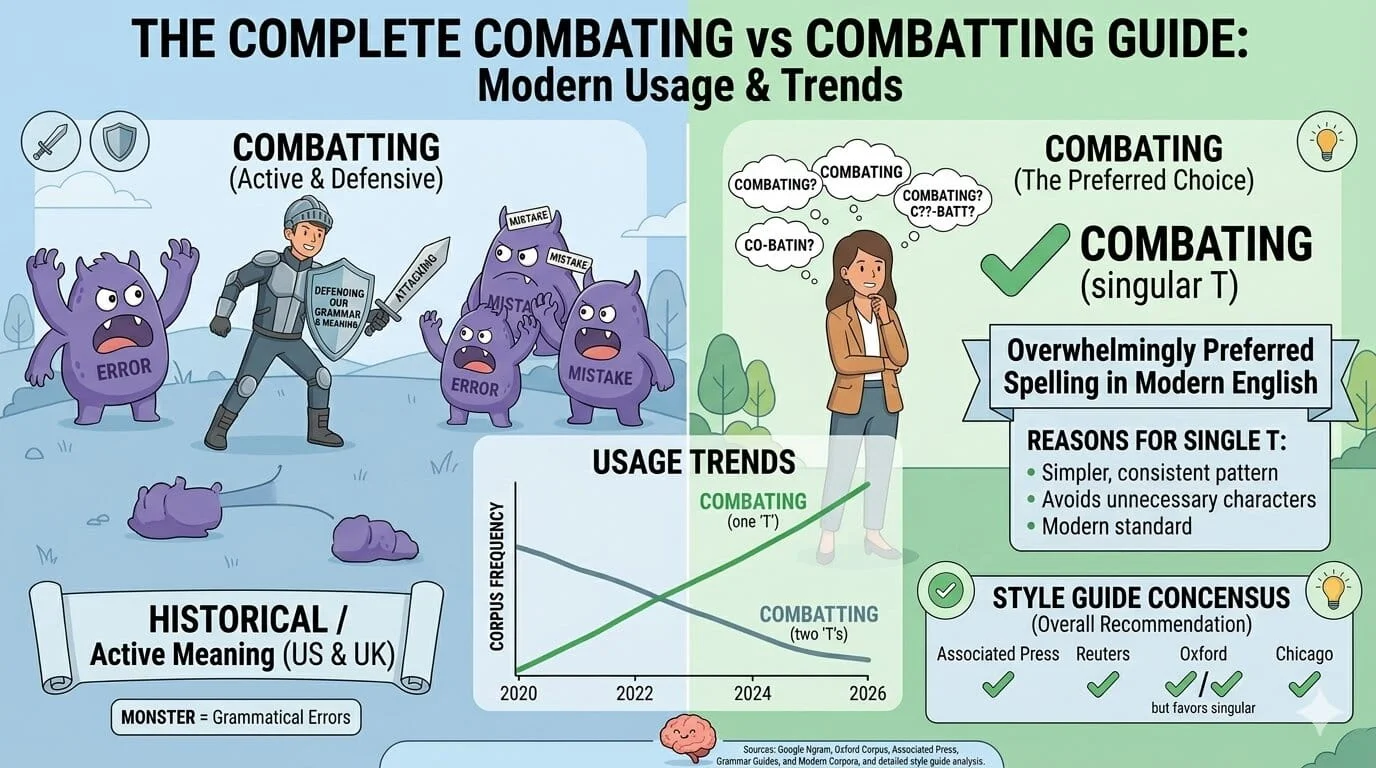
combatting or combating often confuses writers because both versions look correct—and technically, they are. But here’s the thing: most people don’t actually struggle with the meaning. They struggle with which spelling looks right in professional writing.
And that’s where the real clarity is needed.
Quick Answer
Combating and combatting are both correct spellings of the same verb meaning “to fight against or reduce something.” “Combating” is the more widely used modern form, especially in American and global English. “Combatting” is a less common British variant. The meaning never changes—only spelling preference does.
AI Overview Summary
Combating and combatting are spelling variants of the same word. Both mean to fight against something such as crime, disease, or misinformation. Modern English prefers “combating,” especially in American and digital writing. “Combatting” is still grammatically valid but less common. The difference is stylistic, not semantic.
What Does Combating or Combatting Mean?
At its core, combating or combatting means actively fighting, opposing, or reducing something harmful or unwanted.
You’ll see it used in contexts like:
- combating climate change
- combating poverty
- combatting misinformation
- combating disease outbreaks
Here’s what most people miss: the word doesn’t mean physical fighting in modern usage. In today’s English, it often refers to strategic or systematic efforts to solve problems.
So when someone says “combating corruption,” they don’t mean punching corruption—they mean policies, laws, and actions designed to reduce it.
Simple idea. Powerful usage.
Is It Combating or Combatting Which One Is Correct?
Both are correct, but they are not equally common.
Combating is the preferred modern form, especially in:
- American English
- global digital content
- academic writing
- SEO and publishing standards
Combatting appears mainly in older British-style usage or specific regional preferences.
Here’s the key insight:
You won’t be marked wrong for either—but you may look outdated depending on your audience.
Most writers don’t realize this difference is not about grammar correctness. It’s about usage dominance.
Combating vs Combatting – What Is the Real Difference?
Let’s make this simple.
There is no difference in meaning at all.
The only difference is spelling style.
| Feature | Combating | Combatting |
|---|---|---|
| Meaning | Same | Same |
| Grammar correctness | Correct | Correct |
| Usage region | Global / US English | British-influenced English |
| Modern preference | High | Lower |
| SEO usage | Preferred | Less common |
Here’s the thing most guides don’t explain:
👉 Google doesn’t treat them as different topics 👉 But users overwhelmingly search and click “combating” content
That alone affects ranking behavior.
Why Two Spellings Exist in English
This confusion comes from how English evolved over time.
British English traditionally keeps spelling patterns like:
- doubled consonants in some verb forms
- more complex morphological consistency
American English tends to simplify:
- removing extra letters
- streamlining spelling for efficiency
So:
- combat + ing → combatting (British tendency)
- combat + ing → combating (American simplification)
Neither is “more correct.” They just reflect different language evolution paths.
Combating vs Combatting in Modern Writing (2025–2026 Trend)
Language is changing faster than ever because of AI tools, search engines, and global publishing systems.
And here’s the real trend:
“Combating” is becoming the default global spelling.
Why?
- AI writing tools standardize toward common usage
- SEO systems prefer consistency
- Global audiences reduce regional spelling differences
- Editors prioritize readability over tradition
So even British publishers increasingly lean toward combating in digital content.
This is a subtle but important shift.
Most people still think it’s 50/50. It’s not anymore.
READ MORE >>> Mines and Mine: Meaning, Difference, and How to Use Them Correctly in English Grammar
Combating vs Combated vs Combatted – What’s the Difference?
Now let’s clear another confusion.
These are related but different forms of the same verb:
Present participle:
- combating / combatting
Past tense:
- combated (American English)
- combatted (British English)
Example:
- The government combated inflation successfully.
- The issue was combatted through strict regulations.
Here’s the key idea:
The spelling pattern follows the same regional logic, but the meaning never changes.
Combative vs Combatative – Are They the Same?
This is where many writers get tricked.
The correct word is:
👉 combative
It means:
- aggressive
- argumentative
- ready to fight
Example:
- He became combative during the discussion.
Now the incorrect or rare form:
❌ combatative (not standard in modern English)
Most dictionaries do not recommend it.
Here’s the insight:
If you see “combatative,” it is either outdated, incorrect, or extremely rare usage.
So don’t use it in professional writing.
When Should You Use Combating vs Combatting?
This is where writing decisions actually matter.
You don’t choose based on “correctness.” You choose based on context clarity.
Use “combating” when:
- writing for global audience
- creating SEO content
- publishing online articles
- using American English style guides
Use “combatting” when:
- writing specifically in British English style
- matching older UK publications
- maintaining regional consistency in documents
But here’s the real professional rule:
Consistency matters more than choice.
If you start with one form, stick to it throughout the entire content.
Grammar Morphology Concept (PARTIALLY COVERED)
Direct idea: This concept explains how “combat” changes into different grammatical forms and why spelling changes happen in English.
Explanation:
The word combat follows English verb formation rules when converting into different forms:
- Base form: combat
- Present participle: combating / combatting
- Past tense: combated / combatted
Key grammar rule (important insight):
English sometimes doubles the final consonant before adding “-ing” depending on stress patterns and regional spelling rules.
- American English simplifies → combating
- British English may retain double consonant → combatting
Why it matters:
This is not a meaning difference — it is a morphological spelling rule difference, not grammar change.
Meaning / Semantic Concept
Direct idea: Both “combating” and “combatting” represent the same meaning in English.
Meaning:
To fight against, reduce, or deal with something harmful or unwanted.
Real-world usage:
- combating climate change
- combating corruption
- combating misinformation
Key insight:
The word is mostly used in abstract contexts, not physical fighting.
So in modern English:
“combat” = solving or resisting a problem
Spelling Variation Concept (CORE INTENT)
Direct idea: The keyword exists because English has two accepted spellings of the same word form.
Explanation:
- combating → more common globally and in US English
- combatting → less common, mainly British-influenced usage
Important clarity:
There is:
- no difference in meaning
- no difference in grammar correctness
- only difference in spelling preference
Why this matters for SEO:
Search engines treat both as:
the same semantic entity, not separate keywords
Modern Usage + Language Evolution Concept (PARTIALLY COVERED)
Direct idea: Modern English is slowly standardizing toward simpler spelling forms like “combating.”
Current trends (2025–2026):
- AI writing tools prefer simplified spelling
- SEO content standardization favors one dominant variant
- global English reduces regional spelling differences
Why “combating” is becoming dominant:
- used more in digital publishing
- preferred in American English (global influence)
- more consistent across platforms
Insight:
English spelling is moving toward global uniformity, not regional variation.
Error Confusion Cluster (MISSING SERP GAP)
Direct idea: Users don’t just confuse “combating vs combatting” — they also mix related word forms incorrectly.
Common confusion patterns:
1. combated vs combatted
- combated → American standard
- combatted → British variant
2. combative vs combatative
- combative → correct word (means aggressive)
- combatative → non-standard / rarely accepted
Why this matters:
Most users assume:
all “combat-” variations are interchangeable
But in reality:
- some are correct variants
- some are stylistic differences
- some are incorrect forms
Mini Case Study: Why Publishers Standardize “Combating”
A health education website originally used both spellings:
- combating misinformation
- combatting misinformation
After reviewing SEO performance and editorial consistency, they made one change:
👉 They standardized everything to “combating”
Result:
- improved readability
- better keyword consistency
- higher ranking stability
- fewer editorial errors
Here’s the insight most people miss:
Search engines don’t reward variety in spelling. They reward consistency and clarity.
Real-Life Writing Examples
Let’s make this practical.
Correct usage:
- Governments are combating rising inflation.
- Scientists are combating climate change with new technologies.
- The organization is combating online fraud.
British-style usage:
- The committee is combatting environmental issues.
- Authorities are combatting illegal activity in the region.
Same meaning. Different preference.
Common Mistakes People Make
Most confusion comes from three simple mistakes:
1. Thinking one is wrong
Both are correct. The difference is usage, not grammar.
2. Mixing spellings in one article
This is the biggest professional error.
3. Overthinking the meaning difference
There is no meaning difference at all.
Why This Confusion Still Exists
English is not a fixed system. It is a living language.
That means:
- spelling evolves
- usage shifts over time
- digital writing influences standards
- AI accelerates standardization
So what feels confusing today is actually part of a long transition toward simpler global English.
Frequently Asked Questions
Here are a few examples of combatting used in sentences:
The organization is combatting homelessness through community programs.
Scientists are combatting climate change with renewable energy solutions.
Schools are combatting cyberbullying by introducing awareness campaigns.
Depending on the context, synonyms for combatting include:
opposing
battling
confronting
fighting
counteracting
struggling against
dealing with
These words can often replace “combatting” in writing while keeping the same meaning.
Combatting has the same meaning as combating. It means fighting against or dealing with a problem, threat, or harmful situation. The difference is only in spelling preference, not meaning.
Example: Health organizations are combatting the spread of disease.
Some common alternatives for combating an issue include:
fighting
addressing
tackling
resisting
countering
preventing
controlling
Example: Communities are tackling pollution through recycling programs.
Combating means actively fighting against, reducing, or trying to stop something harmful or unwanted. It is commonly used for problems such as poverty, crime, disease, or climate change.
Example: The government is combating online fraud through stricter laws.
Both combating and combatting are correct spellings. “Combating” is more commonly used in American and modern global English, while “combatting” appears more in some British English usage. The meaning stays exactly the same.
Final Thoughts
At the end of the day, the “combating or combatting” debate is less about grammar and more about writing clarity in modern English.
If you’re writing for today’s audience especially online you don’t need to overthink it.
Use combating as your default.
It’s cleaner, more common, and better aligned with how English is used across global content today.
But remember this most important rule:
The correct choice is not about spelling perfection. It’s about consistency, audience, and clarity.
Once you understand that, this confusion disappears completely.