
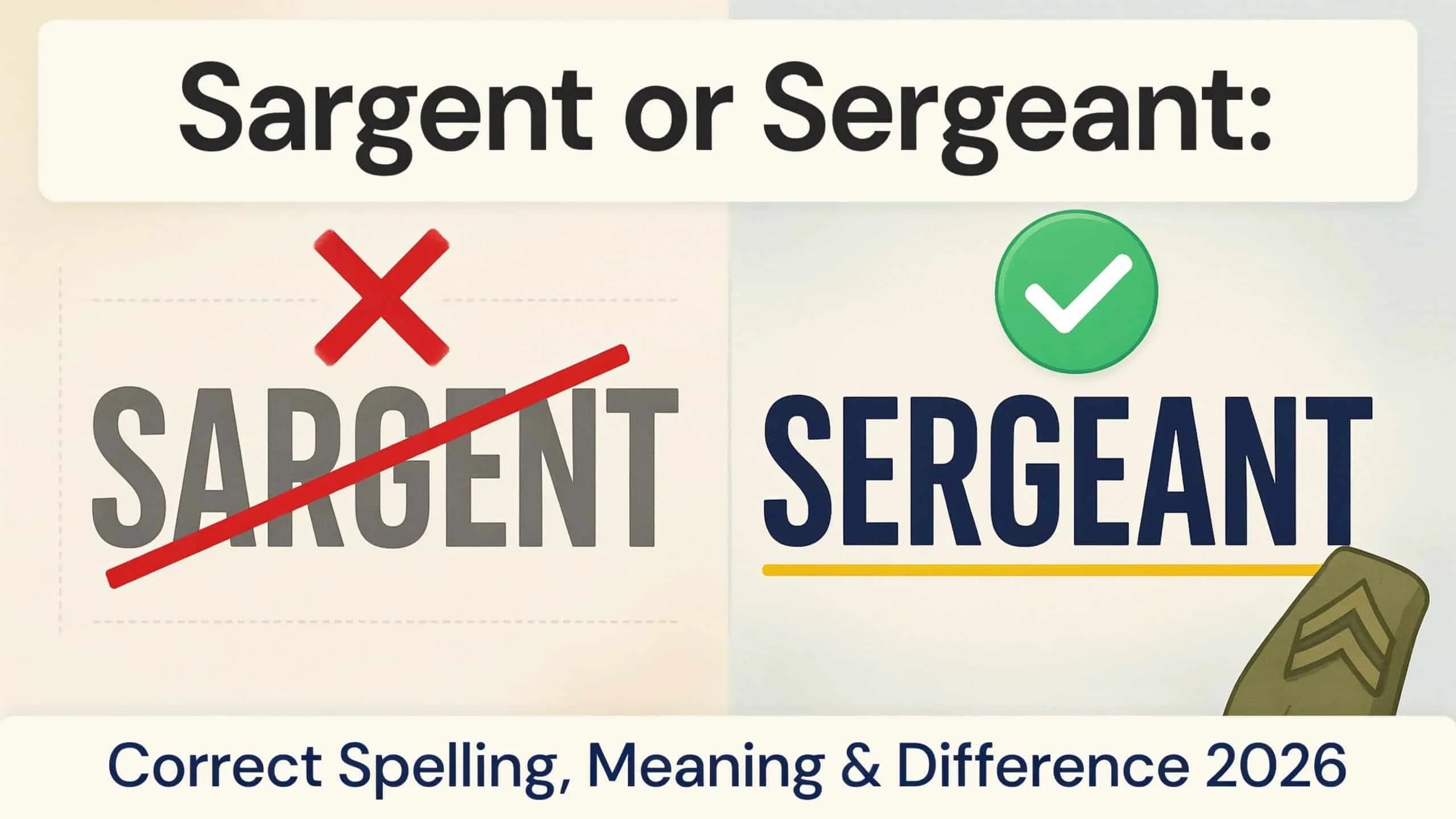
Sargent or sergeant is a very common English spelling confusion, especially for students, ESL learners, and people searching for military or police rank information. The correct spelling is sergeant, which refers to a formal military and police rank used in many countries.
So, to answer the main question directly: “sergeant” is the correct spelling, while “sargent” is usually incorrect and mostly appears as a misspelling or a surname.
In this complete guide, you will understand everything about sargent vs sergeant spelling, their meaning, differences, pronunciation, and even career-related insights like how to become a sergeant in the military or police.
What is Sergeant? (Meaning Explained)
Sergeant is a non-commissioned officer (NCO) rank used in military forces and police departments worldwide. It is a position of responsibility, leadership, and discipline.
A sergeant typically:
- Leads a small group of soldiers or police officers
- Ensures discipline and training
- Reports to higher-ranking officers
- Plays a key role in operational tasks
In simple words, a sergeant is a mid-level leadership rank that connects junior staff with senior officers.
In Military Context
In the army, a sergeant is responsible for supervising troops and ensuring missions are executed properly.
In Police Context
In police departments, a sergeant supervises constables or junior officers and manages daily operations.
📌 Content Summary
The article correctly establishes early that “sergeant” is the correct spelling, while “sargent” is mostly incorrect or used as a surname. It then builds understanding by explaining the meaning of sergeant as a military and police rank, including its responsibilities and real-world usage.
You also expanded the topic beyond spelling by covering:
- The difference between sargent and sergeant
- The pronunciation vs spelling confusion
- Career-related query: how to become a sergeant
- Contextual usage in military and police systems
- Common mistakes and memory tricks
- FAQ-style explanations for user clarity
Sargent vs Sergeant Spelling – Which One is Correct?
This is the most searched confusion keyword: sargent vs sergeant spelling
The correct spelling is:
✔ Sergeant → Correct ❌ Sargent → Incorrect (in most cases)
Why “Sargent” is Wrong?
- It is a common spelling mistake
- It comes from pronunciation confusion
- English spelling is not phonetic
- People mishear the “e” sound
When “Sargent” is Actually Correct?
- It can be used as a surname (family name) Example: People with last name “Sargent”
But in military or police ranking, only “sergeant” is correct.
Difference Between Sargent and Sergeant
The keyword difference between sargent and sergeant is important for clarity.
Simple Explanation:
There is no meaning difference in professional use because:
- “Sergeant” = official rank
- “Sargent” = incorrect spelling (or surname)
Comparison Table
| Feature | Sergeant | Sargent |
|---|---|---|
| Correctness | ✔ Correct | ❌ Incorrect (as rank) |
| Usage | Military & Police | Surname / Mistake |
| Meaning | Leadership rank | No rank meaning |
| Official term | Yes | No |
Why Do People Get Confused Between Sargent and Sergeant?
Many learners struggle with this because English spelling is not always logical.
Main reasons:
- Pronunciation sounds like “sarge-unt”
- Silent letters in English
- Influence of spoken English
- Typing mistakes
- ESL learner confusion
This is one of the most common spelling mistakes in English vocabulary learning.
Pronunciation of Sergeant
Even though it is spelled sergeant, it is usually pronounced as:
👉 “SAR-jent”
This mismatch between spelling and pronunciation is one of the biggest reasons for confusion.
Why pronunciation is different:
- English borrows many words from French
- Spelling stayed original, pronunciation changed over time
- Silent letters evolved in modern English
Mirth Meaning in the Bible: Definition, Verses, and Spiritual Insight
Learn the spelling rules, regional differences, and real-world examples.
What Does Sergeant Mean in Real Life?
A sergeant is not just a word—it is a real leadership position.
Key responsibilities:
- Supervising team members
- Maintaining discipline
- Assigning duties
- Training junior staff
- Reporting to higher officers
Interesting fact:
In many forces, a sergeant is considered the backbone of operational leadership because they directly manage ground-level execution.
How to Become a Sergeant
The keyword how to become a sergeant is highly searched because many people want career growth in military or police services.
General path to becoming a sergeant:
1. Join the Force
- Army, police, or security services
2. Gain Experience
- Work as constable or soldier first
3. Show Performance
- Discipline, leadership, and skills matter
4. Promotion Exams / Evaluation
- Written tests (in some countries)
- Physical and performance assessments
5. Promotion to Sergeant
- Based on merit, seniority, and evaluation
Skills required:
- Leadership ability
- Communication skills
- Physical fitness
- Discipline
- Decision-making ability
Becoming a sergeant usually takes several years of experience and dedication.
Is it spelled sargent or sergeant?
The correct spelling is sergeant. The word “sargent” is usually a common spelling mistake or sometimes a surname, but it is not correct when referring to a rank.
Sergeant is the official term used in the military and police forces. It represents a leadership position responsible for supervising lower-ranked officers and maintaining discipline.
👉 Correct: Sergeant 👉 Incorrect: Sargent (in rank context)
Is Sargent a rank?
No, “Sargent” is not a rank in any official military or police system.
The correct rank is Sergeant.
However, “Sargent” can sometimes appear:
- As a family surname
- In historical or personal names
But it has no official role in ranking systems like the army or police.
How do you spell sergeant in the UK?
In the UK, the spelling is exactly the same as in other English-speaking countries:
👉 S-E-R-G-E-A-N-T
It is used in:
- British Army
- Police ranks (e.g., Police Sergeant)
- Royal Air Force
Even though pronunciation sounds like “sar-jent,” the spelling remains “sergeant” due to its French linguistic origin.
What is the meaning of sargent?
The word “sargent” does not have a valid meaning in standard English when referring to ranks.
However, it may appear in two cases:
- ❌ As a misspelling of sergeant
- ✔ As a proper noun (surname)
So in grammar and official usage, “sargent” has no military or police meaning.
The correct term, sergeant, refers to a non-commissioned officer (NCO) responsible for leadership and supervision duties.
Who is higher than a sargent?
First, the correct spelling is sergeant.
In most military and police hierarchies, ranks above sergeant include:
Typical hierarchy (simplified):
- Sergeant
- Staff Sergeant / Senior Sergeant
- Warrant Officer
- Commissioned Officers (Lieutenant, Captain, etc.)
So, anyone above sergeant is typically:
- Senior non-commissioned officers
- Or commissioned officers
👉 Exact structure varies by country and organization, but sergeant is generally a mid-level rank, not the highest.
What was Sargent famous for?
This question usually refers to people with the surname “Sargent,” not the military rank.
One of the most famous figures is:
John Singer Sargent
A well-known American painter famous for:
- Portrait paintings of high society
- Realistic and elegant painting style
- Works like “Portrait of Madame X”
So in this case:
- “Sargent” is a surname
- Not related to military rank or spelling of sergeant
👉 Important distinction:
- Sargent (name) = famous people (like artists)
- Sergeant (rank) = military/police position
Is Sargent Ever Correct?
Yes—but only in specific cases:
- As a surname (family name)
- In historical or personal names
Example:
- “John Sargent” (a person’s name)
But in all official contexts like army or police: ❌ “Sargent” is wrong ✔ “Sergeant” is correct
Common Mistakes People Make
Here are frequent errors related to this keyword:
- Writing sargent instead of sergeant
- Mispronouncing it as “ser-ge-ant”
- Confusing it with other ranks like corporal
- Using lowercase incorrectly in formal writing
- Thinking both spellings are acceptable
Easy Trick to Remember Correct Spelling
Here’s a simple memory trick:
👉 “Sergeant = SERious + Agent”
Think of a sergeant as a serious agent of authority in the military or police.
This helps you remember: ✔ It starts with “Ser-” not “Sar-”
Real-Life Example Sentences
- The sergeant trained new recruits in the camp.
- A police sergeant handled the investigation.
- He was promoted to sergeant after five years of service.
- Many people mistakenly write sargent, but it is incorrect in this context.
Key Differences in Usage Context
| Context | Usage |
|---|---|
| Military | Sergeant leads soldiers |
| Police | Sergeant supervises officers |
| Writing | Always use “sergeant” |
| Names | “Sargent” may appear as surname |
Quick Facts About Sergeant
- It is a non-commissioned officer rank
- Used globally in armies and police forces
- Derived from Old French origins
- One of the most common mid-level ranks
- Essential for field operations and leadership
FAQs About Sargent or Sergeant
What is correct, sargent or sergeant?
Sergeant is the correct spelling used in military and police contexts.
Why do people write sargent instead of sergeant?
Because of pronunciation confusion and spelling mistakes.
What is the difference between sargent and sergeant?
There is no official difference—sargent is incorrect spelling, sergeant is the correct rank.
Can sargent ever be correct?
Yes, only as a surname, not as a rank.
How do you spell sergeant correctly?
S-E-R-G-E-A-N-T
Final Summary
The confusion between sargent or sergeant is extremely common, but the answer is simple: sergeant is the correct spelling, representing an important military and police rank.
Understanding the difference between sargent and sergeant, their pronunciation, and usage helps avoid one of the most common English spelling mistakes. Whether you’re learning English or preparing for exams, remembering the correct form will improve your accuracy and confidence.
Most importantly, if you are searching for career growth, learning how to become a sergeant gives you insight into a respected leadership position built on discipline, experience, and responsibility.