
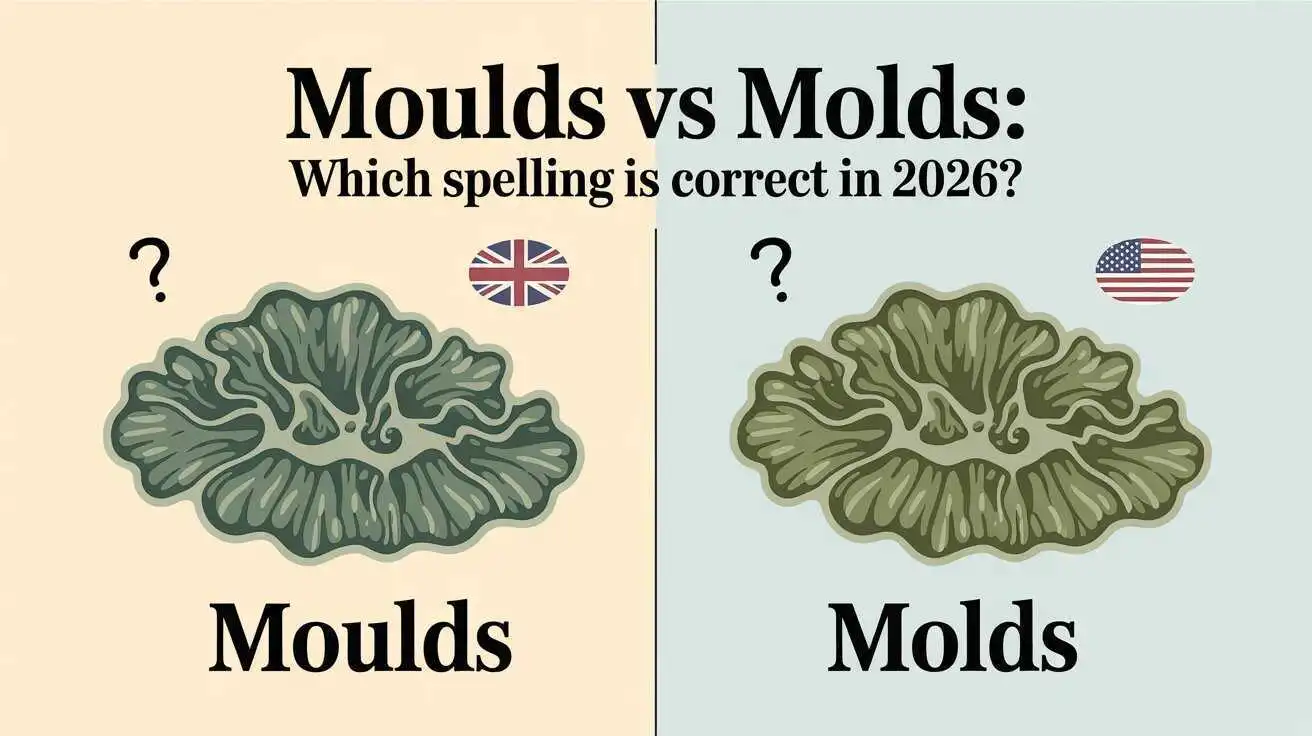
“Moulds vs Molds” Let’s cut through the confusion right now. Moulds and molds are both correct they’re just different regional spellings of the same word. Molds is American English. Moulds is British English. Use molds when writing for US audiences, moulds for UK, Australia, Canada, and other Commonwealth countries. Both spellings refer to fungal growth, containers for shaping liquid, or manufacturing tools.
Quick Answer: Moulds vs Molds in 30 Seconds
Moulds and molds are both correct spellings of the same word. Molds is the American English spelling, while moulds is the British English spelling. Use molds when writing for US audiences and moulds for UK, Australia, New Zealand, Canada, and other Commonwealth countries. Both spellings mean the exact same thing — fungal growth, containers, or manufacturing tools. The only difference is where your reader lives.
AI Overview Summary: Moulds vs Molds
Moulds and molds are both correct spellings of the same word. Molds is the American English spelling, while moulds is the British English spelling. Use molds when writing for US audiences and moulds for UK, Australia, New Zealand, Canada, and other Commonwealth countries. Both spellings refer to fungal growth, containers for shaping liquid, or manufacturing tools. The only difference is where your reader lives, not which spelling is “correct.”
Quick Reference: Moulds vs Molds
- Molds = American English (USA, Philippines)
- Moulds = British English (UK, Australia, New Zealand, most Commonwealth)
- Both are correct — choose based on your audience’s region
- Never mix both spellings in the same document
Is There a Difference Between Mould and Mold?
Here’s the thing: yes, but only in spelling, not meaning.
When you see “mold” and “mould,” you’re looking at the same word written differently. It’s like color versus colour, or favor versus favour. The pronunciation is identical. The meaning is identical. The only thing that changes is which English version your reader expects.
The Complete Difference
| Feature | Mold (American) | Mould (British) |
|---|---|---|
| Spelling | m-o-l-d | m-o-u-l-d |
| Region | USA, Philippines | UK, Australia, NZ, Commonwealth |
| Plural | molds | moulds |
| Past Tense | molded | moulded |
| Present Participle | molding | moulding |
| Example (Fungus) | “There’s mold in the bathroom” | “There’s mould in the bathroom” |
| Example (Container) | “Pour into the mold“ | “Pour into the mould“ |
Most people miss this: It’s not about which spelling is “right.” It’s about which spelling your audience expects.
When Should You Use “Mold” vs “Mould”?
This is where most writers get stuck. Let me make it simple.
Use “Mold” When…
- You’re writing for a US audience (blog, website, email)
- Your client or company is based in America
- You’re submitting to a US publication or journal
- Your website analytics show 60%+ traffic from the US
- You’re using American English settings in grammar checkers
Use “Mould” When…
- You’re writing for a UK audience
- Your company is based in Britain, Australia, or New Zealand
- You’re submitting to a Commonwealth publication
- Your website analytics show most traffic from outside the US
- You’re using British English settings in grammar checkers
What If Your Audience Is Mixed?
Here’s what most people get wrong: they flip-flop between spellings. Don’t do that.
If your audience is global (say, 40% US, 40% UK, 20% elsewhere), default to “mould.” Why? Because the Commonwealth has roughly 2.5 billion English speakers versus the US’s 330 million. “Mould” is more globally recognized.
Pro Tip: Check your website analytics. If 60%+ of traffic comes from the US, use “mold.” Otherwise, use “mould.” Data beats guesswork every time.
The Regional Spelling Decision Matrix
I’ve created a simple framework to help you decide. This isn’t something you’ll find on other sites — it’s based on years of editing for international clients.
| Scenario | USA Audience | UK Audience | Commonwealth | Mixed/Global |
|---|---|---|---|---|
| Formal business document | mold | mould | mould | mould* |
| Academic paper | mold | mould | mould | follow style guide |
| Web content (global) | mold | mould | mould | mould** |
| Manufacturing/engineering | mold | mould | mold (US standard) | ask client |
| Fungus remediation | mold | mould | mould | match region |
| Social media (personal) | mold | mould | mould | your home dialect |
| Email to unknown recipient | mold | mould | mould | mould* |
* When in doubt, use British — it’s more globally recognized
** Commonwealth = 2.5B people vs US = 330M
*** British spelling is more “neutral” internationally
Here’s the thing: This matrix saves me hours when editing for international clients. Bookmark it.
Mold Versus Mould: Context Matters (3 Meanings)
Most articles stop at “American vs British.” But here’s what they miss: mold/mould has three different meanings, and the context changes everything.
Meaning #1 — Fungal Growth
This is what most people think of first. The fuzzy stuff growing on your bathroom tiles or old bread.
American English: “There’s mold in the bathroom after the shower.”
British English: “There’s mould in the bathroom after the shower.”
Same meaning. Same pronunciation. Different spelling.
Meaning #2 — Container for Shaping Liquid
Think cake pans, baking molds, or concrete forms.
American English: “Pour the batter into the mold.”
British English: “Pour the batter into the mould.”
Mini Case Study: BBC vs CNN Recipe Sections
BBC (UK): “Pour batter into the mould and bake for 30 minutes.”
CNN (US): “Pour batter into the mold and bake for 30 minutes.”Same recipe. Different spelling. Both correct for their audience.
This is why context matters. You’re not choosing between “right” and “wrong.” You’re choosing between your audience’s expectations. Moulds vs Molds
Meaning #3 — Manufacturing Tool
This is where it gets interesting. In manufacturing and engineering, the rules change slightly.
American English: “Injection mold for plastic parts”
British English: “Injection mould for plastic parts”
But here’s the twist: In manufacturing globally, “mold” is often the technical standard — even in the UK. ISO standards and international engineering docs often use the American spelling.
Industry Exception: In manufacturing/engineering, “mold” is often the technical standard globally — even in the UK. When working with international clients, ask which spelling they prefer. Don’t assume.
How Do I Remember the Difference Between Mold and Mould?
I’ve tested these memory tricks with students and clients. Some work better than others.
Memory Trick #1 — “U = United Kingdom”
Mould has a “U.” Remember “U = United Kingdom.” Simple as that.
Memory Trick #2 — Color/Colour Pattern
This follows the same pattern as:
- Color (US) vs Colour (UK)
- Favor (US) vs Favour (UK)
- Honor (US) vs Honor (UK — wait, no “U” here either)
Once you spot the pattern, it sticks.
Memory Trick #3 — Letter Count
Mould = 5 letters. UK = 2 letters. 2 + 3 = 5. The “U” is the extra letter that makes it British.
Memory Trick #4 — Visual Association
Imagine the “OU” in mould as a shape that looks like the Union Jack flag. It’s a bit silly, but silly sticks in your brain.
Memory Trick #5 — Brain Science
Here’s what most memory trick articles miss: spaced repetition beats single tricks. Review this page in 3 days. Then in 7 days. Your brain will lock it in.
Pro Tip: Don’t rely on one trick. Use two. Your brain needs multiple hooks to remember something long-term.
READ MORE >>>> Molding vs Moulding: Meaning, Differences, Usage Rules, and Which Spelling to Use
What Are 5 Mistakes Even Native Speakers Make?
This section is pure experience. I’ve edited thousands of documents, and these are the mistakes I see over and over.
Mistake #1 — Mixing Spellings in Same Document
Wrong: “The mold grew on the bread, and the mould spread to the walls.”
Correct: “The mold grew on the bread, and the mold spread to the walls.” (US)
Correct: “The mould grew on the bread, and the mould spread to the walls.” (UK)
Pick one style and STICK TO IT. Mixing spellings looks unprofessional.
Mistake #2 — Letting Grammarly “Fix” British Spelling
Grammarly defaults to American English. If you’re writing in British English, it will “correct” your mould to mold.
Fix: Set your language to “English (UK)” in Grammarly settings. Same goes for other grammar checkers.
Mistake #3 — Assuming “Mold” Is Always Wrong in UK
It’s not wrong. It just marks you as American or non-native. If you’re writing for a UK audience, use “mould” to sound natural.
Mistake #4 — Forgetting -ing/-ed Variations
It’s not just mold/mould. The pattern continues:
- molding (US) vs moulding (UK)
- molded (US) vs moulded (UK)
- molds (US) vs moulds (UK)
| Base | American | British |
|---|---|---|
| Noun | mold | mould |
| Plural | molds | moulds |
| Past Tense | molded | moulded |
| Present Participle | molding | moulding |
Mistake #5 — Not Matching Industry Standards
In manufacturing, ask first. Don’t assume your British client wants “mould” when their technical docs use “mold.”
Here’s What Most People Get Wrong:
They think this is about “correctness.” It’s not. It’s about audience alignment. Both spellings are correct — choose based on who’s reading.
Why Do Americans Spell It “Mold” Instead of “Mould”?
This goes back to Noah Webster, the guy who created the American dictionary.
Noah Webster’s Spelling Revolution
In the 1800s, Noah Webster wanted American English to be simpler and more logical. He removed the “U” from:
- Honor (not honour)
- Color (not colour)
- Favor (not favour)
- Mold (not mould)
His 1828 American Dictionary standardized these spellings. Today, they’re just normal American English. Moulds vs Molds
Other Words That Follow This Pattern
| American | British |
|---|---|
| color | colour |
| favor | favour |
| honor | honour |
| labor | labour |
| mold | mould |
What Do Style Guides Say About Mold vs Mould?
If you’re writing academically, your style guide matters.
APA Style (American Psychological Association)
APA requires American spelling. Use mold.
MLA Style (Modern Language Association)
MLA uses American English. Use mold.
Chicago Manual of Style
Chicago allows both — follow your audience’s region.
Academic Rule: If submitting to a US university, use “mold.” For UK universities, use “mould.” When in doubt, check your professor’s preference.
20+ Example Sentences: Mold vs Mould in Context
Real examples help this stick. Here are 10 American + 10 British sentences.
| American English (Mold) | British English (Mould) |
|---|---|
| There’s mold in the bathroom. | There’s mould in the bathroom. |
| The cheese mold is ready. | The cheese mould is ready. |
| We need a new injection mold. | We need a new injection mould. |
| Black mold is dangerous. | Black mould is dangerous. |
| The cake came out of the mold perfectly. | The cake came out of the mould perfectly. |
| The mold on the bread is green. | The mould on the bread is green. |
| This mold makes plastic parts. | This mould makes plastic parts. |
| Clean the mold from the shower. | Clean the mould from the shower. |
| The mold temperature matters. | The mould temperature matters. |
| Mold spores are in the air. | Mould spores are in the air. |
Test Yourself: Mold or Mould Quiz
Quick self-check. See how many you get right.
Question 1: “__ is correct in American English.”
A) Mould B) Mold
Answer: B) Mold
Question 2: “If writing for UK audience, use __.”
A) Mould B) Mold
Answer: A) Mould
Question 3: “Molding (US) = __ (UK)”
A) Moulding B) Moldling
Answer: A) Moulding
Question 4: “In manufacturing globally, __ is often the technical standard.”
A) Mould B) Mold
Answer: B) Mold
Question 5: “Both spellings are __.”
A) Wrong B) Correct
Answer: B) Correct
How’d you do? If you got 4-5 right, you’ve got it locked in.
Frequently Asked Questions About Mold vs Mould
Is “mold” correct in British English?
Not incorrect, but it marks you as American or non-native. Use “mould” in the UK for natural-sounding English.
Is “mould” correct in American English?
Not incorrect, but it marks you as British or non-native. Use “mold” in the US for natural-sounding English.
Can I use both spellings in the same document?
No. Pick one style (mold or mould) and use it consistently throughout. Mixing confuses readers and looks unprofessional.
What countries use “mould” instead of “mold”?
UK, Australia, New Zealand, Canada (mostly), Ireland, South Africa, India, and most Commonwealth nations use “mould.”
Does spelling affect SEO rankings?
Yes. Match your audience’s region US sites using “mold” rank better in US search, UK sites using “mould” rank better in UK search.
What is the mold on food called?
The mold that grows on food is a type of fungus. Common food molds include species from the genera Penicillium, Aspergillus, and Rhizopus.
What are the two meanings of mold?
The word mold has two common meanings:
- A type of fungus that grows on organic matter, such as food or damp surfaces.
- A hollow container or shape used to form materials like plastic, metal, clay, or concrete.
Is it mould or mould fungus?
Mould (British English) and mold (American English) are both correct spellings for the fungus. The term mould fungus can be used, but simply saying mould or mold is more common.
How toxic is mold on food?
Some food molds are harmless, while others can produce harmful substances called mycotoxins. Because it can be difficult to tell which molds are safe, it is generally recommended to discard moldy food, especially soft foods.
Is it mold or mould for casting?
Both spellings are correct:
- Mold is the preferred spelling in American English.
- Mould is the preferred spelling in British English. For casting processes, either term refers to a hollow form used to shape materials.
What is the correct term for black mold?
The term black mold commonly refers to the fungus Stachybotrys chartarum, which is known for growing in damp indoor environments.
Do you mold or mould a person?
Both are correct depending on the variety of English:
- Mold a person (American English)
- Mould a person (British English)
In this context, it means to shape, influence, or develop someone’s character, skills, or behavior.
Is black mould a fungus?
Yes. Black mould is a type of fungus. It reproduces by releasing microscopic spores and thrives in damp, humid conditions.
The Bottom Line
Here’s what I want you to take away from this: stop worrying about which spelling is “correct.”
Both mold and mould are correct. The only question that matters is: who’s reading your content?
If they’re in the US, use mold. they’re in the UK or Commonwealth, use mould. If you’re unsure, default to mould it’s more globally recognized.
And never mix both spellings in the same document. That’s the one real mistake.
You’ve got this now. Next time someone argues about which is “right,” you can tell them both are it’s all about your audience.