
If you’ve ever stopped in the middle of writing and wondered whether to use long term or long-term, you’re not alone.
This is one of the most common grammar questions writers, students, business professionals, and content creators ask. The confusion happens because both forms are correct—but they’re used differently.
The good news?
Once you understand one simple rule, you’ll never have to guess again.
Quick Answer
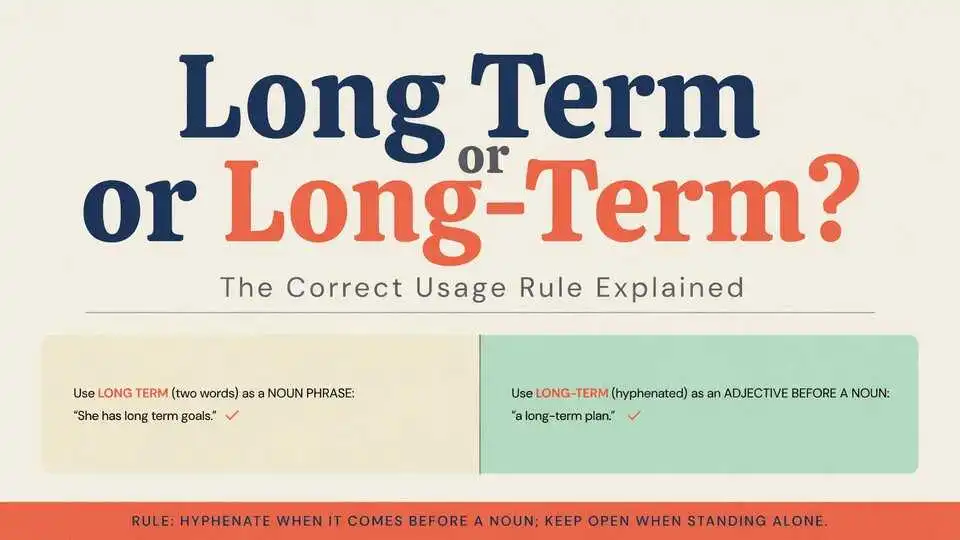
Use long-term when it comes before a noun and acts as a compound adjective.
Use long term when it functions as a noun phrase and stands on its own.
Examples:
- We need a long-term strategy.
- The company is focused on the long term.
The meaning stays the same. The difference is purely grammatical.
Quick Summary
Here is the rule in its simplest form:
| Use | Example |
|---|---|
| Long-term | Long-term investment |
| Long-term | Long-term memory |
| Long-term | Long-term success |
| Long term | In the long term |
| Long term | Thinking long term |
| Long term | Planning for the long term |
A simple way to remember it:
If a noun comes immediately after the phrase, use a hyphen.
What Is the Difference Between Long Term and Long-Term?
The difference comes down to grammar, not meaning.
Both expressions refer to something that happens over an extended period of time.
However, they play different roles in a sentence.
Long-Term
Long-term is a compound adjective.
It describes a noun.
Examples:
- Long-term goals
- Long-term investment strategies
- Long-term planning
- Long-term memory
In each example, the phrase directly modifies the noun that follows.
Long Term
Long term is a noun phrase.
It refers to a long period of time but does not directly describe a noun.
Examples:
- We are focused on the long term.
- Thinking long term leads to better decisions.
- Success often comes in the long term.
Notice something?
There is no noun immediately after the phrase.
That is why the hyphen disappears.
Quick Comparison Table
| Long Term | Long-Term |
|---|---|
| Noun phrase | Compound adjective |
| No hyphen | Hyphen required |
| Refers to a time period | Describes a noun |
| In the long term | Long-term plan |
| Thinking long term | Long-term investment |
Most people miss this distinction.
They focus on meaning.
The real answer is sentence structure.
What Does Long Term Mean?
The phrase long term refers to an extended period of time.
It often appears when discussing future outcomes, goals, or consequences.
Think of it as another way of saying:
- Over time
- Eventually
- In the future
- Across many years
Long Term Meaning in Everyday English
Here are some examples:
- We must think about the long term.
- The decision may hurt now but help in the long term.
- Investors often focus on the long term.
In all these examples, the phrase stands alone.
It isn’t modifying a noun.
That’s why no hyphen is needed.
Long Term Examples
Correct:
- The company is planning for the long term.
- Thinking long term can improve financial results.
- Good habits pay off in the long term.
Incorrect:
- We need a long term strategy.
Corrected:
- We need a long-term strategy.
READ MORE >>> Moulds vs Molds: Which Spelling Is Correct in 2026?
What Does Long-Term Mean?
Long-term functions as a compound adjective.
It combines two words into a single descriptive unit.
Together, they modify a noun.
Examples of Long-Term
- Long-term success
- Long-term goals
- Long-term investment strategies
- Long-term memory
- Long-term planning
In each example, the phrase tells readers something important about the noun.
For example:
“Investment strategies” could mean many things.
When you write long-term investment strategies, you’re specifying the type of strategy.
The hyphen signals that the two words work together.
Why the Hyphen Matters
Consider this sentence:
- We need a long term strategy.
Most readers will understand it.
But grammatically, it is incomplete.
The hyphen creates a clear connection between the words.
Correct:
- We need a long-term strategy.
Professional editors, journalists, and publishers generally prefer this form because it improves clarity.
What Does Long Term or Long-Term Mean on Social Media?
On social media, the phrases long term and long-term are often used when discussing goals, relationships, brand growth, content strategies, and future plans. Understanding the correct usage helps creators, marketers, and businesses communicate more professionally.
Examples of Long-Term on Social Media
- We are building a long-term content strategy.
- Long-term growth matters more than viral success.
- The brand is focused on long-term customer relationships.
Examples of Long Term on Social Media
- Think long term when growing your audience.
- Success on social media happens in the long term.
- Creators who think long term often achieve better results.
How Do You Use Long Term or Long-Term on Social Media?
When writing captions, posts, tweets, or LinkedIn updates, use long-term before a noun and long term when referring to an extended period of time.
Social Media Examples
Correct:
- We have a long-term marketing plan.
- Our team follows a long-term growth strategy.
- Building trust pays off in the long term.
- Don’t chase shortcuts—think long term.
Using the correct form makes your content look more polished and professional, especially on platforms like LinkedIn and X.
The History of Long Term and Long-Term
The phrase long term has been part of English for centuries as a way to describe an extended period of time. As English evolved, writers began using long-term as a compound adjective to improve clarity when describing nouns.
The hyphenated form became increasingly common in business, finance, education, and journalism because it helps readers understand that both words work together as a single modifier.
For example:
- Long-term investment
- Long-term planning
- Long-term success
Today, major style guides such as AP Style, Chicago Style, MLA, and APA generally follow the same rule: use long-term before a noun and long term when the phrase stands alone.
Why Is Long-Term Common in Business and Marketing?
Businesses frequently discuss:
- Long-term growth
- Long-term investments
- Long-term customer retention
- Long-term success
Because these phrases usually appear before nouns, the hyphenated form is far more common in professional writing.
Why Do So Many People Get Long Term and Long-Term Wrong?
Many writers assume the choice depends on meaning. In reality, the difference is grammatical.
Since both forms refer to the same idea—an extended period of time—people often overlook whether the phrase is acting as a noun phrase or a compound adjective.
That’s why understanding the sentence structure is more important than memorizing examples.
The LTN Framework™: Never Get Confused Again
Grammar rules can be hard to remember.
That’s why it helps to have a simple system.
The LTN Framework™ stands for:
Long-Term or Not?
Step 1: Look for a Noun
Ask yourself:
“Does a noun immediately follow the phrase?”
If yes, use long-term.
Examples:
- Long-term investment
- Long-term growth
- Long-term success
Step 2: Remove the Noun
If the phrase stands alone, use long term.
Examples:
- We are thinking long term.
- Success comes in the long term.
Step 3: Read the Sentence Aloud
If both words seem to work together to describe something, a hyphen is usually needed.
This quick test works in almost every situation.
Why Is Long-Term Hyphenated?
Here’s the thing.
English uses hyphens to connect words that work together as a single idea.
Without a hyphen, readers may need an extra moment to interpret the sentence.
That might not seem like a big deal.
But professional writing values clarity.
How Compound Modifiers Work
A compound modifier occurs when two or more words combine to describe a noun.
Examples:
- Well-known author
- High-quality product
- Full-time employee
- Short-term solution
- Long-term strategy
The hyphen tells readers:
“Treat these words as one unit.”
Why Readers Benefit
Imagine seeing:
- Long term investment strategy
Most people understand it.
But:
- Long-term investment strategy
is cleaner and easier to process.
Good writing removes friction.
Hyphens often help achieve that goal.
Long-Term Investment Strategies or Long Term Investment Strategies?
One of the most searched examples is long term investment strategies.
The correct version is:
Long-term investment strategies
Why?
Because long-term modifies the noun strategies.
Examples:
Correct:
- Long-term investment strategies often focus on steady growth.
- Retirement accounts are built around long-term investing.
- Successful investors typically follow long-term plans.
Incorrect:
- Long term investment strategies often outperform emotional decisions.
The hyphen should be included.
Why This Matters in Finance
Financial publications use this format consistently.
Readers expect it.
Professional writing standards expect it.
And editors will often correct the non-hyphenated version immediately.
Long-Term Success or Long Term Success?
Another common question is:
Should it be long-term success or long term success?
The answer is straightforward.
Because the phrase modifies success, the correct form is:
Long-term success
Examples:
- Long-term success requires patience.
- Businesses focus on long-term success rather than quick wins.
- Sustainable growth supports long-term success.
Many writers accidentally remove the hyphen because the phrase feels familiar.
Don’t fall into that trap.
The grammar rule remains the same.
Long-Term Memory or Long Term Memory?
In psychology, education, and neuroscience, the correct term is:
Long-term memory
The phrase describes a specific type of memory.
Examples:
- Information moves into long-term memory through repetition.
- Sleep helps strengthen long-term memory.
- Researchers continue studying long-term memory formation.
Because memory is the noun being described, the hyphen is required.
This is true in both academic and professional writing.
What About Long-Term Parking?
Travelers see this phrase all the time.
Airport signs commonly display:
Long-Term Parking
This is correct.
The phrase describes the noun parking.
Examples:
- Long-term parking is available near the terminal.
- Long-term parking rates are lower than daily rates.
- Travelers often choose long-term parking for extended trips.
If you write:
- Long term parking
many editors will add the hyphen during review.
A Real-World Editing Example
A marketing agency was preparing a report for a Fortune 500 client.
The report contained phrases such as:
- Long term growth plan
- Long term customer retention strategy
- Long term revenue goals
The content team noticed inconsistent formatting.
Editors corrected every phrase to:
- Long-term growth plan
- Long-term customer retention strategy
- Long-term revenue goals
The result?
The document looked more professional, more polished, and aligned with major style guides.
This may seem like a small detail.
But small details often shape how readers perceive credibility.
That is why experienced editors pay attention to hyphenation.
Frequently Asked Questions
Is long term one word or hyphenated?
Neither. Long term is usually written as two separate words when it functions as a noun phrase, such as in “the long term.” When it appears before a noun as a compound adjective, it becomes long-term with a hyphen. It is not considered a single word in standard English.
Does long-term care have a hyphen?
Yes. Long-term care should be hyphenated because long-term acts as a compound adjective describing the noun care. The same rule applies to phrases like long-term investment, long-term memory, and long-term planning.
Should I write long term or long-term?
It depends on how the phrase is used in the sentence. Use long-term before a noun, such as “long-term goals.” Use long term when referring to an extended period of time, such as “thinking long term” or “in the long term.”
Does long term need a dash?
Sometimes. More accurately, it needs a hyphen, not a dash. Use a hyphen when the phrase functions as a compound adjective before a noun. For example, write long-term strategy but focus on the long term.
Is long term a single word?
No. Standard English does not treat long term as a single word. It is either written as two words (long term) or as a hyphenated compound adjective (long-term), depending on the sentence structure.
When should I not use a hyphen?
Do not use a hyphen when long term is functioning as a noun phrase rather than describing a noun. For example:
- We are thinking long term.
- The benefits will appear in the long term.
In these cases, the phrase stands alone and does not require a hyphen.
When should I use a dash instead of a hyphen?
A hyphen (-) joins words together, while a dash (— or –) separates parts of a sentence or shows a pause. For example:
- Hyphen: long-term investment
- Dash: The results were surprising — far better than expected.
When writing long-term, always use a hyphen, not a dash.
Are hyphens unprofessional?
No. In fact, correct hyphenation is considered a sign of professional writing. Major style guides, editors, publishers, and business organizations use hyphens to improve clarity and readability. Using long-term correctly makes your writing look more polished and credible.
What are the most common hyphen mistakes?
Some of the most frequent mistakes include:
- Writing long term strategy instead of long-term strategy
- Adding unnecessary hyphens in phrases like in the long-term
- Using hyphens inconsistently throughout a document
- Confusing hyphens with dashes
- Forgetting to hyphenate compound adjectives before nouns
A simple rule to remember is: if the phrase directly describes a noun, a hyphen is usually needed.
Conclusion: Long Term or Long-Term?
The debate between long term and long-term is much simpler than it first appears. Both forms are correct, but they serve different grammatical purposes.Use long-term when the phrase comes before a noun and acts as a compound adjective. For example, long-term investment strategies, long-term success, long-term memory, and long-term parking all require a hyphen because the phrase is describing the noun that follows.
Use long term when you’re referring to an extended period of time and the phrase stands on its own. Examples like in the long term or thinking long term do not need a hyphen.If you’re ever unsure, remember the simple rule from the LTN Framework™:If a noun immediately follows, use a hyphen. If not, leave it open.
Most grammar mistakes happen because writers focus on the meaning instead of the sentence structure. Once you start looking at how the phrase functions in a sentence, the correct choice becomes obvious.The good news is that this same rule applies to many similar expressions, including short-term, full-time, high-quality, and well-known. Learning it once will improve your writing far beyond this single phrase.
At the end of the day, proper hyphenation may seem like a small detail, but small details build credibility. Whether you’re writing a blog post, academic paper, business report, marketing campaign, or professional email, using long term and long-term correctly helps your writing look polished, clear, and trustworthy.And now, the next time you encounter this grammar question, you won’t have to guess you’ll know exactly which form to use.