
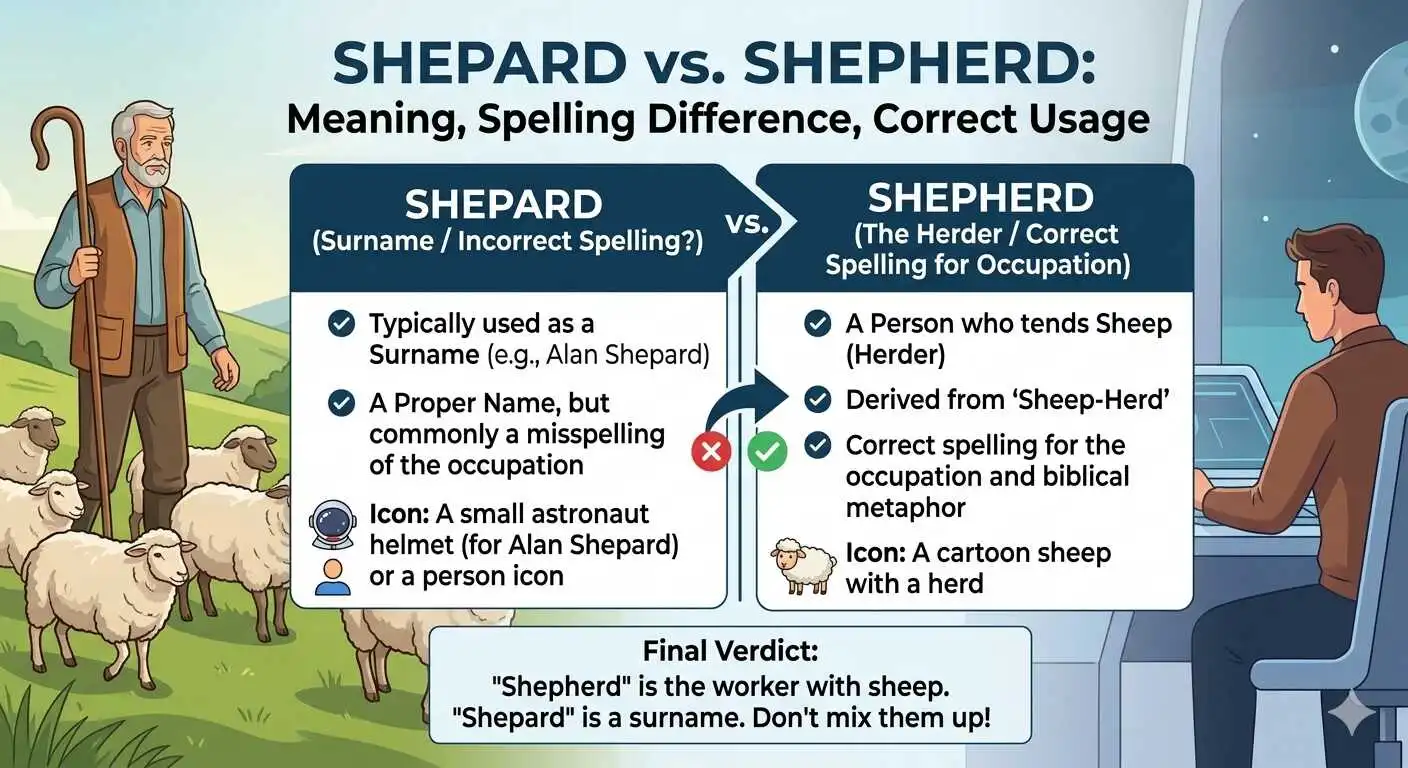
Quick Answer
“shepard vs shepherd” Shepherd is the correct English spelling for a person who tends sheep or acts as a guide or protector. Shepard is usually a surname or a common misspelling. The confusion happens because both words sound identical, but only “shepherd” is used in standard English for the occupation.
AI Overview Summary
Shepherd is the standard English word meaning a person who herds sheep or guides others. Shepard is not a standard spelling of the occupation and is mainly used as a surname. The confusion exists because both words sound the same, leading to frequent spelling mistakes in writing and search queries.
What Does Shepherd Mean?
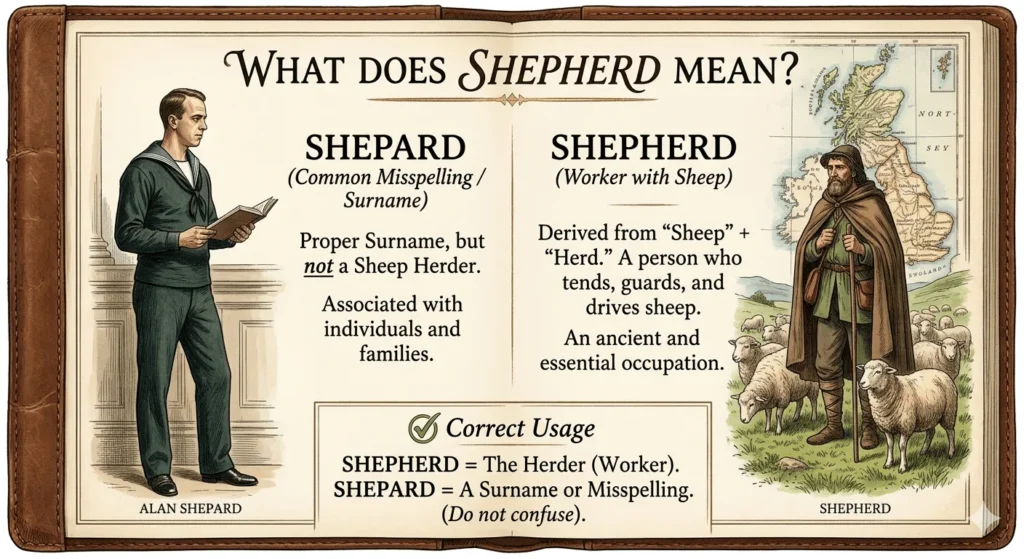
Here’s the thing—most people think “shepherd” only means a person with sheep in a field. That’s true, but it’s not the full story.
A shepherd is someone who:
- Takes care of sheep
- Protects and guides a group
- Symbolically leads or mentors people
So yes, it’s both a job and a metaphor.
For example:
- A teacher can be called a shepherd of students
- A leader can be seen as a shepherd of a team
Simple meaning:
A shepherd is a guide, protector, or caretaker.
Example usage
| Context | Sentence |
|---|---|
| Literal | The shepherd led the sheep to green pastures. |
| Metaphorical | She was a shepherd for young entrepreneurs. |
Most people miss this deeper meaning and only think about animals.
How Do You Spell Shepherd Correctly?
Let’s clear this up once and for all.
The correct spelling is:
👉 S-H-E-P-H-E-R-D
Not shepard. Not sheppard. Not shephard.
Why does this confusion happen? Because English has silent letters, and your brain naturally tries to “simplify” words based on sound.
Common misspellings: shepard vs shepherd
- shepard
- sheppard
- shephard
Here’s the trick: If you hear “shepherd,” your brain drops the “h” sound and accidentally removes letters when writing.
Shepherd vs Shepard (Key Difference Explained)
This is the heart of the confusion.
Direct answer:
- Shepherd = correct English word (occupation + meaning)
- Shepard = surname or incorrect spelling in most contexts
Comparison Table
| Feature | Shepherd | Shepard |
|---|---|---|
| Meaning | Sheep herder / guide | Surname |
| Usage | Standard English | Proper name or error |
| Correct in writing | Yes | Only for names |
| Grammar role | Common noun | Proper noun |
Here’s the key insight: They are not “two versions” of the same word. They belong to different categories.
Why do people confuse shepherd vs shepard?
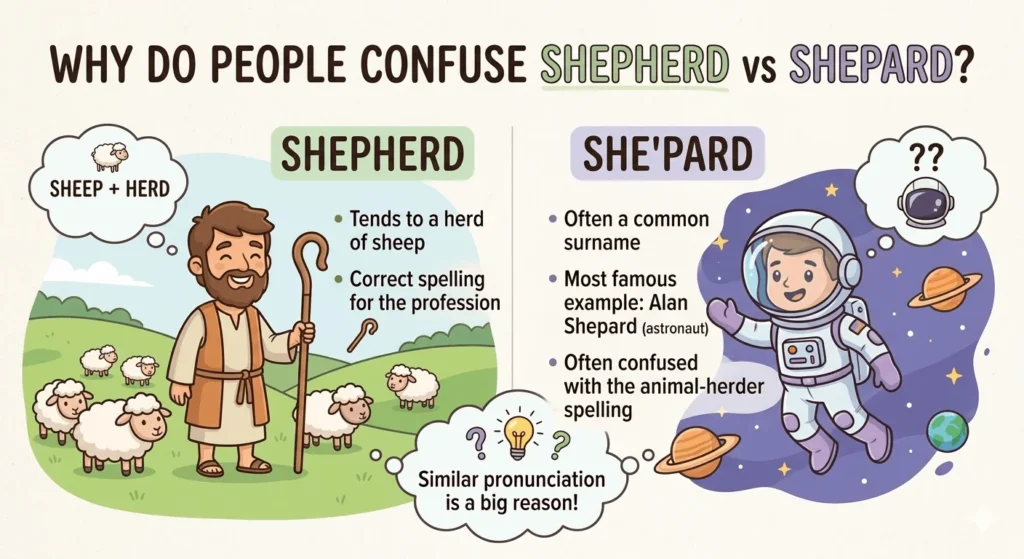
Most people miss this psychological angle.
The confusion happens because:
- Both words sound exactly the same
- English spelling is not phonetic
- People rely on memory, not rules
So your brain thinks:
“If it sounds like ‘shepard’, maybe it’s spelled that way.”
That’s the trap.
Sheppard vs Shepherd: Are They the Same?
Now let’s add another layer of confusion.
Direct answer:
Sheppard is NOT the correct spelling of shepherd, but it is sometimes used as a surname.
This happens because surnames evolve differently from dictionary words.
Why “sheppard” exists:
- Historical spelling variations
- Family names preserved over generations
- Regional English differences
So:
- Shepherd = standard word
- Sheppard = surname variation
Why Do People Spell Shepherd as Shepard?
This is where things get interesting.
It’s not just a spelling mistake—it’s a mental shortcut error.
Most people don’t consciously spell words. They:
- Hear the word
- Store the sound
- Reproduce it later
And since “shepherd” and “shepard” sound identical, the brain simplifies it.
Real cause:
Sound-to-spelling distortion
In simple terms: You write what you hear, not what is correct.
The Sound-to-Spelling Error Model
Here’s a simple framework to understand it:
- Sound stage → You hear “shepherd”
- Mental simplification → Brain removes silent complexity
- Output error → You write “shepard”
That’s it. No grammar knowledge needed for the mistake to happen.
Is Shepard Ever Correct?
Short answer: Yes—but only in specific cases.
Direct answer:
“Shepard” is correct only when used as a proper name, not as the occupation.
Example:
- Shepard Smith (real name)
- Commander Shepard (fictional character)
But if you are writing about a job or role, “shepard” is wrong.
Here’s the key distinction:
- Word = shepherd
- Name = Shepard
Error Severity in Real Writing
Not all mistakes are equally serious.
Let’s break it down:
| Level | Context | Impact |
|---|---|---|
| Low | Text messages | Acceptable |
| Medium | Blogs/social media | Noticeable error |
| High | Academic writing | Incorrect usage |
So if you’re writing professionally, this matters more than you think.
READ MORE >>> Unvoluntary or Involuntary: Meaning, Difference, and Correct Usage in English
Examples of Shepherd in Real Life
Let’s make this practical.
Literal meaning:
- The shepherd guided sheep through the valley.
- The shepherd protected his flock during storms.
Metaphorical meaning:
- A good manager is a shepherd of their team.
- Teachers act as shepherds of knowledge.
That’s why this word appears in leadership and education contexts too.
Common Spelling Mistakes You Should Avoid
This is where most learners slip.
| Wrong spelling | Why it happens |
|---|---|
| shepard | phonetic simplification |
| sheppard | surname confusion |
| shephard | misplaced letters |
Here’s the simple rule: If it refers to animals or guiding → always shepherd
Mini Case Study: Why This Confusion Went Viral shepard vs shepherd
Let’s look at a real-world style example.
A student once searched for “shepard meaning” while writing an essay. The search results included:
- surname references
- gaming characters like “Commander Shepard”
- unrelated definitions
This created confusion, and the student used “shepard” in an academic paper.
Result: The spelling was marked incorrect.
Insight:
Pop culture + surnames + pronunciation = long-term confusion loop
This is why search engines see this keyword so often.
Expert Tip to Never Forget the Spelling
Here’s a simple memory trick:
👉 Shepherd = Sheep + Herd
Focus on the word “herd” That alone anchors the correct spelling.
If it involves animals or guiding:
- Always think “herd”
- Not “name”
This one trick prevents most errors instantly.
Why This Confusion Happens So Often
Let’s connect everything.
People confuse shepherd and shepard because:
- English is not phonetic
- Both words sound identical
- Surnames distort language rules
- Pop culture reinforces incorrect spelling
- Brain simplifies complex spelling patterns
So it’s not carelessness—it’s cognitive efficiency.
Frequently Asked Questions
Shepard is usually a surname or proper name, not a standard English word. It is often used as a family name or fictional character name, while the related word “shepherd” refers to a person who tends sheep or guides others.
In most Bible translations, the correct spelling is “shepherd,” not “shepard.”
For example, the famous verse:
“The Lord is my shepherd…”
So in biblical context, shepherd is the correct and standard spelling used in scripture.
“Shepard” is not accepted as a standard spelling of the word “shepherd.”
However, it is accepted in two cases:
As a surname (family name)
As a proper name (e.g., fictional or real individuals)
For general English usage, the correct spelling remains shepherd.
Shepard is traditionally used as a male given name or surname, but modern naming does not strictly limit it by gender.
So:
Historically: mostly male name
Modern usage: can be unisex depending on preference
The correct English word is:
👉 Shepherd
It refers to:
A person who tends sheep
A guide or protector (metaphorical meaning)
👉 Shepard is usually:
A surname
Or a common spelling mistake
There is no separate female version of Shepard or shepherd.
Both words are gender-neutral when used as a job title.
A female shepherd is simply called: 👉 Shepherd
“Shepard” is not a gendered word. It is mainly:
A surname
A proper name
So it can be used for:
Male individuals
Female individuals
Fictional characters of any gender
Female shepherds are also called:
👉 Shepherds
There is no special feminine form. The profession is gender-neutral in English.
“Shepard” does not stand for anything as an acronym. It is primarily:
A surname
A given name
Sometimes a misspelling of shepherd
Its meaning only becomes clear in context, especially when compared to “shepherd,” which refers to a guide or sheep herder.
Final Thoughts
Here’s the bottom line.
Shepherd vs Shepard is not just a spelling question—it’s a language perception problem.
Once you understand the difference, it becomes simple:
- Shepherd = correct English word for a guide or animal herder
- Shepard = surname or mistake in most contexts
And here’s what most people don’t realize:
You’re not just learning spelling here—you’re learning how English thinks.
That’s why this confusion appears everywhere online, in schools, and even in professional writing.
If you remember one thing, remember this:
👉 If it involves sheep, leadership, or guidance—it’s always shepherd.