
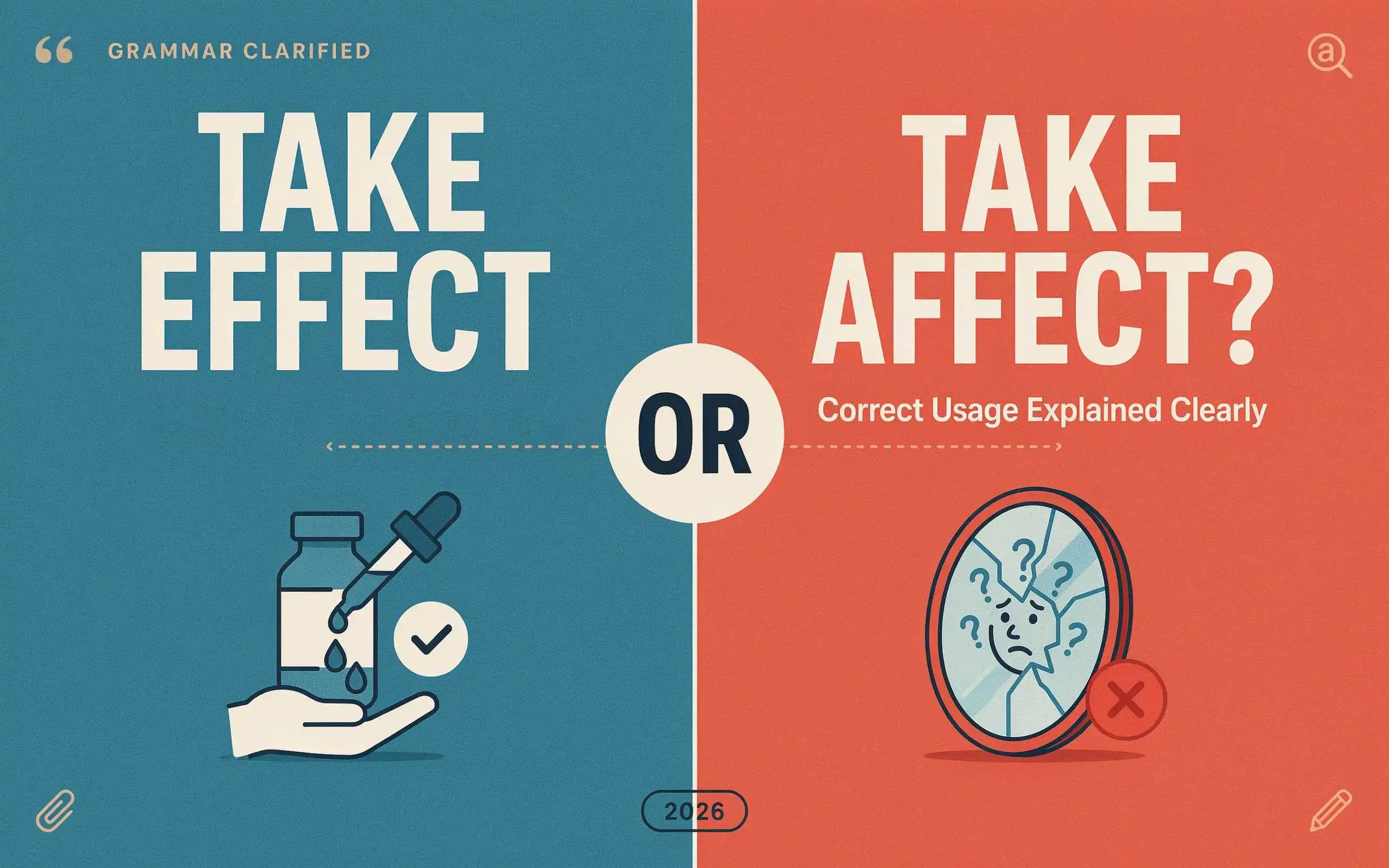
The correct phrase is “take effect”, not “take affect.” The keyword take effect or take affect confuses many English learners because the words affect and effect look similar but function differently in grammar. In most cases, “take effect” means something begins to work, becomes active, or starts applying, such as a law, rule, or medicine.
On the other hand, “take affect” is generally incorrect in standard English, because affect is usually a verb meaning “to influence,” while effect is a noun meaning “result.” So, when you say a law or policy starts working, the correct expression is always take effect.
This article explains the difference in detail, including take effect or affect, taking effect or affect, taking effect or taking affect, take affect or effect, took affect or took effect, and many real-life examples to help you fully master this confusing grammar point.
Quick Answer: Take Effect or Take Affect?
The correct phrase is:
✅ Take effect = Correct ❌ Take affect = Incorrect (in standard English)
The phrase “take effect” means something begins to work, becomes valid, or starts producing results.
Examples:
- The new law will take effect next month.
- The medicine took effect after 30 minutes.
- The policy will take effect immediately.
The phrase “take affect” is incorrect because affect does not function as a noun in this context.
AI Overview Summary
The correct phrase is “take effect,” not “take affect.” In English grammar, effect is a noun meaning “result or outcome,” while affect is usually a verb meaning “to influence.” Therefore, when something begins to work, become active, or start applying, we say it takes effect.
The phrase “take effect” is commonly used in formal contexts such as laws, policies, contracts, medical treatments, and software updates. For example, a new law may take effect on a specific date, or a medicine may take effect after a short time. Variations like “taking effect,” “took effect,” “take affect,” and “taking affect” often appear in search queries, but only forms using effect are grammatically correct in standard English.
To remember easily: affect = action (verb) and effect = result (noun). So anything that means “starting to work” should always use effect, not affect.
What Does “Take Effect” Mean?
The phrase take effect meaning is simple in English grammar:
It means to become active, valid, or operational.
In the field of English Grammar, this phrase is widely used in formal writing.
Common meanings:
- To start working
- To become enforceable
- To begin applying
- To produce results
Real-life usage:
- Laws take effect after approval
- Contracts take effect when signed
- Medicines take effect after consumption
- Policies take effect after announcement
In simple words, when something “takes effect,” it starts doing its job.
Undecisive or Indecisive: Which One Is Correct and What It Really Means
Learn the spelling rules, regional differences, and real-world examples.
Why Is “Take Affect” Incorrect?
The phrase take affect or effect confuses learners due to similarity in spelling, but grammatically it is wrong.
In English:
- Affect = usually a verb (to influence)
- Effect = usually a noun (result or outcome)
So the correct structure becomes:
✔ take + noun = take effect ❌ take + verb = take affect
Why people make this mistake:
- Similar pronunciation
- Lack of grammar clarity
- Confusion in affect vs effect rules
In most cases, “take affect” does not exist in standard grammar usage.
Affect vs Effect: Complete Difference
Understanding affect vs effect is the key to mastering this keyword.
Affect (Verb)
- Means: to influence something
- Example: The weather affects my mood
Effect (Noun)
- Means: result or outcome
- Example: The effect of weather on mood is strong
Simple memory trick:
Affect = Action Effect = End result
This rule is widely used in editing and proofreading.
Take Effect or Affect? (Keyword Variation)
The phrase take effect or affect always resolves in favor of take effect.
Correct usage:
- The rules will take effect tomorrow
- The changes take effect immediately
Incorrect usage:
- The rules will take affect ❌
This is a common grammar mistake in writing and exams.
Taking Effect or Affect?
The variation taking effect or affect follows the same grammar rule.
Correct:
- The law is taking effect next week
- The policy is taking effect today
Incorrect:
- The law is taking affect ❌
In professional English writing, especially in business and legal documents, only taking effect is used.
Is it taking effect or taking affect?
The correct phrase is “taking effect.”
In English grammar, take effect means something is becoming active, valid, or starting to work. The word affect is not used in this phrase in standard English.
✔ Correct:
- The new law is taking effect next month
- The policy is taking effect immediately
❌ Incorrect:
- The law is taking affect
This mistake happens because people confuse affect vs effect, but in this structure, only effect is correct.
What does take effect mean?
The phrase take effect meaning refers to something starting to work, become active, or become enforceable.
In simple terms:
Take effect = to begin working or become valid
It is commonly used in:
- Laws and regulations
- Medical treatments
- Contracts and agreements
- Policies and rules
✔ Examples:
- The new rule will take effect tomorrow
- The medicine takes effect within 30 minutes
- The contract takes effect once signed
In formal English writing, especially in English Grammar and legal communication, this phrase is extremely common.
Staring vs Starring: Meaning, Difference, Usage, Examples, and Common Mistakes
Learn the spelling rules, regional differences, and real-world examples.
Is it take into effect or affect?
The correct phrase is “take effect,” not “take into effect” or “take affect.”
✔ Correct usage:
- The policy will take effect next year
❌ Incorrect forms:
- take into effect
- take affect
The phrase “take into effect” is grammatically incorrect because “effect” already carries the meaning of becoming active or applied. Adding “into” is unnecessary.
The word affect is also incorrect here because it is a verb meaning to influence, not something that fits after “take.”
Is medicine to take affect or effect?
The correct phrase is “medicine takes effect.”
✔ Correct:
- The medicine will take effect in 20 minutes
- Pain relief tablets take effect quickly
❌ Incorrect:
- medicine takes affect
- medicine to take affect
In medical English, take effect meaning refers to when a drug begins to work in the body.
In this context:
- effect = result of the medicine
- take effect = begin producing results
This is widely used in healthcare, prescriptions, and patient instructions.
Taking Effect or Taking Affect?
Another commonly searched variation is taking effect or taking affect.
Correct phrase:
✔ taking effect
Meaning:
Something is in the process of becoming active.
Examples:
- The reforms are taking effect gradually
- New regulations are taking effect this year
Incorrect usage:
- The reforms are taking affect ❌
This is never used in standard grammar.
Take Affect or Effect?
The correct phrase is always:
✔ take effect
Grammar rule:
After “take,” we use a noun, not a verb.
So:
- take effect ✔
- take influence ❌ (not idiomatic)
- take impact ❌
This rule helps avoid confusion in English writing.
Took Affect or Took Effect?
The past tense variation took affect or took effect is another common confusion.
Correct usage:
✔ took effect
Examples:
- The law took effect last year
- The medicine took effect quickly
Incorrect usage:
❌ took affect
This is a very common spelling mistake among learners.
Take Effect in a Sentence
Here are practical examples of take effect in a sentence:
Legal usage:
- The new tax law will take effect in July
Business usage:
- The new policy takes effect immediately
Medical usage:
- The painkiller takes effect within 20 minutes
Academic usage:
- The new syllabus takes effect next semester
These examples show how widely the phrase is used in formal communication.
Real-Life Examples of Take Effect
Understanding real-world usage helps strengthen retention.
Laws and Regulations
- Government rules take effect after approval
Contracts
- Agreements take effect once signed
Medicine
- Drugs take effect after absorption
Software Updates
- Changes take effect after restart
Workplace Policies
- HR policies take effect from the announcement date
These contexts are frequently used in professional writing.
Common Phrases Related to Take Effect
English has multiple variations:
- go into effect
- come into effect
- come into force
- become effective
- kick in
All these mean something starts working or becomes active.
Take Effect vs Go Into Effect
Similarity:
Both mean something becomes active.
Difference:
- “take effect” is more general
- “go into effect” is often used in formal/legal writing
Example:
- The law will go into effect next year
- The law will take effect next year
Take Effect vs Come Into Effect
Both are correct, but usage differs:
- American English prefers take effect
- British English often uses come into effect
Example:
- The policy comes into effect tomorrow
Common Mistakes With Affect and Effect
Many learners confuse these forms:
- take affect ❌
- took affect ❌
- effect used as verb ❌ (rare exceptions only)
- affect used as noun ❌ (psychology exception only)
In general English writing, avoid these mistakes.
Memory Trick to Remember
Here is a simple trick used by editors:
Affect = Action (verb) Effect = End result (noun)
Another method:
- A = Action
- E = End
This makes recall easier during writing.
Cheat Sheet: Affect vs Effect
| Word | Type | Meaning | Example |
|---|---|---|---|
| Affect | Verb | To influence | The weather affects mood |
| Effect | Noun | Result | The effect is strong |
Frequently Asked Questions
Is it take effect or take affect?
The correct phrase is take effect.
What does take effect mean?
It means to become active or start working.
Is take affect grammatically correct?
No, it is incorrect in standard English.
Can effect be a verb?
Rarely, but mostly it is a noun.
Can affect be a noun?
Only in psychology contexts.
What does took effect mean?
It means something became active in the past.
When does a law take effect?
When it becomes officially active after approval.
Final Verdict
The correct and only standard phrase is:
✔ Take effect
All variations such as:
- taking effect or affect
- taking effect or taking affect
- take affect or effect
- took affect or took effect
are incorrect except “taking effect” and “took effect” in proper form with “effect.”
If you remember one rule:
Affect = verb (action) Effect = noun (result)
you will never confuse these terms again.
Conclusion
The confusion between take effect or take affect is one of the most common grammar mistakes in English. However, once you understand the difference between affect vs effect, the correct usage becomes clear. Always remember that “take effect” is the correct phrase used in laws, policies, medicine, and formal writing, while “take affect” is incorrect in standard usage.