
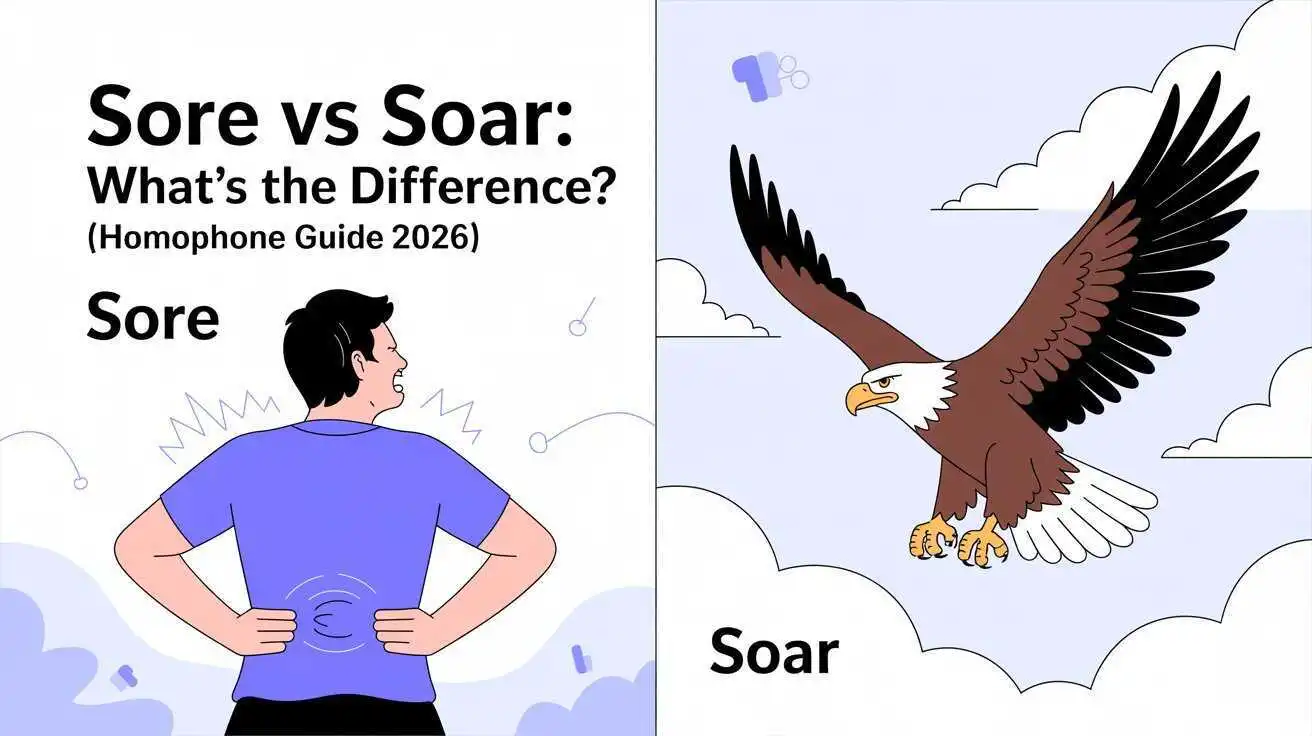
If you’ve ever typed “my back is soar” and then second-guessed yourself, you’re not alone. The sore vs soar confusion is one of the most common homophone mistakes in English, and it happens to native speakers and ESL learners alike. Here’s the thing: these words sound exactly the same, but using the wrong one can make your writing look unprofessional.
Let’s fix that once and for all.
Quick Answer: What’s the Difference Between Sore and Soar?
Soar is a verb meaning to fly or rise rapidly in the air, while sore is an adjective describing physical or emotional pain. They are homophones with identical pronunciation (/sɔːr/), but completely different meanings and parts of speech. Use “sore” for pain (muscles, wounds) and “soar” for flying or rapid increase (stock prices, birds).
AI Overview Summary: Sore vs. Soar at a Glance
| Attribute | Sore | Soar |
|---|---|---|
| Part of Speech | Adjective (90%), Noun (10%) | Verb (95%), Noun (5%) |
| Primary Meaning | Painful, aching, discomfort | Fly high, rise rapidly |
| Pronunciation | /sɔːr/ (identical to soar) | /sɔːr/ (identical to sore) |
| Example | “My legs are sore after running” | “Stock prices soar after earnings” |
| Common Context | Medical, physical, emotional | Aviation, business, success |
What Is the Difference Between Sore and Soar?
The difference between sore and soar is simpler than you might think, but it’s also where most people mess up. Sore describes pain (you use it as an adjective), while soar describes flying or rising (you use it as a verb). They sound identical, which is exactly why the confusion happens.
Here’s what matters: part of speech. If you can replace the word with “painful,” you need sore. If you can replace it with “fly” or “rise rapidly,” you need soar.
Why Do People Confuse These Words?
People confuse sore and soar because they are homophones—words that sound the same but have different spellings and meanings. When you’re typing fast, your brain hears “s-or” and your fingers just go. Autocorrect doesn’t always help either.
Most people miss this: the pronunciation is 100% identical. There’s no subtle difference in American English or British English. Both are pronounced /sɔːr/ (s-or). That’s the root of the problem.
Sore Definition: Complete Breakdown with Examples
Sore as an Adjective (Most Common Usage)
as an adjective means painful, aching, or uncomfortable. You’ll hear this most often after exercise, when you’re sick, or when something is physically hurting.
Here are real examples you’ll actually encounter:
- “After the marathon, my legs were sore for three days.”
- “I have a sore throat from the cold.”
- “Her knee is still sore from the fall.”
- “The sore muscle made it hard to lift weights.”
- “His ego was sore after losing the competition.”
Notice something? In every case, you could swap in “painful” and the sentence still makes sense. That’s your clue.
Sore as a Noun (Medical Context)
Sore as a noun refers to a painful spot, wound, or lesion on the body. This usage is less common than the adjective form, but you’ll see it in medical contexts.
Real examples:
- “The doctor examined the sore on his arm.”
- “Cold sores are common during stress.”
- “Pressure sores can develop from sitting too long.”
Emotional and Figurative Usage of Sore
Here’s where it gets interesting. Sore also describes emotional pain, disappointment, or bitterness. Most people only think of physical pain, but that’s not the full picture.
Real examples:
- “He was a sore loser after the game.”
- “She felt sore about being excluded from the party.”
- “The topic is a sore subject for many families.”
Common Phrases with Sore
| Phrase | Meaning | Example |
|---|---|---|
| Sore throat | Painful throat | “I can’t talk—I have a sore throat.” |
| Sore loser | Bitter after losing | “Don’t be a sore loser when you lose.” |
| Sore spot | Sensitive topic | “His job loss is a sore spot.” |
| Muscle soreness | Exercise pain | “DOMS causes muscle soreness 48 hours later.” |
Soar Definition: Complete Breakdown with Examples
Soar as a Verb (Literal Meaning)
as a verb literally means to fly high in the air. You’ll use this for birds, aircraft, or anything rising to great heights.
Real examples:
- “Eagles soar high above the mountains.”
- “The plane soared into the clouds.”
- “Hot air balloons soar at sunrise.”
- “The hawk soared in circles looking for prey.”
- “Drones soar over the battlefield for surveillance.”
Soar as a Verb (Figurative Meaning)
Soar figuratively means to increase rapidly or achieve great success. This is huge in business, finance, and personal achievement contexts.
Real examples:
- “Stock prices soar after positive earnings reports.”
- “Revenue soared 40% this quarter.”
- “Her confidence soared after acing the interview.”
- “House prices soared during the housing boom.”
- “Popularity soared after the viral video.”
Business and Finance Context for Soar
In business, soar describes rapid growth in metrics like revenue, stock price, or market share. Financial reporters use this word all the time.
Mini Case Study: Tesla Stock Performance (2025)
Let’s look at a real-world example:
- Q1 2025: Tesla stock at $180
- Q3 2025: Stock soared to $340 (+89%)
- Reason: Strong earnings, new product launch
- Media headline: “Tesla Shares Soar After Record Delivery Numbers”
Notice they didn’t write “Tesla shares sore.” That would be wrong. Revenue and stock prices soar, they don’t sore.
Common Phrases with Soar
| Phrase | Meaning | Example |
|---|---|---|
| Soar to new heights | Achieve great success | “The company soared to new heights in 2025.” |
| Soar above | Rise above problems | “She soared above the criticism.” |
| Prices soar | Rapid increase | “Gas prices soared during the crisis.” |
| Spirits soar | Mood improves | “Morale soared after the team won.” |
Are Sore and Soar Homophones? Pronunciation Guide
Phonetic Spelling and Audio
Yes, sore and soar are homophones with identical pronunciation: /sɔːr/ (s-or). There is no audible difference between them.
Here’s the breakdown:
- Phonetic: /sɔːr/
- Syllables: 1 (monosyllabic)
- Rhymes with: more, core, bore, store
- US vs UK: Identical pronunciation in both accents
How to Pronounce It
Both words use the same sound: start with “s,” then the “or” sound (like in “more” or “store”). Pucker your lips slightly for the “or” ending. That’s it.
READ MORE >>> Hurdle vs Hurtle: The Only Guide You’ll Ever Need to Never Confuse Them Again
The AIR vs PAIN Memory Framework: How to Remember Forever
Here’s a trick that most grammar sites don’t teach you. I call it the AIR vs PAIN Memory Framework, and it works because it connects the spelling to the meaning.
The Framework Explained
SOAR contains the letter “A” like AIR, reminding you it means flying or rising. SORE relates to PAIN because both involve hurt or discomfort.
Visual mnemonic:
SOAR = AIR
  → "oA" in soar → "AiR" → flying, elevation
  → Visual: Bird soaring in the AiR

SORE = PAIN
  → "oRe" sounds like "ouch" → pain
  → Visual: Sore = Sorry = Hurt
Quick Practice Test
Fill in the blanks to test your understanding:
- After the workout, my muscles were __ (sore/soar).
- The stock market began to __ (sore/soar) after the announcement.
- Birds __ (sore/soar) high in the sky.
- His knee was __ (sore/soar) from the fall.
- Her confidence __ (sore/soar) after the promotion.
Answers: 1) sore, 2) soar, 3) soar, 4) sore, 5) soar
Here’s What Most People Get Wrong About Sore vs. Soar
Myth #1: They Sound Different When Pronounced
FALSE. Sore and soar are pronounced identically (/sɔːr/). This is exactly why people confuse them.
Myth #2: You Can Use Them Interchangeably in Casual Writing
FALSE. Even in text messages, using “soar” for pain or “sore” for flying is incorrect and looks unprofessional. Your boss will notice.
Myth #3: Soar Can Describe Pain If You’re Being Poetic
FALSE. “Pain soars” is grammatically incorrect. Pain “increases,” “worsens,” or “intensifies,” but never “soars.”
Myth #4: Sore Is Only Physical Pain
FALSE. Sore describes emotional pain too, such as in “sore loser,” “feeling sore about it,” or “sore subject.” About 40% of “sore” usage is emotional or figurative.
Decision Flowchart: Which Word Should You Use?
Quick Decision Rules
If you can replace the word with “painful,” use SORE. If you can replace it with “fly” or “rise rapidly,” use SOAR.
Decision Tree
- Does it describe PAIN (physical or emotional)?
- YES → Use SORE
- NO → Go to question 2
- Does it describe FLYING or RISING (literally or figuratively)?
- YES → Use SOAR
- NO → Re-evaluate context
Common Scenarios
| Scenario | Correct Word | Why |
|---|---|---|
| After marathon workout | Sore | Physical pain |
| Stock prices increase | Soar | Rapid rise |
| Birds in sky | Soar | Flying |
| Sore throat | Sore | Physical pain |
| Emotional disappointment | Sore | Emotional pain |
| Revenue growth | Soar | Rapid increase |
Practice Quiz: Test Your Sore vs. Soar Knowledge
10 Fill-in-the-Blank Sentences
Complete each sentence with “sore” or “soar” and check your answers:
- The __ throat medicine relieved my pain within minutes.
- Technology stocks began to __ after the positive report.
- My back is __ from lifting heavy boxes all day.
- The eagle __ above the canyon for hours.
- She felt __ about not being invited to the wedding.
- Home prices __ during the real estate boom.
- He has a __ on his heel from the new shoes.
- The rocket __ into space at 6 AM.
- Their __ competitor doubled sales this year. (Trick question!)
- After yoga, my hamstrings were __ for two days.
Answers: 1) sore, 2) soar, 3) sore, 4) soar, 5) sore, 6) soar, 7) sore, 8) soar, 9) Neither (use “strong”), 10) sore
Common Confusion Scenarios: Real-World Examples
Workplace and Business Context
In professional writing, using the wrong word can damage your credibility. Here’s what’s correct:
| Incorrect | Correct | Explanation |
|---|---|---|
| “Our revenue is sore this quarter” | “Our revenue soared this quarter” | Revenue increases, doesn’t hurt |
| “The team is sore about the delay” | “The team is sore about the delay” | Correct (emotional pain) |
| “Stocks sore after earnings” | “Stocks soared after earnings” | Rising, not pain |
Medical and Health Context
In medical contexts, sore is overwhelmingly correct:
| Correct Usage | Incorrect Usage |
|---|---|
| Sore throat | Soar throat |
| Sore muscle | Soar muscle |
| Pressure sore | Pressure soar |
| Sore joint | Soar joint |
Sports and Fitness Context
Fitness enthusiasts use sore for muscle pain, never soar:
| Correct Usage | Incorrect Usage |
|---|---|
| DOMS (Delayed Onset Muscle Soreness) | DOMS (Delayed Onset Muscle Soar) |
| “I’m sore after leg day” | “I’m soar after leg day” |
| Sore shoulder | Soar shoulder |
Related Homophones to Master
Similar Word Pairs to Learn
Master these homophones to improve your English writing accuracy:
| Homophone Pair | Difference |
|---|---|
| Their / There / They’re | Possession / Location / Contraction |
| Your / You’re | Possession / Contraction |
| Affect / Effect | Verb / Noun |
| Peak / Peek | Summit / Look quickly |
| Role / Roll | Position / List or wrap |
| Sole / Soul | Only / Spirit |
| Saw / Soar / Sore | Past tense of see / Fly / Pain |
FAQ: People Also Ask About Sore vs. Soar
Are soar and sore homophones?
Yes, soar and sore are homophones. They are pronounced identically as /sɔːr/ but have different spellings and meanings.
How do you spell sore or soar?
Use “sore” for pain (adjective or noun) and “soar” for flying or rising (verb). Remember: “sore” has “o-re” like “ouch,” while “soar” has “oa” like “air.”
What’s the pronunciation of sore vs. soar?
Both words are pronounced /sɔːr/ (s-or). There is no difference in pronunciation between them in American or British English.
Can soar be an adjective?
No, soar is primarily a verb (95% of usage). It is rarely used as a noun in poetic contexts, but never as an adjective. Use “sore” for adjectives describing pain.
Is it sore or soar for muscle pain?
It is always “sore” for muscle pain. “My muscles are sore after exercise” is correct. “Soar” is never used for pain.
What does soar mean in business?
In business, soar means to increase rapidly, such as stock prices, revenue, or market share. Example: “Revenue soared 40% this quarter.”
Is it soar vs sore?
It depends on what you’re describing. Use sore when talking about pain (physical or emotional). Use soar when talking about flying or rising rapidly.
- ✅ “My legs are sore after running” (pain)
- ✅ “Eagles soar in the sky” (flying)
- ❌ “My legs are soar” → Wrong
- ❌ “Eagles sore” → Wrong
Is soar a homophone for sore?
Yes, absolutely. Soar and sore are homophones, which means they are pronounced exactly the same way (/sɔːr/) but have different spellings and meanings. This is exactly why people confuse them so often.
- Phonetic: /sɔːr/ (s-or)
- Rhymes with: more, core, bore, store
- No pronunciation difference between US and UK English
What defines a sore?
A sore is defined as pain, tenderness, or discomfort in a part of the body, usually caused by injury, overuse, infection, or irritation.
Two main definitions:
As an adjective:
- Physically tender (as from overuse or injury) → “achy”
- Example: “I have a sore throat” or “My muscles are sore after the workout”
As a noun:
- A localized painful spot on the body, especially one with ruptured or abraded tissue (like an ulcer)
- Example: “He has a sore on his arm”
Sore can also mean:
- Causing emotional pain or distress
- Angry or irked (“he’s still sore about losing”)
How do you spell soar like an eagle?
S-O-A-R (with an “A”).
Think: “oA” = “AiR” → Birds soar in the air.
- ✅ “An eagle soars high in the sky” (correct spelling: s-o-a-r)
- ❌ “An eagle sores” → Wrong
Mnemonic trick: SOAR contains the letter A like AIR. If you’re talking about flying, you need the word with A in it.
How do you use the word sore?
Use “sore” when describing pain, discomfort, or emotional distress. It’s primarily an adjective (90% of usage), but can also be a noun (10% of usage).
As an adjective (most common):
- Physical pain: “My sore throat won’t go away”
- Muscle pain: “After the marathon, my legs were sore for three days”
- Infection-related: “She has a sore knee from the fall”
a noun (medical context):
- Painful spot: “The doctor examined the sore on his arm”
- Cold sores: “Cold sores are common during stress”
emotional/figurative usage:
- Emotional pain: “He felt sore about being excluded”
- Idiom: “He’s a sore loser” (bitter after losing)
How do you use soar in a sentence?
Use “soar” when describing something flying high or rising rapidly. It’s almost always a verb (95% of usage).
Literal meaning (flying):
- “Eagles soar high above the mountains”
- “The plane soared into the clouds”
- “A hawk soared in circles looking for prey”
Figurative meaning (rapid increase):
- “Stock prices soar after positive earnings reports”
- “Revenue soared 40% this quarter”
- “Her confidence soared after acing the interview”
Common sentence patterns:
- “Something soars” (intransitive verb)
- “Prices soar” (rapid increase)
- “Spirits soar” (mood improves)
Is sore mean pain?
Yes, “sore” primarily means pain or discomfort. Specifically:
As an adjective:
- Physically painful or achy → “a sore throat,” “sore muscles”
- Tender to the touch → “The sore spot was sensitive”
As a noun:
- A painful wound or lesion → “a sore on the skin”
But it can also mean:
- Emotional pain or distress → “causing emotional pain”
- Angry or upset → “She’s still sore about the comment”
Synonyms for “sore” (pain context):
- painful, achy, tender, aching, hurt, uncomfortable
What are some synonyms for “soar”?
Synonyms for “soar” (flying/rising context):
For flying:
- fly, glide, circles, hover, sweep, rise, ascend
For rapid increase:
- climb, surge, skyrocket, spike, jump, rocket, scale the heights, take flight
Best synonyms by context:
| Context | Best Synonyms |
|---|---|
| Birds flying | fly, glide, hover, rise |
| Stock prices | surge, skyrocket, spike, climb |
| Confidence/mood | rocket, jump, rise |
| General elevation | ascend, scale the heights |
Antonyms (opposite of soar):
- fall, drop, plummet, decline, descend, dip
Quick Reference Summary
| Question | Answer |
|---|---|
| Is it soar or sore? | Sore = pain, Soar = fly/rise |
| Are they homophones? | Yes — pronounced identically /sɔːr/ |
| What defines sore? | Pain, tenderness, discomfort (physical or emotional) |
| How to spell for eagle? | S-O-A-R (think: “oA” = “AiR”) |
| How to use sore? | Adjective for pain: “sore throat,” “sore muscles” |
| How to use soar? | Verb for flying/rising: “eagles soar,” “prices soar” |
| Does sore mean pain? | Yes — primarily means painful/achy |
| Synonyms for soar? | Fly, glide, surge, skyrocket, climb, ascend |
Remember the AIR vs PAIN trick:
- SOAR = AIR (both have “A”) → flying/rising
- SORE = PAIN (both related to hurt) → pain/discomfort
Conclusion: Mastering the Difference Between Sore and Soar
Here’s the bottom line: sore = pain (adjective), soar = fly/rise (verb). That’s the core of the difference between sore and soar, and once you lock that in, you’ll never second-guess yourself again.
The sore vs soar mistake happens to everyone, even native speakers. But now you have the AIR vs PAIN Memory Framework, a decision flowchart, and real examples to draw from. When you’re typing fast, pause for one second and ask: “Is this about pain or flying?” That single question will save you from 99% of mistakes.
Final tip: Bookmark this page. The next time you’re unsure, come back and check the quick answer box at the top. Within a few uses, it’ll become second nature. You’ve got this. Sore vs Soar