
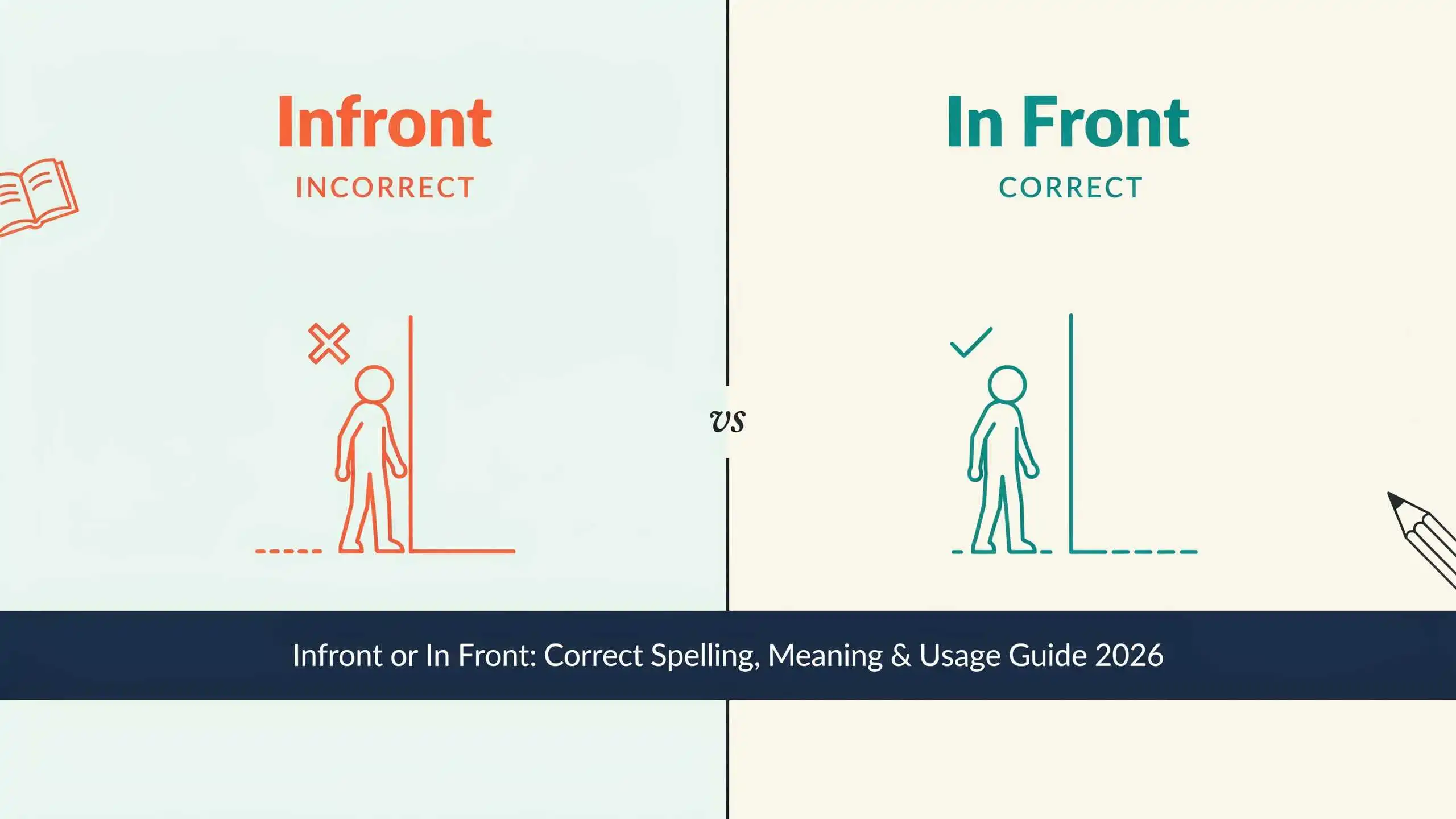
infront or in front is a common spelling confusion in English, especially among learners and writers who want to make their writing correct and professional. The simple and direct answer is that “in front” is the correct spelling, while “infront” is incorrect in standard English usage.
This confusion usually happens because the phrase is spoken as a single flow, but in written English it must be separated into two words. In this guide, you will clearly understand the difference, correct usage, grammar rules, examples, and common mistakes related to in front or infront spelling so you never get confused again.
Infront or in Front – Quick Answer
The correct form is “in front”, not “infront.”
- ✔ in front = Correct English phrase
- ❌ infront = Incorrect spelling (not standard English)
Example:
- The car is parked in front of the house.
So if you are wondering is it infront or in front, the answer is always “in front.”
Got it — you want a clean AI Overview-style summary (like Google SERP snippet tone), not a review or explanation.
AI Overview Summary
The phrase “in front or in front” is a common English spelling confusion, but the correct form is “in front.” The word “infront” is incorrect and not accepted in standard English grammar.
People often search for “is it infront or in front” or “in front or infront spelling” due to the way the phrase sounds in spoken English. However, in grammar rules, “in front” is a two-word prepositional phrase used to describe position or location.
In addition to its meaning, “in front” is used with “of” (in front of) to show where something is placed in relation to another object, while “infront” has no valid dictionary meaning.
Is It Infront or in Front? (Grammar Explanation)
Many learners ask is it infront or in front, and the confusion is understandable. In English grammar, “in front” is a prepositional phrase, made of two separate words:
- “in” (preposition)
- “front” (noun)
Together, they describe position or location.
👉 English rules do not allow them to be merged into one word in formal writing. That is why “infront” is considered incorrect in standard grammar.
In Front or Infront Spelling (Comparison Table)
| Feature | In Front | Infront |
|---|---|---|
| Correctness | ✔ Correct | ❌ Incorrect |
| Usage | Formal & Informal English | Not accepted |
| Grammar Type | Prepositional phrase | Spelling mistake |
| Meaning | Position in space | No valid meaning |
| Dictionary status | Accepted | Not listed |
This table clearly shows the in front or infront spelling difference in English writing.
Spicey or Spicy – Which Spelling Is Correct? (Meaning, Usage, and Full Guide)
Learn the spelling rules, regional differences, and real-world examples.
Why “Infront” Is Incorrect in English
The word “infront” is not recognized in standard English dictionaries. It is considered a common spelling mistake made by learners.
Reasons why it appears:
- Fast typing habits
- Phonetic writing (writing as it sounds)
- Lack of grammar awareness
- Influence of informal online writing
👉 In professional writing, infront is always incorrect, so it should be avoided.
Meaning of “In Front” in English
The phrase “in front” refers to a position that is ahead of something or someone.
Simple definition:
In front means being located at the forward position of something.
Example meanings:
- Position in space
- Directional reference
- Physical placement
How to Use “In Front” in Sentences (Examples)
Understanding usage is important for mastering in front or infront grammar rules.
Examples:
- The teacher stood in front of the class.
- There is a tree in front of my house.
- She parked her bike in front of the shop.
- The dog is sitting in front of the door.
- He waited in front of the station.
These examples show correct real-life usage of in front of meaning in sentences.
In Front or Infront – Common Confusion Explained
Many people confuse in front or infront spelling because both sound similar in speech. However, spoken English often blends words, which leads learners to incorrectly combine them in writing.
Main reasons for confusion:
- Spoken language influence
- Lack of grammar correction in texting
- Similar pronunciation
- Learning English as a second language
👉 This is why infront vs in front grammar mistakes are very common.
In Front vs Infront (Key Differences)
The difference is simple but important:
- In front → Correct grammatical phrase used in English
- Infront → Incorrect spelling with no grammatical validity
Key takeaway:
If you are writing formally, academic content, or SEO articles, always use “in front.”
Is “Infront” a Real Word in English?
No, “infront” is not a real English word.
It does not appear in:
- Oxford Dictionary
- Cambridge Dictionary
- Merriam-Webster
It is only found in informal writing and should be treated as a spelling error, not a valid term.
Which is correct, in front or infront?
First of all, the correct form is “in front”, not “infront.”
In English grammar, “in front” is a proper two-word prepositional phrase used to show position or location. On the other hand, “infront” is not accepted in standard English and is considered a spelling mistake.
✔ in front → Correct ❌ infront → Incorrect
Example:
- The car is parked in front of the house.
👉 Therefore, if you are confused about which is correct, in front or infront, the answer is always “in front.”
What is meant by “infront”?
To begin with, the word “infront” is not a real English word. Instead, it is simply a common spelling error made by learners.
Moreover, people often write it incorrectly because:
- It sounds like a single word when spoken
- They assume “in + front” can be combined
- Informal typing habits lead to mistakes
However, in proper English usage:
❌ “infront” has no dictionary meaning ✔ “in front” means a position ahead of something
Correct meaning:
- in front = located forward or ahead of something
How do you use infront in a sentence?
Firstly, it is important to clarify that you should NOT use “infront” in sentences, because it is incorrect English.
Instead, you should always use “in front”.
Incorrect usage (common mistake):
- The car is parked infront of the house.
Correct usage:
- The car is parked in front of the house.
Furthermore, the correct structure is:
in front of + noun
Examples:
- She stood in front of the mirror.
- The teacher is standing in front of the class.
- A tree is planted in front of the building.
How do you say “infront”?
Interestingly, there is no separate pronunciation for “infront” because it is not a valid word.
Instead, you should pronounce it as:
✔ “in front” → /ɪn frʌnt/
Pronunciation breakdown:
- in → short and soft sound
- front → rhymes with “hunt”
Additionally, when spoken naturally, it may sound like one flow, which is why many learners mistakenly write it as one word.
👉 However, in writing, it must always remain two separate words.
What comes in front of?
To understand this correctly, the phrase “in front of” is always followed by a noun (a person, place, or object).
Structure:
in front of + noun
Examples:
- in front of the house
- in front of the school
- in front of the car
- in front of me
Example sentences:
- A bicycle is parked in front of the gate.
- She stood in front of me during the ceremony.
- The shop is located in front of the station.
Moreover, this phrase is widely used to describe position, direction, and spatial relationships in English.
Is it front or frount?
To clarify, the correct spelling is “front”, not “frount.”
Correct:
✔ front
Incorrect:
❌ frount
Meaning of “front”:
The word front refers to:
- the forward part of something
- the side that faces ahead
- the position that comes first
Examples:
- The front door is open.
- Please sit in the front row.
In addition, “frount” is simply a spelling mistake, similar to “infront.”
Quick Summary (Important Grammar Rule)
To summarize everything clearly:
- ✔ Always write in front (two words)
- ❌ Never write infront (incorrect spelling)
- ✔ “front” is the correct spelling
- ❌ “frount” is incorrect and invalid
👉 Ultimately, the easiest rule to remember is:
Whenever you describe position, always use “in front of” — never combine it into one word.
In Front Of – Meaning and Usage
The phrase “in front of” is an extension of in front, used to describe position relative to an object.
Meaning:
It means something is located ahead of or facing something else.
Examples:
- The car is in front of the garage.
- She stood in front of the mirror.
👉 This phrase is widely used in daily English communication and is important for understanding spatial relationships.
Common Mistakes with “In Front”
Many learners repeatedly make these mistakes:
- Writing infront as one word
- Using it incorrectly in formal writing
- Mixing it with similar phrases like “before”
- Overusing it in place of directional terms
👉 These mistakes often lead to lower writing quality in academic and SEO content.
Quick Grammar Rule to Remember
To avoid confusion forever:
Always write “in front” as two separate words when describing position or location.
This simple rule eliminates all confusion around in front or infront spelling.
FAQ
Is infront or in front correct in English?
The correct form is in front. “Infront” is incorrect.
Why is infront incorrect?
Because English grammar requires it to be a two-word prepositional phrase, not a single word.
What is the meaning of in front?
It means being positioned ahead of something or someone.
Can we ever use infront in writing?
No, it is not accepted in formal or standard English writing.
What is the correct spelling: infront or in front?
The correct spelling is in front.
Final Summary
To conclude, the confusion around infront or in front is very common, but the rule is simple. The correct spelling is always “in front”, while “infront” is a spelling mistake and should be avoided in all forms of writing.
If you remember one rule:
👉 in front = correct English usage 👉 infront = incorrect spelling
Using the correct form improves your grammar accuracy, writing quality, and SEO performance in content creation.