
If you’ve ever paused mid-sentence and thought, “Is it laid or layed?”—you’re not alone. This is one of the most common English grammar doubts, even for confident writers.
The confusion is real because English verbs like lay and lie don’t follow simple patterns. But once you understand the rule behind them, it becomes surprisingly easy.
Quick Answer
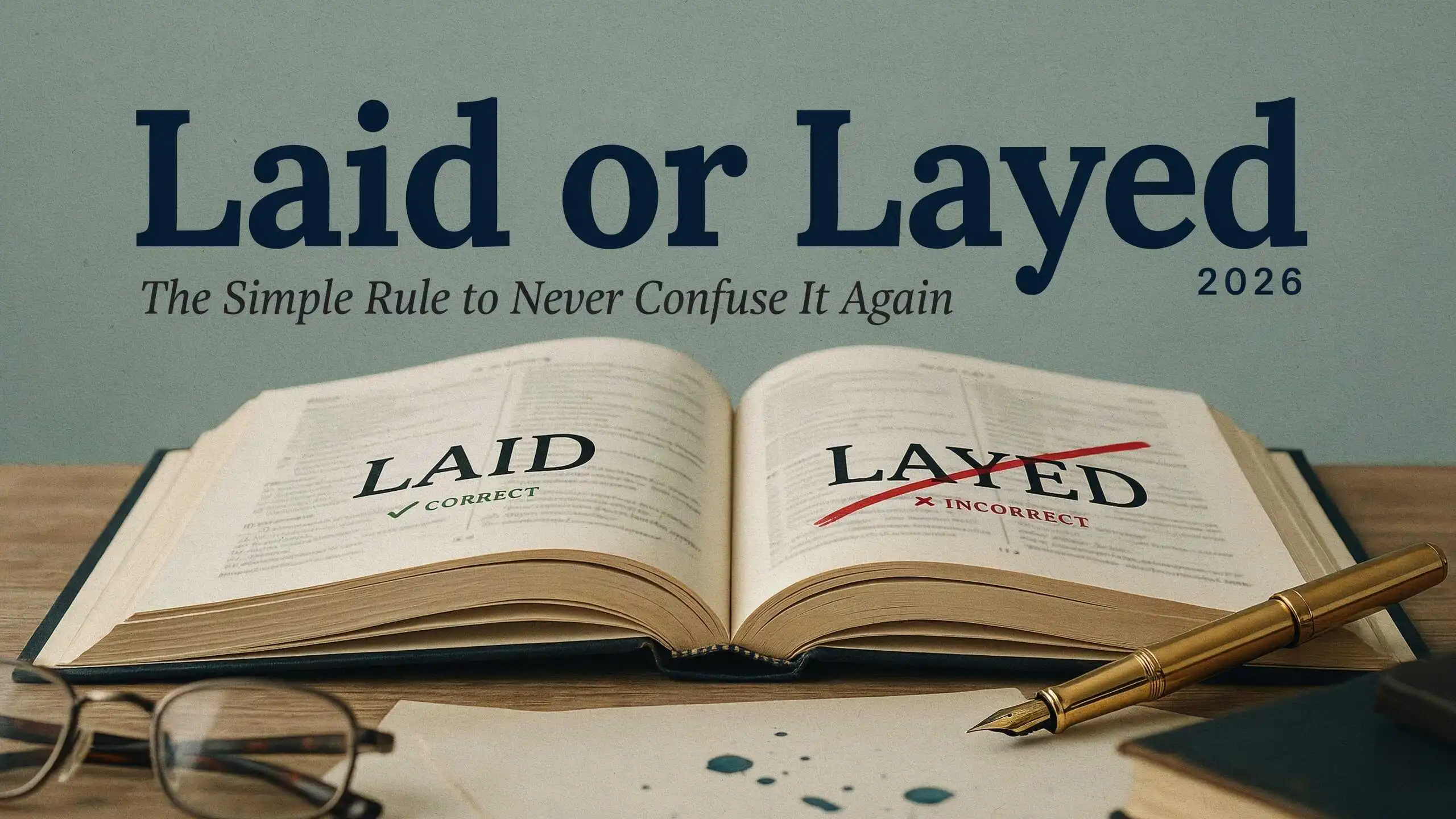
Laid is the correct spelling and is the past tense of “lay.” “Layed” is incorrect in modern standard English and should not be used in writing.
You use laid when something is being placed or put down. The confusion happens because English has irregular verbs like lay and lie, which change form in unexpected ways. Once you learn the object rule, you will rarely make this mistake again.
AI Overview Summary
Laid is the correct past tense of the verb “lay,” while layed is not standard English. Lay requires an object (you lay something down), while lie does not (you lie down). The confusion comes from irregular verb patterns. Understanding whether an object exists helps determine correct usage instantly.
Is It Laid or Layed? The Correct Answer Explained
Here’s the thing—only “laid” is correct in modern English.
You will see “layed” online sometimes, but that is either:
- A spelling mistake
- Or outdated/non-standard usage
Why this matters
Using the wrong form doesn’t just look like a typo. In formal writing like emails, assignments, or job applications, it can affect how professional your writing feels.
Simple rule:
If you are talking about placing something, the correct past tense is always laid.
Examples
- I laid the phone on the table.
- She laid the book beside her bag.
Notice how something is being placed. That’s the key idea.
Difference Between Laid and Layed
Let’s make this crystal clear.
| Word | Correct? | Meaning | Example |
|---|---|---|---|
| Laid | Yes | Past tense of “lay” | I laid the bag down |
| Layed | No | Incorrect spelling | Not used in standard English |
Most people assume “-ed” always works for past tense. That’s where the mistake comes from. English doesn’t always play fair with rules.
Here’s what most learners miss: “Lay” is irregular, so it does NOT follow normal verb patterns.
Lay vs Lie vs Laid (The Real Confusion)
This is where things get tricky. But once you see the pattern, it clicks.
Lay (present tense)
Used when something has an object.
- I lay the book on the desk.
- She lays the clothes on the bed.
Lie (present tense)
Used when no object is involved.
- I lie down after work.
- He lies on the sofa.
Laid (past tense of lay)
This is where your keyword comes in.
- I laid the book on the desk.
- She laid the phone on the table.
Simple truth:
- Lay = you put something
- Lie = you rest
- Laid = past action of putting something
Most confusion happens because “lay” also looks like past tense—but it isn’t.
In Route vs En Route: The Correct Spelling Explained 2026
Learn the spelling rules, regional differences, and real-world examples.
Is it laid or layed in bed?
The correct form is not “laid” or “layed” when you are talking about yourself in bed. You should use “lie” (present tense) instead.
So you say:
- I lie in bed (correct)
You use “lay” and “laid” when you place something or someone else down, not when you describe your own resting position.
Simple rule: If you are resting yourself, use lie, not laid.
Is it laid or layed on the floor?
The correct form is “laid on the floor,” not “layed.”
You use “laid” when someone places something onto a surface.
Correct examples:
- I laid the blanket on the floor.
- She laid the book on the floor.
Incorrect:
- I layed the blanket on the floor ❌
Key idea: If something is being placed on the floor, always use laid.
Do I lay in bed or lie in bed?
The correct form is “lie in bed.”
- I lie in bed every night. (correct)
- I lay in bed last night. (past tense correct)
- I lay in bed every night. (incorrect for present tense)
Here’s the thing most people miss:
- lie = to rest yourself
- lay = to put something down
So when YOU are in bed, you are not placing anything—you are resting. That’s why lie is correct.
Is it lay or lie down to sleep?
The correct form depends on tense:
Present tense:
- I lie down to sleep.
Past tense:
- I lay down to sleep last night.
Here’s the confusing part: “Lay” is actually the past tense of “lie,” which is why people mix them up.
Simple rule:
- Today → lie down
- Yesterday → lay down
Most people get this wrong because they assume “lay” is present, but it is not.
Is “I am lying in bed” correct?
Yes, “I am lying in bed” is 100% correct.
It is present continuous tense:
- I am lying in bed (right now)
- She is lying in bed watching TV
Important distinction:
- lying in bed = correct (resting position)
- laying in bed = incorrect in this context
Here’s what most learners miss:
“Laying” is only used when you are placing something else, not when you are resting.
So:
- Correct: I am lying in bed
- Incorrect: I am laying in bed ❌
Is It Laid or Layed Down?
Short answer: It is always “laid down.”
You will never use “layed down” in correct English.
Examples:
- He laid down his keys on the counter.
- The teacher laid down the rules clearly.
Why people get confused: They assume adding “-ed” makes it past tense. But again—English breaks that expectation here.
Is It Laid Out or Layed Out?
This is another very common search confusion.
The correct phrase is: laid out
Examples:
- The designer laid out the website structure.
- She laid out all the documents on the table.
What it means:
“Laid out” means arranged or organized in a clear way.
You might see “layed out” in casual writing, but it is incorrect in formal English.
Why People Confuse Laid and Layed
Let’s go deeper than just rules.
Here’s the real reason this mistake happens:
1. English verb patterns feel inconsistent
Most verbs follow:
- talk → talked
- play → played
So people assume:
lay → layed ❌
But English has irregular verbs that break this system.
2. Lay vs Lie overlap
These two verbs are especially confusing because:
- They sound similar
- Their past forms change unexpectedly
3. Memory overload
When speaking quickly or writing casually, people guess instead of applying rules.
Most people miss this:
The confusion is not about spelling—it’s about verb structure logic.
The Lay vs Lie vs Laid Decision System (Easy Rule)
Here’s a simple method you can actually use while writing.
Step 1: Ask “Is something being placed?”
- Yes → use lay/laid
- No → use lie/lay/lain
#2: Check object
- If there is an object → use lay or laid
- If there is no object → use lie
#3: Convert tense
- Present → lay / lie
- Past → laid / lay
- Past participle → laid / lain
Quick Table for Clarity
| Situation | Present | Past |
|---|---|---|
| With object | lay | laid |
| No object | lie | lay |
This is the simplest mental shortcut you can use.
Real-Life Examples of Laid in Writing
Let’s connect grammar to real life.
Example 1: Email mistake
A student wrote:
“I layed the file on your desk.”
It looks small, but in professional writing, this reduces credibility.
Correct version:
“I laid the file on your desk.”
Example 2: Workplace communication
“The manager laid out the plan clearly.”
This sounds structured, professional, and correct.
Example 3: Social writing
“She laid her phone aside and left.”
Even in casual writing, correctness still matters when clarity is important.
Mini Case Study: How One Small Word Affects Perception
A job applicant once submitted a cover letter with the sentence:
“I layed out the project strategy during my internship.”
The recruiter noticed the grammar error immediately.
What happened next?
- The candidate’s skills were not questioned
- But attention to detail was questioned
That’s the key insight:
Small grammar mistakes don’t just affect correctness—they affect perception.
Fixing “layed” to “laid” would have avoided this issue completely.
Expert Tips to Never Confuse It Again
Here are simple tricks you can actually use:
1. The “PUT test”
If you can replace the verb with “put,” use laid.
- I put the book down → I laid the book down ✔️
2. Object check
Ask:
“Is something being acted upon?”
If yes → use laid.
3. Slow thinking trick
Before writing, pause and check:
- Am I describing placement? → laid
- Am I describing rest? → lie/lay
Most mistakes disappear with this small habit.
Common Grammar Mistakes You Should Avoid
People often:
- Add “-ed” to all verbs automatically
- Mix spoken English with written English rules
- Forget object-based verb structure
- Assume lay is past tense of lie
Once you notice these patterns, your accuracy improves quickly.
Frequently Asked Questions
Use the object rule: if something is being placed, use laid.
The correct form is “laid out.”
The correct form is “laid down.”
Laid is the correct past tense of lay. Layed is incorrect spelling.
Laid is correct. Layed is not accepted in standard English.
It is “a body is lying”, not laying.
We use lie (lying) when something is in a resting position on its own, without being placed there by someone.
Correct:
The body is lying on the ground.
Incorrect:
The body is laying on the ground ❌
Simple rule:
If something is just resting or positioned somewhere, use lying.
The correct sentence is:
I lay in bed. (past tense of “lie”)
Here’s the confusion:
“lied” is the past of lie (to not tell the truth)
“lay” is the past of lie (to rest down)
So for bed/resting, you say:
Present: I lie in bed
Past: I lay in bed
Wrong: I lied in bed ❌ (this means you were not telling the truth)
Key insight:
“Lied” = telling a false statement
“Lay” = past tense of resting position
The correct form is:
The dog is lying on the floor.
We use lying because the dog is resting, not placing something.
Correct examples:
The dog is lying on the bed.
The dog was lying in the sun.
Incorrect:
The dog is laying on the floor ❌ (unless it is placing something, which dogs don’t do in this context)
Simple rule:
Animals and people lie down → so they are lying, not laying.
Conclusion
Once you understand the logic behind it, laid vs layed stops being confusing.
The truth is simple:
- Laid is always correct
- Layed is always wrong in modern English
But the real skill is not just memorizing this rule—it’s understanding why it exists. When you see how object-based verbs work, your grammar becomes more natural, not forced.
So next time you write, don’t guess. Pause for a second and ask whether you are placing something. If you are, choose “laid”—and you’ll almost always get the correct answer.