
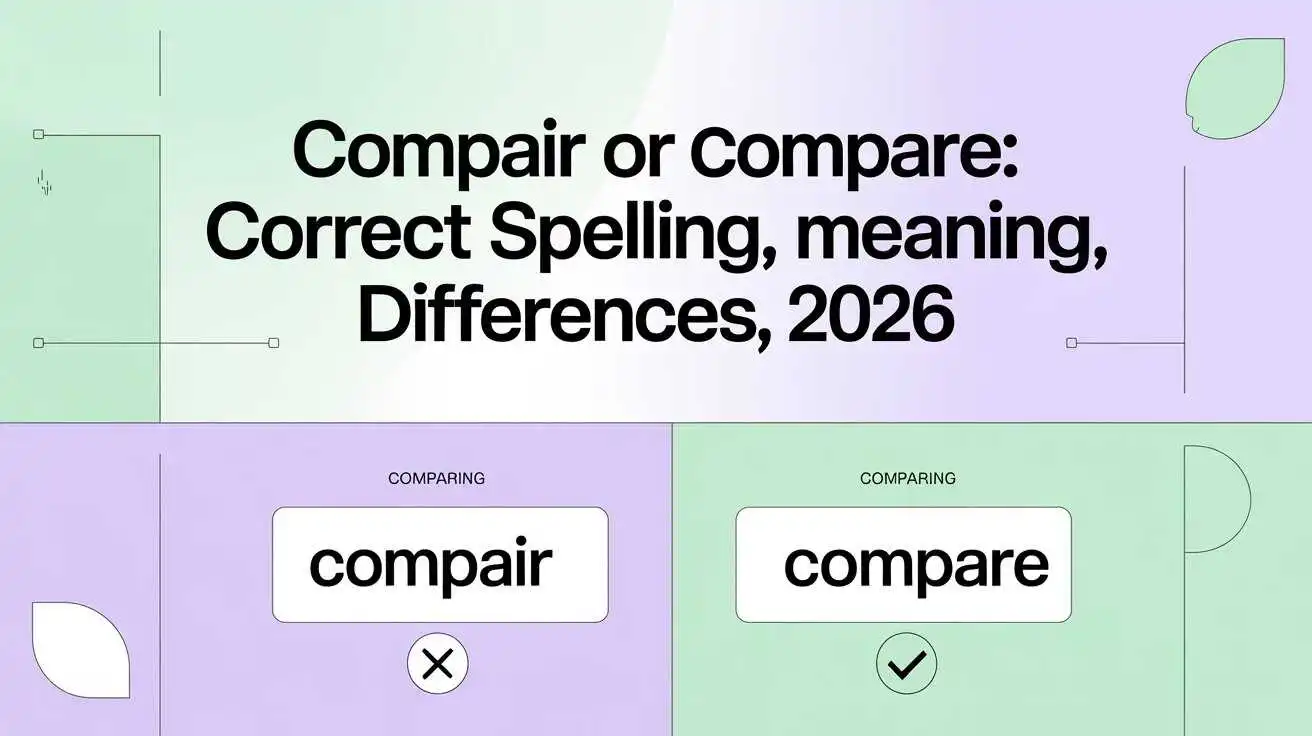
If you’ve ever typed “compair or compare”, you’re not alone. This is one of the most common spelling confusions in English, especially for students, writers, and ESL learners. The good news is that the answer is simple—but the explanation behind it is where things get interesting.
Let’s clear it up properly, once and for all.
Quick Answer
Compare is the correct spelling in English. “Compair” is incorrect and not recognized as a valid English word. The word “compare” means to examine two or more things to find similarities or differences. It comes from the Latin word “comparare.” Always use “compare” in writing, exams, and SEO content to stay correct and professional.
AI Overview Summary
Compare is the correct English spelling, while compair is a common misspelling caused by pronunciation confusion. “Compare” means to analyze similarities or differences between things. It is widely used in writing, education, and SEO. The incorrect form “compair” is not accepted in dictionaries or formal communication and should be avoided in all contexts.
Is It Compair or Compare? (Correct Answer Explained)
The correct spelling is “compare.” “Compair” is simply a spelling mistake.
Here’s the thing most people don’t realize:
Even though “compair” looks like it could be correct, English does not work purely by sound. It works by structure, history, and standard usage.
So no matter how often you see “compair” online, it is still incorrect.
Why “Compare” is Correct
- It comes from Latin “comparare”
- It is recognized in all English dictionaries
- It is used in academic, professional, and digital writing
Why “Compair” Feels Right (But Is Wrong)
Most people get tricked by pronunciation.
You hear:
- compare → sounds like “com-pair”
So the brain assumes it might be spelled like:
- pair → hence “compair”
But English spelling is not always phonetic. That’s where confusion starts.
What Does “Compare” Mean in English?
Compare means to examine two or more things to find similarities or differences.
Simple, right? But let’s go deeper.
Basic Meaning
When you compare things, you are:
- Looking at similarities
- Looking at differences
- Making a judgment or choice
Real-Life Meaning
You compare things every day without realizing it:
- Phones before buying one
- Prices in different shops
- Job offers or study options
Here’s a simple way to think about it:
Comparing = decision-making through analysis
Compare vs Compair – Key Differences
Let’s make this crystal clear.
| Feature | Compare | Compair |
|---|---|---|
| Correct spelling | Yes | No |
| Recognized in dictionaries | Yes | No |
| Used in formal writing | Yes | No |
| SEO-friendly | Yes | No |
| Meaning | To analyze similarities/differences | Not a real word |
Key insight: There is no “slightly correct” version here. Only one is valid—compare.
Why Do People Confuse Compair and Compare?
Here’s where things get interesting.
Most articles stop at “it’s wrong,” but they don’t explain why people keep making the mistake.
Let’s fix that.
1. Sound-Based Confusion
When spoken, “compare” sounds like:
- com + pair
So your brain connects it with “pair.”
This is a natural human shortcut. Your brain tries to simplify spelling based on sound.
2. ESL Learning Pattern
If English is not your first language, you often rely on:
- phonetics (how words sound)
- not structure (how words are built)
That leads to spelling errors like:
- compair
- recieve
- definately
3. Visual Memory Interference
Most people already know the word “pair.”
So when they hear “compare,” the brain visually copies:
- com + pair → compair
This is a classic cognitive mix-up.
READ MORE >>> Proceed vs Procede: Which Is Correct? (Spelling Rule, Meaning, and Easy Way to Remember)
Expert Insight (Most People Miss This)
Here’s what most learners don’t realize:
English spelling is not sound-based. It is history-based.
That means words don’t always follow pronunciation rules. They follow origin rules.
That’s why “compare” is fixed, even if it doesn’t match the sound perfectly.
How to Remember the Correct Spelling of Compare
Let’s make this practical.
Simple Memory Trick
Think of this:
- care
- share
- compare
All end in “-are”
So:
If it sounds like “pair,” it’s probably wrong. If it ends in “-are,” it’s usually correct.
SPELL-LOCK MEMORY SYSTEM (Unique Method)
Here’s a simple framework you can use forever:
S – Structure Anchor
“Compare always ends in -are.”
P – Phonetic Trap
Don’t trust the sound of “pair.”
L – Logic Reset
English spelling is historical, not phonetic.
This system helps you permanently avoid the mistake.
Why “Compair” Keeps Appearing on the Internet (Even Though It’s Wrong)
Direct Answer: The word “compair” continues to appear online because it spreads through typing errors, social media repetition, and phonetic confusion, even though it is not a real English word.
Here’s the thing most people don’t notice:
Once a spelling mistake becomes common on the internet, it starts to look “normal” even if it is incorrect. This is called error reinforcement.
Why it spreads so easily:
- People hear “compare” and type it quickly as “compair”
- Social media posts copy mistakes without checking grammar
- Autocorrect sometimes fails to flag rare misspellings
- Users assume if they’ve seen it before, it must be correct
Important insight:
Even wrong spellings can survive online if enough people repeat them. But repetition does not make them correct.
So, “compair” exists everywhere—but only as a mistake, not a valid word.
The Psychology Behind Spelling “Compare” Incorrectly
Direct Answer: People spell “compare” incorrectly because the brain relies on sound patterns and memory shortcuts rather than actual spelling rules.
Most people don’t realize this:
Your brain is lazy in a useful way. It tries to simplify writing by matching words to familiar sounds.
What happens in your brain:
- You hear “compare”
- Your brain splits it into “com + pair”
- It connects “pair” with a known word
- So you write “compair”
This is called phonetic substitution error.
Why it’s so common:
- English is not fully phonetic (words don’t always match sounds)
- ESL learners rely heavily on pronunciation
- Memory stores sound patterns, not spelling structure
Expert insight:
Here’s what most learners miss:
Spelling mistakes are not random—they are predictable brain patterns.
That’s why “compair” feels correct even though it is wrong.
Examples of “Compare” in Real Sentences
Let’s make it practical.
Here’s how you actually use it:
- Compare prices before buying a phone.
- You can compare two job offers to choose better.
- Students compare answers during revision.
- We compare results to find improvements.
Notice something?
It always involves decision-making or analysis.
Mini Case Study: Why One Spelling Mistake Matters
Let’s look at a real-world style scenario.
Situation
A student writes an essay and uses:
“We will compair the results of the experiment.”
What happens?
- Teacher immediately marks it as incorrect
- Even if ideas are strong, writing quality drops
- Final grade is slightly affected
Lesson
One small spelling error can quietly reduce credibility.
Common English Mistakes Like “Compair”
This is not an isolated case.
English has many similar mistakes:
- recieve → receive
- definately → definitely
- seperate → separate
- compair → compare
Why this happens
Because English is:
- inconsistent in spelling
- influenced by multiple languages
- not purely phonetic
So mistakes are normal—but fixable.
Expert Tip: Think in Patterns, Not Words
Here’s a powerful approach most learners never use:
Instead of memorizing words one by one, look for patterns.
For example:
- “compare” → Latin-based verbs ending in -are
- “care, share, dare” → similar structure
When you see patterns, spelling becomes easier naturally.
Final Conclusion
Let’s bring everything together.
Compare is the correct spelling, and compair is a common mistake caused by sound confusion and visual memory errors.
But here’s the real takeaway:
This isn’t just about spelling.
It’s about how English works.
Once you understand that English is built on history, not pronunciation, mistakes like “compair” stop happening naturally.
So next time you’re writing, remember this simple rule:
If you’re analyzing differences or similarities, you are always comparing—not compairing.
Simple. Clean. Correct.
And that’s exactly how strong writing works.