
Quick Answer
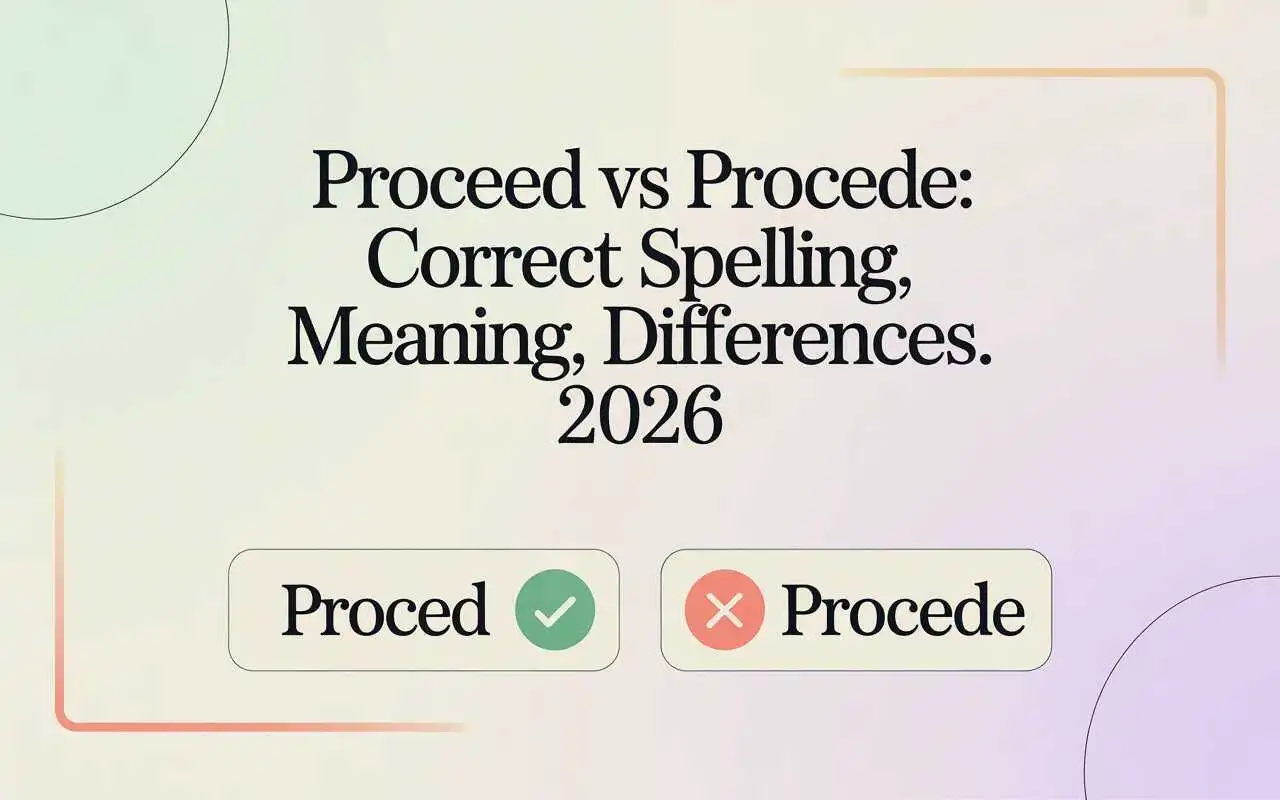
“Proceed vs Procede” Proceed is the correct spelling and means to move forward or continue. “Procede” is not a valid English word it’s simply a misspelling. If you’re unsure, remember this: “proceed” always has double “e” and is the only correct form in every situation.
AI Overview Summary
“Proceed” is the correct spelling used when you mean to continue or move forward. “Procede” is always incorrect. The confusion happens because of similar-looking words like “precede” and “procedure.” A simple rule helps: words related to forward movement often use “-ceed,” while “-cede” words usually relate to coming before something.
Which Is Correct: Proceed or Procede?
Short answer: Proceed is correct. “Procede” is wrong and should never be used.
Here’s the thing… this is one of those mistakes that looks small—but it instantly stands out in writing.
- Proceed = correct English word
- Procede = spelling mistake
There’s no exception. No regional variation. No hidden rule. If you write “procede,” it’s incorrect—every time.
What Does “Proceed” Mean and How Is It Used?
Short answer: “Proceed” means to continue, move forward, or carry on with something.
Most people think it’s just a formal word—but you actually use it more often than you realize.
Common meanings of “proceed”
- Continue an action
- Move to the next step
- Advance in a process
Real-life examples
- Please proceed with the payment.
- We will proceed after approval.
- The meeting will proceed as planned.
You’ll see it in emails, instructions, exams, and even casual conversations. It’s everywhere.
Why Do People Confuse “Proceed” and “Procede”?
Short answer: The confusion comes from similar-looking words like “precede” and “procedure.”
Most people miss this…
It’s not just a random spelling mistake. Your brain is actually trying to follow patterns—but it mixes them up.
The real reasons behind the confusion
- Similar pronunciation
- Exposure to words like “procedure” (no double “e”)
- Lack of clear spelling rules
Words that trigger confusion
- precede
- procedure
- succeed
Your brain sees patterns—but English doesn’t always play fair.
The “-CEED vs -CEDE” Rule (A Simple Framework You Can Actually Remember)
Short answer: Words ending in “-ceed” usually relate to moving forward, while “-cede” words often relate to coming before.
Let’s fix this confusion properly.
The Forward vs Before Rule
| Pattern | Meaning | Examples |
|---|---|---|
| -ceed | Move forward | proceed, succeed, exceed |
| -cede | Come before | precede, recede |
Here’s the insight:
- proceed → move forward
- precede → come before
That one distinction clears up most confusion instantly.
How to Remember the Correct Spelling of “Proceed”
Short answer: The easiest way to remember “proceed” is to link the double “e” with continuous forward movement.
Let’s make this stick.
Memory trick 1: Double “e” = keep going
Think of the two “e” letters as steps moving forward.
Memory trick 2: “Proceed” contains “speed”
You move forward with speed → proceed.
Memory trick 3: Visual trick
Imagine a road with two lanes (ee) pushing you forward.
Expert Tip: Don’t just memorize—connect the spelling to meaning. That’s how it stays in your memory.
READ MORE >>> Filed vs Filled: What’s the Difference? (Examples, Rules & Easy Memory Trick)
Proceed vs Procede vs Procedure (The Real Difference Explained)
Short answer: “Proceed” means move forward, “precede” means come before, and “procedure” refers to a process.
This is where most confusion comes from.
| Word | Meaning | Example |
|---|---|---|
| Proceed | Move forward | Proceed with the plan |
| Precede | Come before | A precedes B |
| Procedure | Process | Follow the procedure |
Here’s what’s interesting…
- “Proceed” and “precede” look similar but mean opposite things
- “Procedure” breaks the pattern completely
That’s why people accidentally write “procede.”
Is “Procede” Ever Correct in Any Situation?
Short answer: No, “procede” is never correct in modern English.
No exceptions. No edge cases.
If you see it:
- It’s a typo
- Or a spelling mistake
Even in British English—it’s still wrong.
Real-World Usage: Where This Mistake Actually Matters
Short answer: Using the wrong spelling can hurt your credibility in professional and academic writing.
This isn’t just grammar—it’s perception.
Email example
“Please procede with the request” → Looks careless
Academic writing
Misspelling basic words can affect grades.
Workplace communication
Small errors signal lack of attention to detail.
Mini Case Study
A job applicant sent an email saying, “Kindly procede with my application.”
The recruiter noticed immediately.
The result? They were seen as careless—even though their qualifications were strong.
Lesson: Tiny spelling mistakes can create big doubts.
Common Mistakes Related to “Proceed”
Short answer: The most common mistakes involve misspelling or confusing similar words.
Here are typical errors:
- procede
- proced
- proceding
Correct forms:
- proceed
- proceeding
Once you understand the pattern, these mistakes become easy to avoid.
READ MORE >>> Adjuster or Adjustor: Correct Spelling, Meaning, and Which One You Should Use
Quick Decision Guide: Never Confuse These Words Again
Short answer: If it means moving forward, use “proceed.” If it means coming before, use “precede.”
Use this simple logic:
- Talking about moving forward? → Use proceed
- Talking about something happening earlier? → Use precede
- Unsure about “procede”? → It’s wrong. Always.
Simple. Fast. Reliable.
Expert Tips to Avoid Spelling Mistakes Like This
Short answer: Practice patterns, not just words, and use tools to double-check your writing.
Here’s what actually works:
- Learn spelling patterns like “-ceed vs -cede”
- Use spellcheck tools
- Read your writing before sending
- Practice with real examples
Pro Insight: The more patterns you learn, the fewer mistakes you make overall—not just with this word.
Proceed vs Procede: The Linguistic Origin and Why the Spelling Differs
Explanation: The difference between “proceed” and “procede” comes from Latin roots, not modern English spelling rules. “Proceed” comes from procedere, meaning “to go forward,” which evolved into “proceed” in English while keeping the double “ee” sound pattern.
“Procede” appears wrong because English dropped many Latin spellings but kept pronunciation patterns. Over time, English standardized “-ceed” words (like succeed, exceed, proceed), while “-cede” became a separate group (like precede, recede).
Key insight: The confusion exists because English split Latin root words into two spelling families that look similar but carry different meanings.
Proceed vs Procede: How Native Speakers Actually Avoid This Mistake in Real Writing
Explanation: Native speakers rarely memorize spelling rules directly. Instead, they rely on pattern recognition and exposure. Words like “proceed,” “succeed,” and “exceed” appear together frequently, so the brain naturally groups them as “-ceed = forward action” words.
In real writing, native speakers also depend heavily on:
- Auto-correct systems
- Reading exposure (seeing correct spelling repeatedly)
- Context-based guessing (meaning determines spelling choice)
Key insight: They don’t “think” about spelling rules—they recognize patterns subconsciously through repetition.
Proceed vs Procede: Pattern Recognition Method Used by Language Experts to Never Get It Wrong Again
Explanation: Language experts use a system called morphological pattern grouping, where words are memorized in families instead of individually.
For example:
- -ceed group (movement forward): proceed, succeed, exceed
- -cede group (position/sequence): precede, recede
Experts teach learners to mentally tag meanings instead of letters:
- “Forward action = CEED”
- “Before/step-back concept = CEDE”
Key insight: Once the brain links meaning + pattern, spelling becomes automatic instead of memorized.
FAQs
Is “procede” a real word?
No, it is a misspelling of “proceed” and is not recognized in standard English.
Why does “proceed” have double “e”?
It follows a pattern shared with similar verbs like “succeed” and “exceed,” rooted in historical language development.
What is the difference between proceed and precede?
“Proceed” means to move forward, while “precede” means to come before something.
How do I remember the spelling of proceed?
Link the double “e” with continuous forward movement—it helps lock the spelling in your memory.
Is “procede” used in British English?
No, it is incorrect in both British and American English.
Conclusion
Let’s keep it simple.
“Proceed” is correct. “Procede” is not.
But here’s what really matters…
You’re not just learning a spelling you’re learning a pattern.
Once you understand the difference between -ceed (forward) and -cede (before), this confusion disappears. Not just for this word but for others too.
And that’s the real win.
Because good writing isn’t about memorizing everything. It’s about understanding how things work.
Now you don’t just know the answer. You won’t forget it.