
Introduction
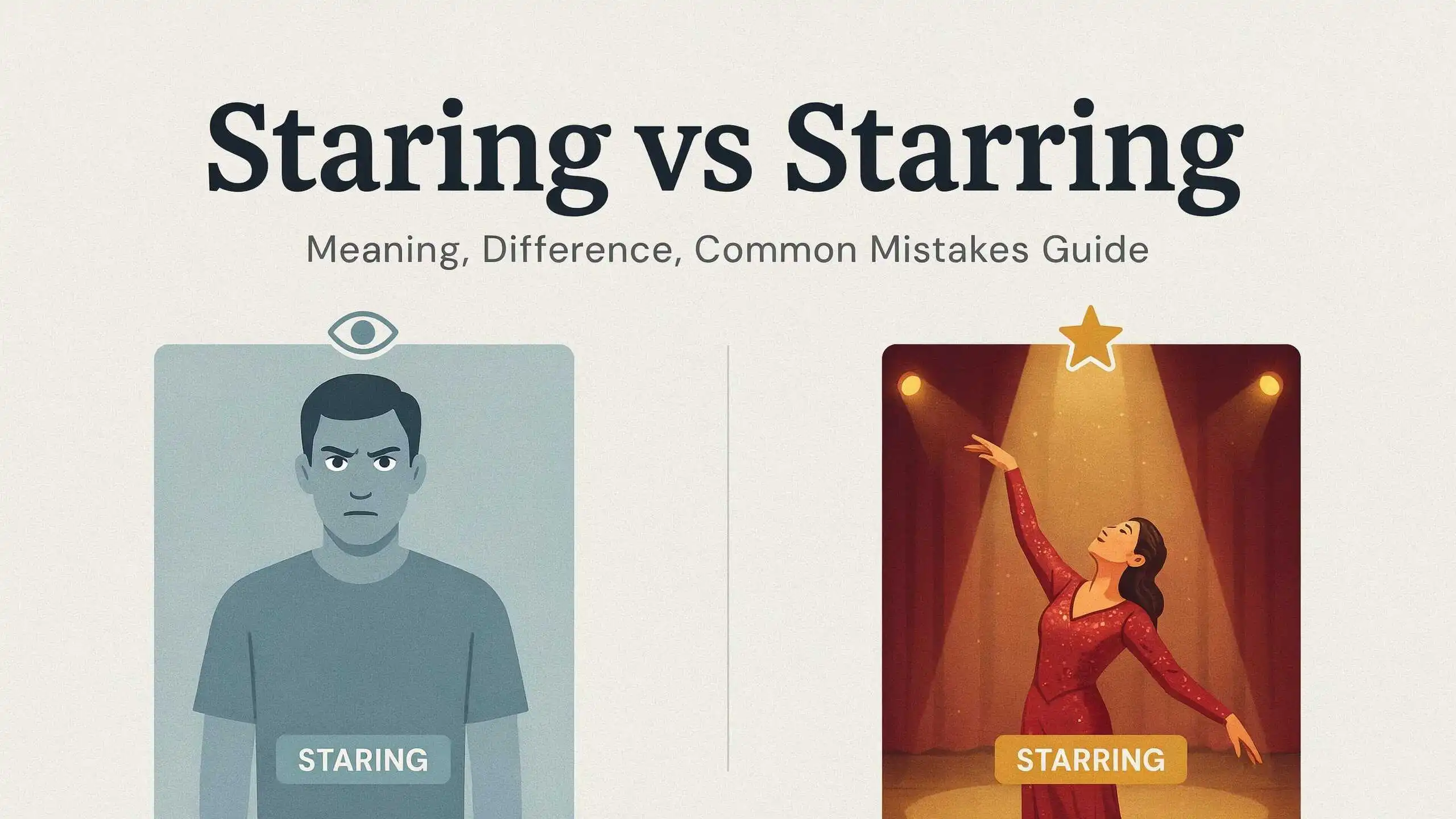
staring vs starring is one of the most commonly confused word pairs in English writing because both words look and sound almost identical, yet their meanings are completely different. In simple terms, the difference between staring and starring is that staring means looking at someone or something for a long time with focus, while starring means playing a main role in a movie, show, or performance. Many learners also confuse similar forms like stared vs starred, which adds to spelling and grammar mistakes in writing. This article explains everything in a clear, practical, and SEO-friendly way so you never confuse these words again.
Quick Answer: Difference Between Staring and Starring
The difference between staring and starring is based on meaning and context:
- Staring means looking at someone or something continuously or fixedly.
- Starring means featuring as the main actor or playing a lead role in a movie, TV show, or performance.
Although they differ by only one letter, their meanings belong to completely different contexts: behavior vs entertainment.
AI Overview Summary
Staring vs starring is a commonly confused pair of English words that differ in meaning, context, and usage. The difference between staring and starring is simple: staring refers to looking at someone or something for a long time with focus, while starring refers to playing a main or leading role in a movie, TV show, or performance. Although the words look similar, they belong to completely different contexts behavior versus entertainment.
In grammar terms, staring is the present participle of “stare,” and starring is the present participle of “star,” which doubles the “r” when forming the verb. A common related confusion is stared vs starred, where stared is the past tense of stare and starred is the past tense of star.To use them correctly, remember: if it involves eyes or looking, use staring; if it involves acting or film roles, use starring.
Staring vs Starring – Complete Comparison
To clearly understand staring vs starring, it helps to compare them side by side.
| Feature | Staring | Starring |
|---|---|---|
| Meaning | To look at something for a long time | To play a leading role in a film or show |
| Context | Daily behavior, emotions | Movies, acting, entertainment |
| Verb Form | stare → staring → stared | star → starring → starred |
| Example | He was staring at the sky | She is starring in a movie |
| Usage Type | Action (visual attention) | Role (performance credit) |
This comparison shows why starring vs staring cannot be used interchangeably.
What Does Staring Mean?
The word staring meaning refers to looking directly at something or someone for a long time without moving your eyes away. It often shows strong emotions like surprise, curiosity, anger, confusion, or deep thought.
In simple terms, staring meaning in English is “to look fixedly or continuously at something.”
Common Usage of Staring
- Staring at a person during a conversation
- Staring at an object in confusion
- Staring at screens or phones for long periods
- Staring in shock or fear
Examples of Staring
- He kept staring at the window during the storm.
- The child was staring at the magician in surprise.
- Why are you staring at me like that?
In these cases, staring meaning in a sentence always refers to looking, not acting or performing.
What Does Starring Mean?
The word starring meaning is used in entertainment and film contexts. It refers to someone playing a main or important role in a movie, TV show, or stage performance.
In other words, starring meaning in movies refers to lead actors who are officially credited as main performers.
Starring in Movies Explained
When you see a movie credit like “starring,” it means the actor has a major role in the production.
Examples of Starring
- She is starring in a new Netflix series.
- The film is starring a famous Hollywood actor.
- He is starring in a Broadway production.
So, starring meaning in a sentence always connects to acting or performance.
Laid or Layed: Correct Spelling, Grammar Rules, and Simple Guide to Lay vs Lie Confusion
Learn the spelling rules, regional differences, and real-world examples.
Why People Confuse Staring and Starring
Many learners confuse staring or starring because:
- They differ by only one letter.
- Both words are pronounced similarly.
- Autocorrect may not highlight the mistake.
- Both words are grammatically correct but context-dependent.
Another reason is that stare vs star confusion creates overlap in meaning for beginners learning English.
A simple explanation is:
- Staring = behavior (eyes)
- Starring = profession (acting)
Staring vs Starring – Common Mistakes
Many writing errors occur when people mix these words. Below are common mistakes:
Incorrect vs Correct Usage
- ❌ She is staring in a movie
- ✅ She is starring in a movie
- ❌ He is starring at me
- ✅ He is staring at me
- ❌ The actor was staring in the film
- ✅ The actor was starring in the film
These examples show how correct usage of staring and starring depends on context.
Stared vs Starred – Past Tense Confusion
The keyword stared vs starred is another common confusion among learners.
Meaning Difference
- Stared = past tense of stare (looked at something)
- Starred = past tense of star (acted in a movie)
Examples
- He stared at the door for minutes.
- She starred in a popular TV series.
Understanding stared vs starred examples helps prevent grammar mistakes in writing.
Is it starring or staring in a movie?
The correct word is starring in a movie, not staring. The word starring is used in the entertainment industry to show that an actor is playing a main or leading role in a film, TV show, or performance. For example, “The movie is starring a famous actor” means the actor has a central role in the production. On the other hand, staring refers to looking at something or someone for a long time, which does not relate to movies or acting.
How do you spell staring as in looking at someone?
When you mean looking at someone continuously or fixedly, the correct spelling is staring (S-T-A-R-I-N-G). It comes from the verb “stare.” For example, “He is staring at me” means he is looking at you for a long time. A common mistake is mixing it with starring, but that word belongs to movies and acting, not visual attention or behavior.
Is stare starring or staring?
The correct form is staring when referring to the verb “stare.” Staring is the present participle of “stare,” meaning to look directly at something for a long time. Starring comes from a completely different verb “star,” which refers to acting in a lead role. So, when talking about looking, always use staring, not starring.
When should I use starring?
You should use starring when referring to movies, TV shows, theatre, or any entertainment context where someone plays a main role. For example, “She is starring in a new Netflix series” means she is the lead actor in that show. It is commonly used in credits, film descriptions, and entertainment news.
When to use starring?
Use starring whenever you are talking about acting roles, film credits, or performances. It is used to describe who the main actors are in a production. For example, “The film starring Tom Cruise was a hit” shows that Tom Cruise has a leading role. It should never be used when talking about looking at something or someone.
Is it stared or starred?
Both stared and starred are correct, but they have completely different meanings. Stared is the past tense of “stare,” meaning someone looked at something for a long time. For example, “He stared at the sky.” Starred is the past tense of “star,” meaning someone acted in a movie or had a main role. For example, “She starred in a famous film.” The correct choice depends entirely on the context.
Grammar Breakdown of Staring and Starring
To fully understand staring vs starring grammar rules, we need to look at verb forms:
| Base Verb | Present Participle | Past Tense |
|---|---|---|
| stare | staring | stared |
| star | starring | starred |
Key Rule
The verb “star” doubles the “r” in starring because of English spelling rules when forming present participles.
This is why spelling confusion starring vs staring happens frequently.
Why Are Staring and Starring Commonly Confused Words?
The confusion comes from:
- Similar spelling
- Similar pronunciation
- Lack of context awareness
- ESL learning challenges
- Overlapping mental associations
This makes them part of commonly confused English words in grammar learning.
Easy Memory Trick for Staring vs Starring
To remember the difference between staring and starring, use this simple trick:
- Staring = one R = looking
- Starring = two R’s = role (actor)
Think of it like this:
- One R = eyes (looking)
- Two R’s = red carpet (acting career)
This mnemonic helps learners quickly avoid mistakes.
Decision Guide: When to Use Staring vs Starring
If you are unsure which word to use, follow this rule:
- If it involves eyes or looking, use staring
- If it involves movies or acting, use starring
This is the simplest correct usage of staring and starring guide.
Real-Life Usage Examples
Staring Examples
- She was staring at the painting for hours.
- He kept staring at the teacher during the lecture.
- They were staring at the screen in silence.
Starring Examples
- The movie is starring a famous actress.
- He is starring in a new action film.
- The series is starring multiple international actors.
These examples show staring in sentences vs starring in sentences clearly.
Quick Practice Quiz
Fill in the blanks:
- She is __ at the board during class.
- The actor is __ in a blockbuster movie.
- Why are you __ at me like that?
- He __ in a famous TV drama.
Answers:
- staring
- starring
- staring
- starred
This helps reinforce the staring vs starring grammar guide.
Common Learner Mistakes and Corrections
Many ESL learners make predictable errors:
- Mixing movie context with staring
- Forgetting double “r” in starring
- Using staring instead of starring in entertainment context
Correcting these improves writing clarity and avoids grammar mistakes.
Advanced Grammar Insight (Optional but Important)
The difference also comes from verb structure:
- Staring = present participle of “stare”
- Starring = present participle of “star” (with consonant doubling rule)
This makes them part of English verb form confusion patterns.
Frequently Asked Questions
Is it staring or starring at me?
It is staring at me because it refers to looking.
What does starring mean in a movie?
It means playing the main role in a film or TV show.
Why do people confuse staring and starring?
Because they look and sound similar but have different meanings.
Can staring and starring be used interchangeably?
No, they cannot be used interchangeably.
What is the difference between staring and starring?
Staring refers to looking; starring refers to acting in a role.
Is starring only used for actors?
Yes, it is mainly used in entertainment contexts.
Summary: Staring vs Starring
The confusion between staring vs starring is common, but the distinction is simple:
- Staring = looking at something or someone
- Starring = playing a leading role in entertainment
Understanding this difference, along with examples and grammar rules, ensures you never misuse these words again.