
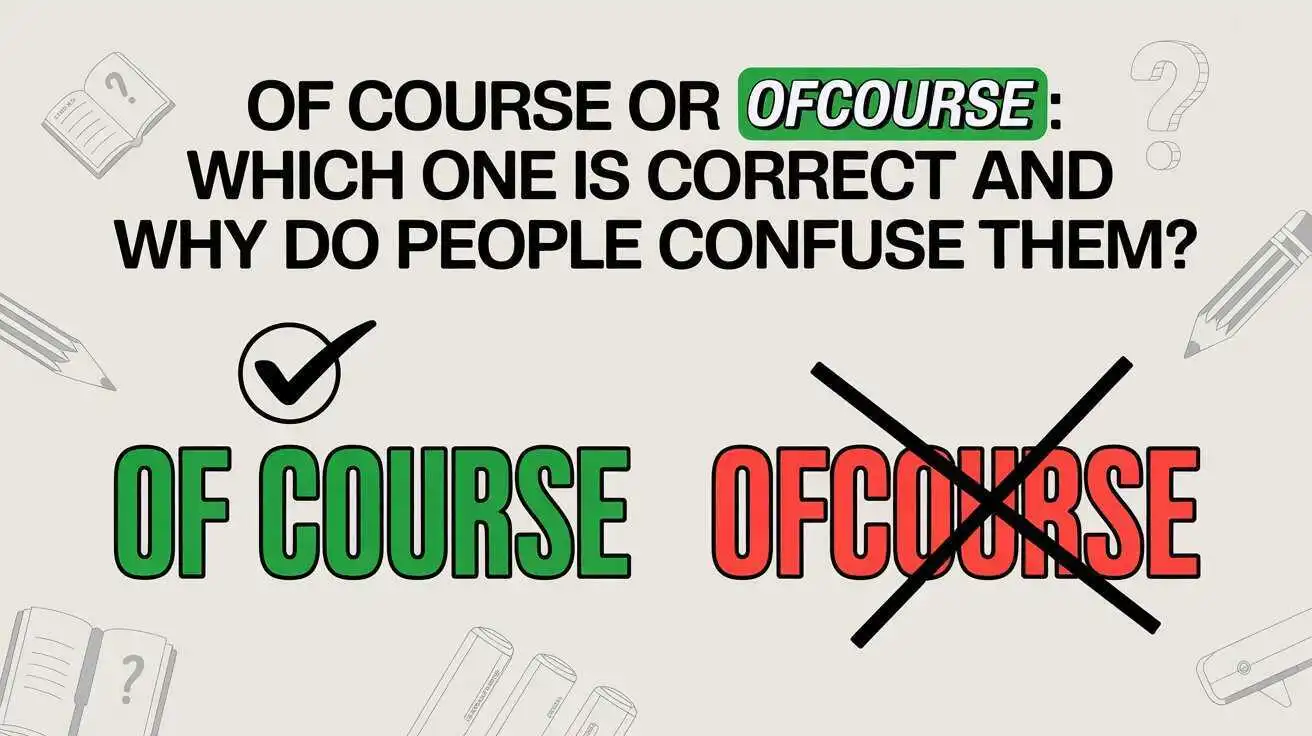
Of course or ofcourse if you’ve ever paused while typing this phrase, you’re not alone. Thousands of people search for this exact grammar question because “ofcourse” looks strangely correct at first glance. But here’s the truth: only one version is accepted in standard English.
And there’s actually a fascinating reason why so many people make this mistake.
Let’s clear it up once and for all.
Quick Answer
“Of course” is the correct spelling. “Ofcourse” is incorrect and should not be used in formal or professional writing. The confusion happens because people pronounce “of course” quickly in conversation, making it sound like a single word even though it is grammatically a two-word phrase.
AI Overview Summary
- Of course is the correct spelling in English.
- Ofcourse is considered a misspelling.
- The phrase stays separate because it contains two individual words: “of” and “course.”
- Many people mistakenly combine them because spoken English blends the phrase together.
- “Of course” can sound friendly, polite, reassuring, sarcastic, or dismissive depending on tone.
Is It “Of Course” or “Ofcourse”?
The correct form is “of course.” The version “ofcourse” is not recognized in standard English dictionaries.
Here’s a quick comparison:
| Correct | Incorrect |
|---|---|
| of course | ofcourse |
Simple enough, right?
But most people miss something important here.
The mistake isn’t caused by poor grammar skills. In many cases, it happens because the human brain naturally merges words that are spoken together frequently.
That’s why “ofcourse” looks believable.
Why Is “Of Course” Two Words?
The phrase “of course” contains:
- Of → a preposition
- Course → a noun
Together, they form an expression that means:
- certainly
- naturally
- obviously
- without question
Because both words still keep their individual grammatical roles, English keeps them separated.
For example:
- “Of course I’ll help you.”
- “Yes, of course.”
- “She is, of course, correct.”
The phrase acts like one idea emotionally, but grammatically it remains two words.
Why “Ofcourse” Looks Correct to So Many People
Here’s where things get interesting.
Most grammar articles stop after saying:
“Of course is correct.”
But they never explain why your brain thinks otherwise.
That’s the real issue.
The Phrase Compression Framework
People mentally combine phrases when four things happen:
- The phrase is spoken quickly
- The words appear together constantly
- The phrase expresses one emotional meaning
- Fast typing reduces spacing attention
This is what we call the Phrase Compression Framework.
Think about these common mistakes:
| Incorrect | Correct |
|---|---|
| alot | a lot |
| infact | in fact |
| atleast | at least |
| aswell | as well |
Notice the pattern?
Your brain starts treating the phrase like a single visual object.
That’s exactly why “ofcourse or of course” confuses so many people.
READ MORE >>> Aether vs Ether: Meaning, Differences, Usage, and Why Both Words Still Matter
Spoken English Makes the Confusion Worse
Native speakers rarely pronounce “of course” slowly.
Instead, it often sounds like:
“uh-course”
or
“ofcourse”
in rapid speech.
So your ears hear one word even though grammar rules say otherwise.
This is one of the biggest reasons ESL learners struggle with the phrase.
And honestly? Even native speakers type it incorrectly sometimes.
Off Course or Ofcourse: What’s the Difference?
This is another common confusion.
Although they look similar, off course and of course have completely different meanings.
| Phrase | Meaning |
|---|---|
| of course | certainly or naturally |
| off course | away from the correct route |
Examples:
Of Course
- “Of course you can borrow my laptop.”
- “She was, of course, joking.”
Off Course
- “The airplane drifted off course.”
- “The ship moved off course during the storm.”
So if you’re wondering about off course or ofcourse, remember:
- off course = real phrase
- ofcourse = incorrect spelling
How to Use “Of Course” Correctly
The phrase is incredibly flexible.
You can use it in:
- conversations
- emails
- customer service
- academic writing
- casual texting
Here are some real-life examples.
Formal Examples
- “Of course, I would be happy to assist you.”
- “The report was, of course, reviewed carefully.”
Casual Conversation Examples
- “Of course I remember you.”
- “Yeah, of course!”
Workplace Examples
- “Of course, I’ll send the updated file.”
- “Of course we can schedule another meeting.”
Academic Writing Examples
- “The experiment was, of course, limited by sample size.”
In professional writing, moderation matters.
Using “of course” too often can sound repetitive or overly certain.
Can “Of Course” Sound Rude?
Yes. And this is something many grammar websites completely ignore.
Tone changes everything.
Look at these examples:
| Tone | Example |
|---|---|
| Friendly | “Of course, happy to help.” |
| Professional | “Of course, I’ll handle it.” |
| Sarcastic | “Oh, of course you forgot again.” |
| Condescending | “Well, of course.” |
Same phrase.
Completely different emotional effect.
That’s why context matters more than people realize.
Mini Case Study: Why Native Speakers Still Write “Ofcourse”
A marketing manager sends dozens of Slack messages every day.
One afternoon, she types:
“Ofcourse I’ll update the campaign.”
She knows proper grammar. So why did the mistake happen?
Because fast digital communication changes how the brain processes language.
When we:
- type quickly
- skim text
- rely on autocorrect
- read social media constantly
our brains prioritize speed over spacing precision.
This is why even fluent English speakers accidentally write:
- ofcourse
- atleast
- infact
The mistake is cognitive, not intellectual.
That’s an important distinction.
Is “Of Course” Formal or Informal?
Actually, it works in both.
That’s part of why the phrase is so common.
Formal Situations
- business emails
- customer support
- academic discussions
Informal Situations
- texting
- social media
- casual conversation
But there’s a catch.
In formal communication, “of course” can sometimes sound too strong or emotionally loaded.
For example:
Slightly Better
- “Certainly.”
- “Absolutely.”
- “I’d be happy to.”
Alternatives to “Of Course”
Sometimes you may want a different tone.
Here are useful alternatives:
| Phrase | Tone | Formality |
|---|---|---|
| certainly | professional | high |
| absolutely | enthusiastic | medium |
| sure | casual | low |
| naturally | polished | medium-high |
| definitely | conversational | medium |
This helps avoid repetition while improving communication style.
Of Course My Horse: What Does It Mean?
You’ve probably heard:
“Of course, my horse.”
It’s a playful rhyming phrase people use jokingly to emphasize agreement.
Example:
- “Are you coming tonight?”
- “Of course, my horse.”
The expression became popular online because:
- it rhymes
- it sounds funny
- it’s memorable
But it’s very informal.
You would never use it in:
- business emails
- academic writing
- professional communication
How Do You Say “Of Course” in Korean?
In Korean, “of course” is commonly translated as:
물론 (mullon)
It expresses:
- certainty
- agreement
- reassurance
Examples:
- “물론이죠” = “Of course.”
- “물론 가능합니다” = “Of course it’s possible.”
Of Course in Korean Language
The phrase is widely used in both casual and polite speech.
Of Course in Japanese Language
In Japanese, “of course” is commonly translated as:
もちろん (mochiron)
It’s used when:
- agreeing politely
- expressing certainty
- reassuring someone
Examples:
- “もちろんです” = “Of course.”
Pronunciation
- Mochi-ron
Japanese speakers often use it in:
- daily conversations
- customer service
- polite responses
Words People Commonly Combine Incorrectly
“Ofcourse” isn’t the only example.
English is full of phrases people accidentally merge together.
| Incorrect | Correct |
|---|---|
| alot | a lot |
| atleast | at least |
| infact | in fact |
| aswell | as well |
| everytime | every time |
Here’s the thing…
Many of these errors happen because spoken English compresses sounds naturally.
Your brain remembers the sound first, not always the spacing.
Expert Tips to Remember the Correct Spelling
Want an easy memory trick?
Use this rule:
If both words still carry separate meaning, keep them separate.
For example:
- of + course
- in + fact
- at + least
Another helpful method: Read the phrase slowly in your head while typing.
It sounds simple, but it works surprisingly well.
Frequently Asked Questions
Is “Ofcourse” a Real Word?
No. “Ofcourse” is considered incorrect in standard English.
Why Is “Of Course” Two Words?
Because “of” and “course” function as separate grammatical units within the phrase.
Can You Use “Of Course” in Formal Emails?
Yes. It is acceptable in professional writing when used naturally and politely.
Does “Of Course” Sound Rude?
Sometimes. Tone and context determine whether it sounds helpful, sarcastic, or dismissive.
What Is the Difference Between “Off Course” and “Of Course”?
“Off course” means away from the intended route, while “of course” means certainly or naturally.
How Do You Say “Of Course” in Korean?
The most common translation is 물론 (mullon).
How Do You Say “Of Course” in Japanese Language?
The common Japanese equivalent is もちろん (mochiron).
Conclusion
So, of course or ofcourse?
The correct answer is always “of course.”
But the real story goes deeper than simple spelling rules.
People confuse the phrase because spoken English naturally blends words together. Add fast typing, social media habits, and visual pattern recognition, and suddenly “ofcourse” starts looking believable.
That’s why this mistake is so common.
The good news? Once you understand why the confusion happens, remembering the correct version becomes much easier.
And honestly, that’s how language learning works best — not just memorizing rules, but understanding the human behavior behind them.