
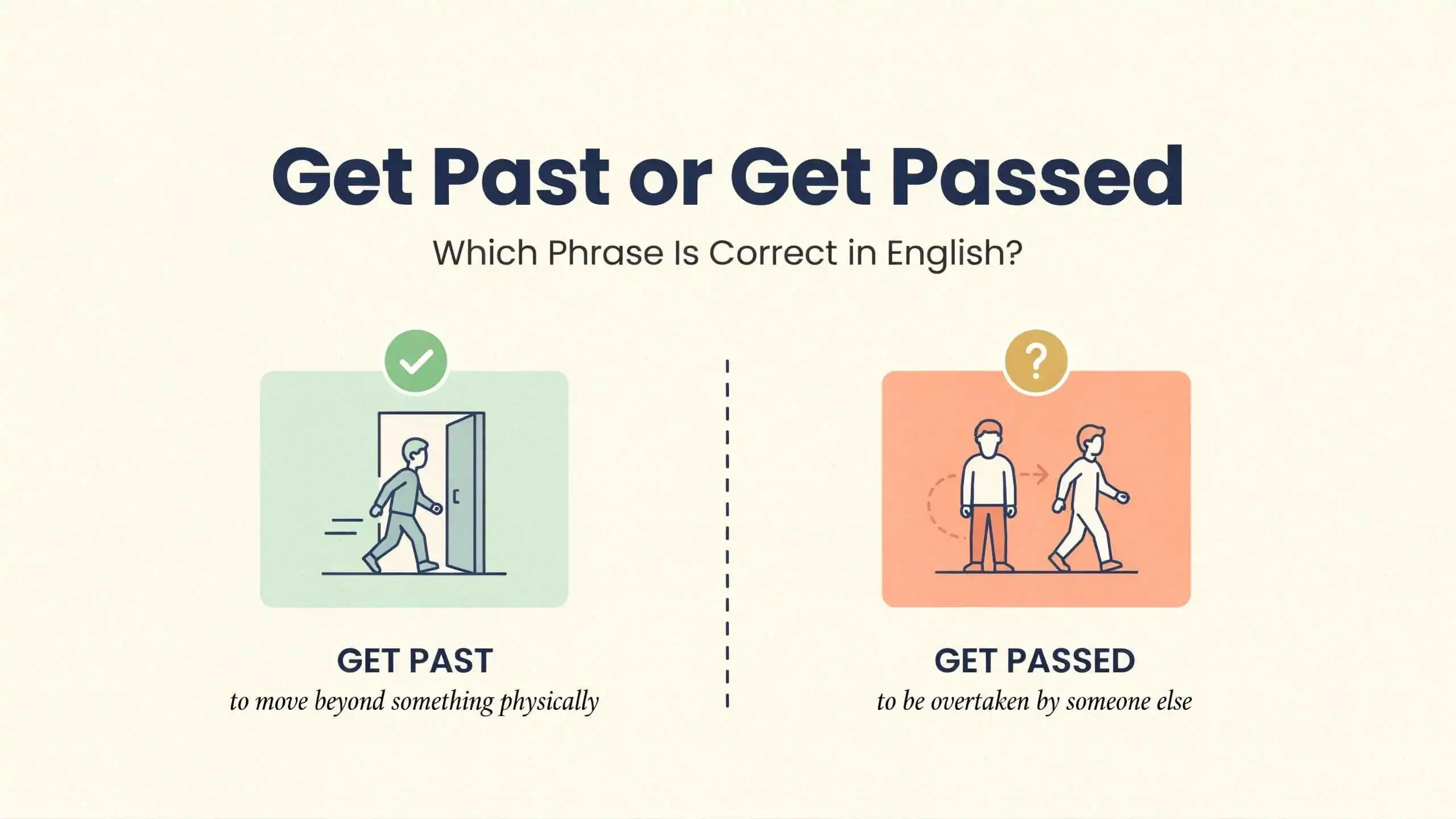
Get past or get passed is one of the most confusing grammar questions in English because both phrases sound identical but have completely different meanings. The correct answer depends on context: “get past” is usually correct when you mean to overcome or move beyond something, while “get passed” is only correct when someone or something moves in front of you or something is handed to you in a passive action.
In simple terms, if you are asking “get passed or get past”, the safe and most common choice in everyday English is get past. However, get passed or get past both exist in grammar, and understanding their difference is essential for writing correct English sentences. Variations like get pass or get past, getting passed or past, and get passed or get past are commonly searched because learners struggle with this homophone pair.
Quick Answer: Get Past or Get Passed?
The fastest way to understand this is:
- Get past = correct for “overcoming or moving beyond something”
- Get passed = correct for “being overtaken or receiving something”
So in most cases, especially in exams, writing, or everyday English:
👉 You should use “get past”
Examples:
- I can’t get past this level. ✅
- He got passed by another runner. ✅
- I can’t get passed this level. ❌ (incorrect in most contexts)
This is why most people searching get past or get passed, get passed or get past, or get pass or get past are usually looking for the same answer: “get past” is the correct default choice.
AI Summary Overview: Get Past vs. Get Passed
The confusion between these two terms comes from their similar pronunciation, but their meanings are completely different in English grammar.
In most cases, you should use “get past” because it describes overcoming obstacles, moving beyond something, or progressing forward in life, emotions, or physical situations.
- When to use “Get Past”: Focuses on progress, healing, or overcoming challenges.
- Example: “I need to get past this problem” or “She got past her fear.”
- Example: “I walked past the shop” (here, it works as a preposition showing movement beyond a point).
- When to use “Get Passed”: Used only when something or someone moves in front of you, overtakes you, or transfers an item to you.
- Example: “He got passed by another runner” (being overtaken in sports or traffic).
- Example: “The note got passed around the class” (an item being physically transferred).
Moreover, many learners confuse these phrases because they rely on sound instead of meaning. However, the rule is simple: use the form with ‘t’ when you mean overcoming, and use the ‘-ed’ form when you mean an action of passing or being overtaken.
Overall, English speakers use the first phrase far more often in emotional, academic, and daily contexts. Meanwhile, the passive variant remains limited to specific situations. Therefore, if you want to write correctly and naturally, focus on “get past” as your default choice and only switch to the alternative when the sentence clearly involves being overtaken or handed something.
What Does “Get Past” Mean?
The phrase get past is a phrasal verb that means to move beyond something physically, emotionally, or mentally. It is the most commonly used form in modern English.
Physical Meaning of Get Past
This refers to moving from one place to another:
- I couldn’t get past the security guard.
- She managed to get past the traffic jam.
- We need to get past the locked gate.
Figurative or Emotional Meaning of Get Past
This is very common in daily communication:
- He cannot get past his fear of failure.
- She is trying to get past her breakup.
- I need to get past this anxiety.
In these cases, get past = overcome, recover, or move forward emotionally.
Synonyms of Get Past
To improve SEO relevance and semantic depth, here are related LSI terms:
- overcome
- move beyond
- get through
- surpass
- progress forward
- recover from
- push through
What Does “Get Passed” Mean?
The phrase get passed is grammatically correct but has a very different meaning. It is a passive construction of the verb “pass.”
Meaning 1: Being Overtaken
- He got passed by three cyclists.
- The car got passed on the highway.
Here, someone or something moves ahead of you.
Meaning 2: Receiving Something
- She got passed a note in class.
- He got passed the ball during the match.
This meaning is often used in sports or communication contexts.
Key Insight
Unlike get past, the phrase get passed is NOT used for overcoming challenges. That is why confusion happens when people search:
- get passed or get past
- getting passed or past
- get pass or get past
They are often mixing two completely different grammatical ideas.
Past vs Passed: The Core Grammar Difference
Understanding past vs passed is the key to mastering this topic.
| Word | Type | Meaning | Example |
|---|---|---|---|
| Past | Preposition / Adverb / Noun / Adjective | Beyond, time before | I walked past the store |
| Passed | Verb (past tense of pass) | Moved by, transferred | He passed the exam |
Why They Are Confused
They are homophones, meaning they sound the same but are spelled differently and have different meanings.
This is the main reason people search:
- get past or get passed
- get passed or get past
- get pass or get past
- getting passed or past
Get Pass or Get Past: Which Is Correct?
Many users mistakenly search get pass or get past, but “get pass” is generally incorrect in standard English.
- ❌ get pass the exam
- ✅ get past the exam
Important Rule: If you are using “get” as a verb, the correct structure is almost always get past, not “get pass.”
Getting Passed or Past: Which Is Correct?
Another common confusion is getting passed or past.
Correct Usage:
- I am getting past this difficulty. ✅
- I am getting passed by other runners. ✅
Incorrect Usage:
- I am getting past by others. ❌
- I am getting passed this problem. ❌
The difference depends entirely on whether you mean:
- Overcoming something → get past
- Being overtaken → get passed
Is it Get Passed or Get Past?
Understanding get past or get passed is important because both sound the same but have very different meanings. In most everyday situations, “get past” is correct, while “get passed” is only used in specific passive situations like sports or movement.
Is it get passed or get past?
First of all, the correct phrase depends on meaning. However, in most cases, “get past” is the right choice.
- ✅ I can’t get past this problem. (correct)
- ❌ I can’t get passed this problem. (incorrect)
Moreover, “get past” means to overcome or move beyond something, whether physically or emotionally. On the other hand, “get passed” means someone or something moves ahead of you or something is given to you.
Therefore, if you are unsure, always prefer get past, because it is the most commonly used form in English.
Is it I walked past or I walked passed?
This is one of the most common grammar mistakes. The correct sentence is:
- ✅ I walked past the shop.
- ❌ I walked passed the shop.
In addition, “past” here works as a preposition, meaning “by” or “beyond.” However, “passed” is a verb (past tense of pass) and cannot be used in this structure.
So, whenever you describe movement like walking, going, or running by something, always use past, not passed.
What does get past it mean?
The phrase “get past it” means to recover from something emotionally or mentally and move forward.
For example:
- She is trying to get past it after the breakup.
- He needs time to get past it and focus again.
Furthermore, it is often used in emotional or psychological contexts. In simple words, it means “stop letting something affect you and move on.”
In conclusion, it is a phrase used for healing, recovery, and emotional progress.
Timeframe or Time Frame: Which Is Correct? (Complete Grammar Guide)
Learn the spelling rules, regional differences, and real-world examples.
Is it get past me or get passed me?
Both can be correct, but the meaning changes completely depending on context.
- ✅ He tried to get past me in the crowd. (correct)
- ❌ He tried to get passed me in this context. (incorrect)
However:
- ✅ He got passed me in the race. (passive sports context, less common in this exact structure)
Most importantly, “get past me” is used when someone is trying to move beyond or bypass you, while “get passed me” is generally incorrect in standard grammar usage.
Therefore, in most everyday sentences, get past me is the correct and natural choice.
When should I use get past?
You should use get past whenever you mean:
Overcoming something
- I need to get past my fear.
Moving beyond a physical object
- I couldn’t get past the gate.
Emotional recovery
- She is trying to get past her trauma.
Additionally, get past is widely used in both formal and informal English, making it the safest and most natural option in writing and speaking.
In summary, if your meaning is “overcome” or “move beyond,” then get past is always the correct choice.
Is get passed by ever correct?
Yes, “get passed by” is grammatically correct, but it is used in specific situations only.
✔ Correct usage examples:
- I got passed by a fast car.
- He got passed by two runners.
Here, it means someone or something moved ahead of you.
However, it is important to note that:
- It is mostly used in sports, traffic, or movement contexts
- It is NOT used for emotional or abstract situations
Therefore, while it is correct, it is limited in usage compared to get past, which is much more common in everyday English.
When Is “Get Passed” Correct?
Sports Context
- He got passed in the final lap.
- The striker got passed the ball.
Traffic Context
- I got passed by a speeding car.
Communication Context
- The message got passed along quickly.
However, these are specific cases only, unlike get past, which is widely used.
Get Past vs Get Passed Comparison Table
| Situation | Correct Phrase | Example |
|---|---|---|
| Overcoming fear | Get past | I got past my anxiety |
| Physical barrier | Get past | Get past the door |
| Being overtaken | Get passed | I got passed by a runner |
| Receiving object | Get passed | I got passed a note |
This table is important for featured snippet optimization.
Common Mistakes with Get Past or Get Passed
Many learners make predictable mistakes:
❌ I can’t get passed this level
✔ I can’t get past this level
❌ Nothing gets passed you
✔ Nothing gets past you
❌ I want to get pass this problem
✔ I want to get past this problem
These errors occur because learners confuse verb structure and homophones.
Memory Trick to Remember the Difference
Here is an easy rule:
✔ Passed = Action
Something happened to you or you received something.
✔ Past = Position
You move beyond something.
Simple formula: If you mean “overcome,” always use past.
Why People Confuse Past and Passed
This confusion happens because:
- They are homophones
- Spoken English sounds identical
- Both are common in daily usage
- Grammar rules are not always taught clearly
This is why searches like:
- get past or get passed
- get pass or get past
- getting passed or past are extremely common.
Real-Life Usage Examples
Get Past Examples
- I can’t get past this emotional pain.
- She finally got past her fear of public speaking.
- We need to get past this misunderstanding.
Get Passed Examples
- He got passed by two competitors.
- The note got passed around the classroom.
- I got passed the microphone during the event.
Advanced Insight: Grammar Breakdown
Get Past
- “Get” = verb
- “Past” = preposition/adverb
- Function = phrasal verb (overcome or move beyond)
Get Passed
- “Get” = auxiliary verb
- “Passed” = past participle of pass
- Function = passive voice construction
This explains why both exist but are not interchangeable.
British vs American English Usage
There is no major difference between UK and US English for this grammar rule.
However:
- Both prefer get past for overcoming situations
- Both use get passed in sports or passive contexts
Why “Get Past” Is More Common
Data from usage patterns shows:
- “Get past” is used in emotional, academic, professional, and daily contexts
- “Get passed” is limited to specific actions
So in SEO and writing, get past dominates search intent.
Frequently Asked Questions (FAQs)
Is it get past or get passed?
In most cases, get past is correct.
Can you say get passed?
Yes, but only when someone is overtaking you or giving you something.
What is the difference between past and passed?
“Past” refers to position or time, while “passed” is a verb meaning moved or transferred.
Is “nothing gets past you” correct?
Yes, it is correct and commonly used.
Is “I can’t get past this level” correct?
Yes, it is the most natural usage.
Is “get pass” correct?
No, it is grammatically incorrect in standard English.
Conclusion
Understanding get past or get passed is essential for mastering English grammar because it involves homophones, verb structures, and contextual meaning. In most situations, get past is the correct and preferred choice, especially when expressing overcoming obstacles, emotions, or challenges.
On the other hand, get passed is only correct in passive situations, such as sports, traffic, or receiving something.
To summarize:
- Use get past → overcoming something
- Use get passed → being overtaken or receiving something
If you remember this simple rule, you will never confuse get past or get passed, get passed or get past, or getting passed or past again.