
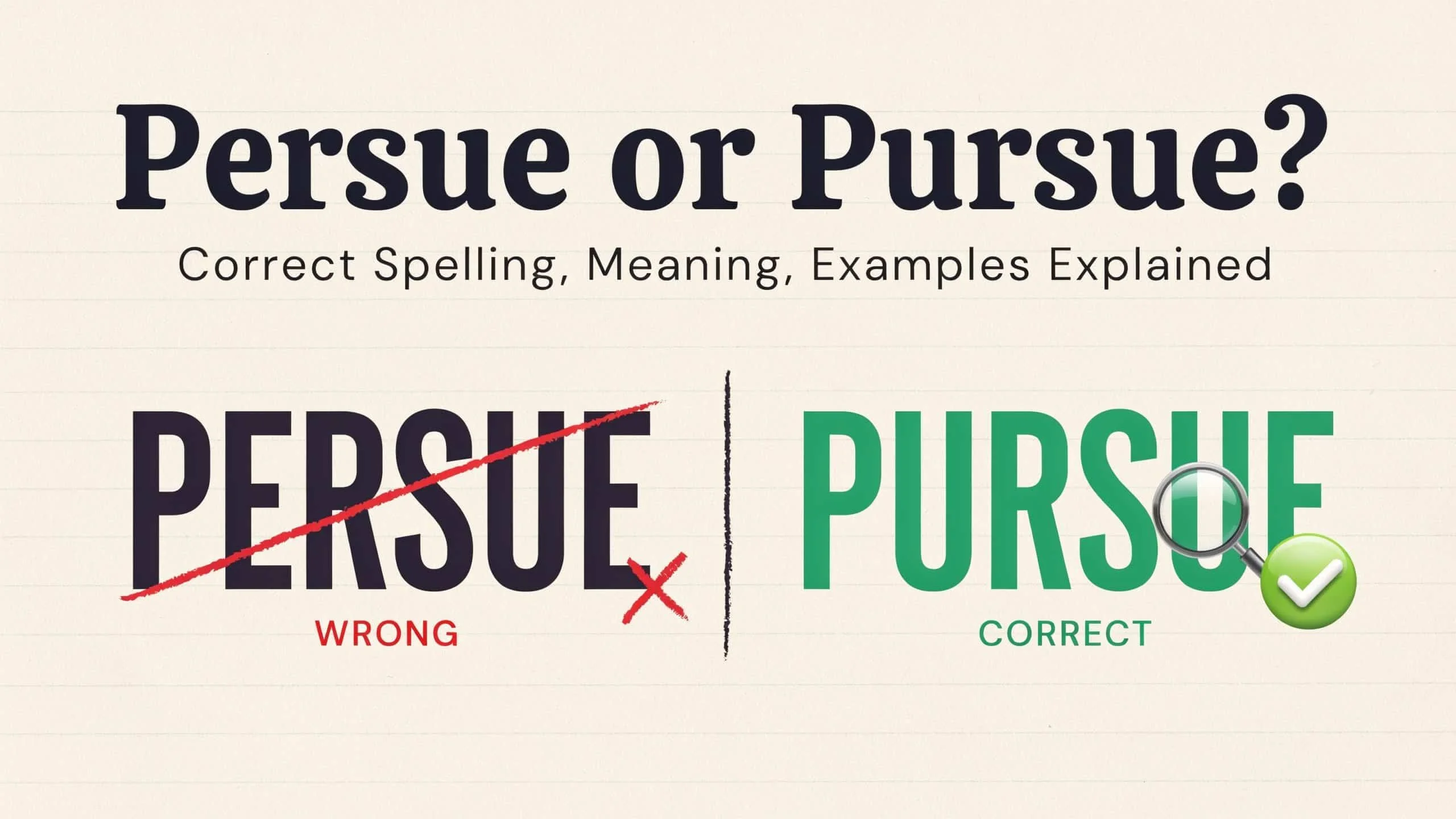
Quick Answer: Persue or Pursue? The correct spelling is pursue. Persue is not a correct English word—it’s a common misspelling. Whether you’re writing an essay, email, business document, or social media post, you should always use pursue. Likewise, pursuing is correct, while persuing is incorrect.
Persue or Pursue is one of the most common spelling questions in the English language. If you ever wondered if you should write pursue or persue, here’s the answer. The correct spelling is pursue. Persue is a common misspelling of pursue.
Many English learners and even native speakers write persuing or pursuing or search for pursuing or persuing accidentally because English spelling doesn’t always follow predictable patterns. Luckily, once you understand the rule that governs the word, it’s much easier to remember it.
AI Summary
If you’re wondering whether Persue or Pursue is the correct spelling, the answer is simple. Pursue is the only correct English word, and persue is a common misspelling that has no meaning in the standard English. Pursue is a verb meaning to follow, seek, strive for or work toward a goal, opportunity, career, dream or objective. Similarly, the correct present participle is pursuing, not persuing.
A guide to the difference between pursue and persue, with meaning, pronunciation, verb forms, examples, common misspellings, and comparison to similar words such as peruse and persuade. It also contains handy memory aids, grammar tips and real-world examples to help you use pursue correctly and confidently in academic, professional and everyday writing.
Persue or Pursue: Which One Is Correct?
The correct spelling is pursue.
The word persue does not exist in standard English dictionaries and should never be used in formal or informal writing.
| Word | Correct? | Meaning |
|---|---|---|
| Pursue | ✅ Yes | To follow, seek, chase, or work toward something |
| Persue | ❌ No | Incorrect spelling |
Whenever you’re talking about following a dream, chasing a goal, seeking knowledge, or continuing a career path, the correct word is always pursue.
Remember: If you’re unsure whether it’s persue or pursue, always choose pursue.
Pursue or Persue: Is There Any Difference?
Many people ask whether pursue or persue have different meanings.
The answer is no.
There isn’t a difference because persue is simply a misspelling of pursue.
For example:
❌ I want to persue higher education.
✅ I want to pursue higher education.
Similarly,
❌ She decided to persue her dreams.
✅ She decided to pursue her dreams.
Only pursue should appear in your writing, whether it’s academic, professional, or personal.
Is “Persue” a Real English Word?
No.
Persue is not a recognized English word.
Major dictionaries classify pursue as the correct spelling.
People usually write persue because:
- They pronounce the word quickly.
- English contains many confusing vowel combinations.
- Typing errors happen frequently.
- Similar-looking words create confusion.
This is why persue remains one of the most common English spelling mistakes.
What Does Pursue Mean?
The meaning of pursue depends on the context, but it generally means to follow, seek, continue, or strive toward something.
It can describe both physical and abstract actions.
For example:
- Pursue a career
- Pursue your dreams
- Pursue justice
- Pursue happiness
- Pursue higher education
- Pursue opportunities
- Pursue knowledge
Simple Definition
Pursue means to work toward achieving something or to follow someone or something.
Formal Definition
To continue or carry out an activity, objective, investigation, career, ambition, or goal with determination.
How Do You Pronounce Pursue?
The pronunciation of pursue is:
/pərˈsuː/
Phonetically:
per-SOO
The stress falls on the second syllable.
Many learners mistakenly pronounce it as “per-sue” with equal emphasis, but the second syllable should receive the stronger stress.
Why Do People Misspell Pursue?
The word pursue contains the vowel combination ue, which many writers accidentally reverse.
Instead of writing:
pursue
they write:
persue
This happens because English contains many irregular spelling patterns.
Another reason is that our brains tend to spell words the way they sound.
Persuing or Pursuing: Which Is Correct?
Another common spelling question is persuing or pursuing.
The correct spelling is pursuing.
Persuing is incorrect.
| Word | Correct? |
|---|---|
| Pursuing | ✅ |
| Persuing | ❌ |
Examples:
✅ She is pursuing a medical degree.
✅ They are pursuing new opportunities.
❌ He is persuing success.
Pursuing or Persuing: Why Does the Spelling Stay the Same?
Many learners think the spelling changes when -ing is added.
It doesn’t.
The base word pursue keeps its spelling pattern.
Correct:
- pursue
- pursuing
- pursued
- pursues
Incorrect:
- persuing
- pursueing
Verb Forms of Pursue
| Verb Form | Example |
|---|---|
| Base Form | pursue |
| Third Person | pursues |
| Present Participle | pursuing |
| Past Tense | pursued |
| Past Participle | pursued |
Understanding these forms improves both professional writing and academic English.
Coliseum or Colosseum – Difference, Meaning, Spelling & Complete Guide
Learn the spelling rules, regional differences, and real-world examples.
Examples of Pursue in Sentences
Career
She decided to pursue a career in software engineering.
Education
Many students pursue higher education after graduation.
Business
Successful entrepreneurs continually pursue new opportunities.
Everyday Conversation
You should always pursue your dreams despite obstacles.
Legal Context
The police continued to pursue the investigation.
Common Phrases with Pursue
Some of the most common collocations include:
- Pursue success
- Pursue happiness
- Pursue justice
- Pursue excellence
- Pursue knowledge
- Pursue your dreams
- Pursue opportunities
- Pursue a career
- Pursue a degree
- Pursue research
- Pursue innovation
- Pursue financial freedom
Using these naturally strengthens both your vocabulary and writing style.
How to Remember the Correct Spelling of Pursue
A simple memory trick is:
“You pursue with UE.”
Notice the last two letters:
…UE
Think of:
“You pursue your dreams.”
Because the word you contains “u”, it can help you remember the correct ending.
Another easy technique is to read the word several times in context rather than memorizing it alone.
Research on language learning shows that words learned within meaningful sentences are easier to remember than isolated vocabulary.
Synonyms of Pursue
Depending on the context, pursue can be replaced with:
- Seek
- Chase
- Follow
- Strive
- Aim for
- Go after
- Continue
- Work toward
- Attempt
- Accomplish
Each synonym carries a slightly different nuance, so choose the one that best fits your sentence.
Antonyms of Pursue
The opposite of pursue includes:
- Abandon
- Avoid
- Ignore
- Neglect
- Quit
- Stop
- Give up
Knowing antonyms helps expand your vocabulary and improves communication.
What Does Persue Mean?
Persue has no meaning because it is not a real English word. It is simply a common misspelling of pursue.
The correct word, pursue, means to follow, seek, strive for, or work toward a goal, dream, career, opportunity, or objective. For example, you can pursue higher education, pursue a career, or pursue your dreams.
If you accidentally write persue, replace it with pursue to ensure your writing follows standard English spelling.
How Do You Use Pursue in a Sentence?
Since persue is an incorrect spelling, it should never be used in a sentence. Instead, always use pursue.
Here are some correct examples:
- She decided to pursue a career in medicine.
- They will pursue every opportunity for growth.
- He wants to pursue higher education abroad.
- The detective continued to pursue the investigation.
- Never stop trying to pursue your dreams.
These examples show that pursue can be used in academic, professional, legal, and everyday contexts.
5 Examples of Pursue in Sentences
Here are five simple examples that demonstrate the correct usage of pursue:
- Sarah plans to pursue a degree in computer science after high school.
- The company continues to pursue innovative business opportunities worldwide.
- You should always pursue your goals with confidence and determination.
- The police pursued the suspect until he was safely arrested.
- Many people pursue happiness by maintaining a healthy work-life balance.
These examples highlight the different meanings of pursue, including following a goal, seeking opportunities, continuing an investigation, and striving for personal success.
Pursue vs Peruse
These words often confuse learners.
| Pursue | Peruse |
|---|---|
| To chase or seek | To read or examine carefully |
Examples:
- She decided to pursue a new career.
- He perused the report before the meeting.
Although the spellings look similar, the meanings are completely different.
Pursue vs Persuade
Another commonly confused pair is pursue and persuade.
| Pursue | Persuade |
|---|---|
| Follow or work toward something | Convince someone |
Examples:
- She wants to pursue medicine.
- He tried to persuade her to stay.
Origin and History of Pursue
The word pursue comes from the Old French poursuivre, which traces back to the Latin prosequi, meaning to follow after.
Over time, English adopted the spelling pursue, and it has remained the accepted standard in both American English and British English.
Understanding a word’s origin often makes it easier to remember its spelling.
Common Grammar Mistakes
Here are mistakes you should avoid:
| Incorrect | Correct |
|---|---|
| Persue | Pursue |
| Persuing | Pursuing |
| Pursueing | Pursuing |
| Persued | Pursued |
Proofreading your writing helps eliminate these common errors.
American vs British English
Good news—there is no spelling difference between American and British English.
Both use:
- Pursue
- Pursuing
- Pursued
Only the pronunciation may vary slightly depending on regional accents.
Quick Case Study
Imagine two students submitting scholarship applications.
Student A writes:
“I want to persue higher education.”
Student B writes:
“I want to pursue higher education.”
Although both students have the same intention, the second sentence demonstrates correct English spelling, stronger attention to detail, and better writing quality. Small spelling differences like this can influence first impressions in academic and professional settings.
Frequently Asked Questions
Is persue correct?
No. Persue is a misspelling. Always use pursue.
What is the difference between persue or pursue?
There is no difference in meaning because persue is not a valid English word. Pursue is the only correct spelling.
How do you spell pursuing?
The correct spelling is pursuing. Persuing is incorrect.
Is persuing or pursuing correct?
Always use pursuing.
Can pursue mean “chase”?
Yes. Depending on the context, pursue can mean to chase, follow, seek, or strive toward something.
Is pursue a verb?
Yes. Pursue is a regular verb with the forms pursues, pursuing, and pursued.
Key Takeaways
- Pursue is the correct spelling.
- Persue is an incorrect spelling.
- Pursuing is correct, while persuing is incorrect.
- Pursue means to follow, seek, strive for, or work toward a goal.
- It is commonly used in education, careers, business, law, and everyday communication.
- Learning the correct spelling improves your English grammar, writing skills, and professional communication.
Conclusion
If you’ve ever been unsure whether to write Persue or Pursue, the answer is clear: pursue is the only correct spelling in standard English. Whether you’re writing about pursuing higher education, pursuing a career, or pursuing your dreams, using the correct form reflects strong language skills and attention to detail.
Remember the simple rule: “You pursue with UE.” Keep practicing the word in real sentences, and you’ll naturally avoid common mistakes like persue, persuing, or pursueing. By understanding its meaning, pronunciation, verb forms, and usage, you’ll be able to use pursue confidently in both everyday conversations and professional writing.