
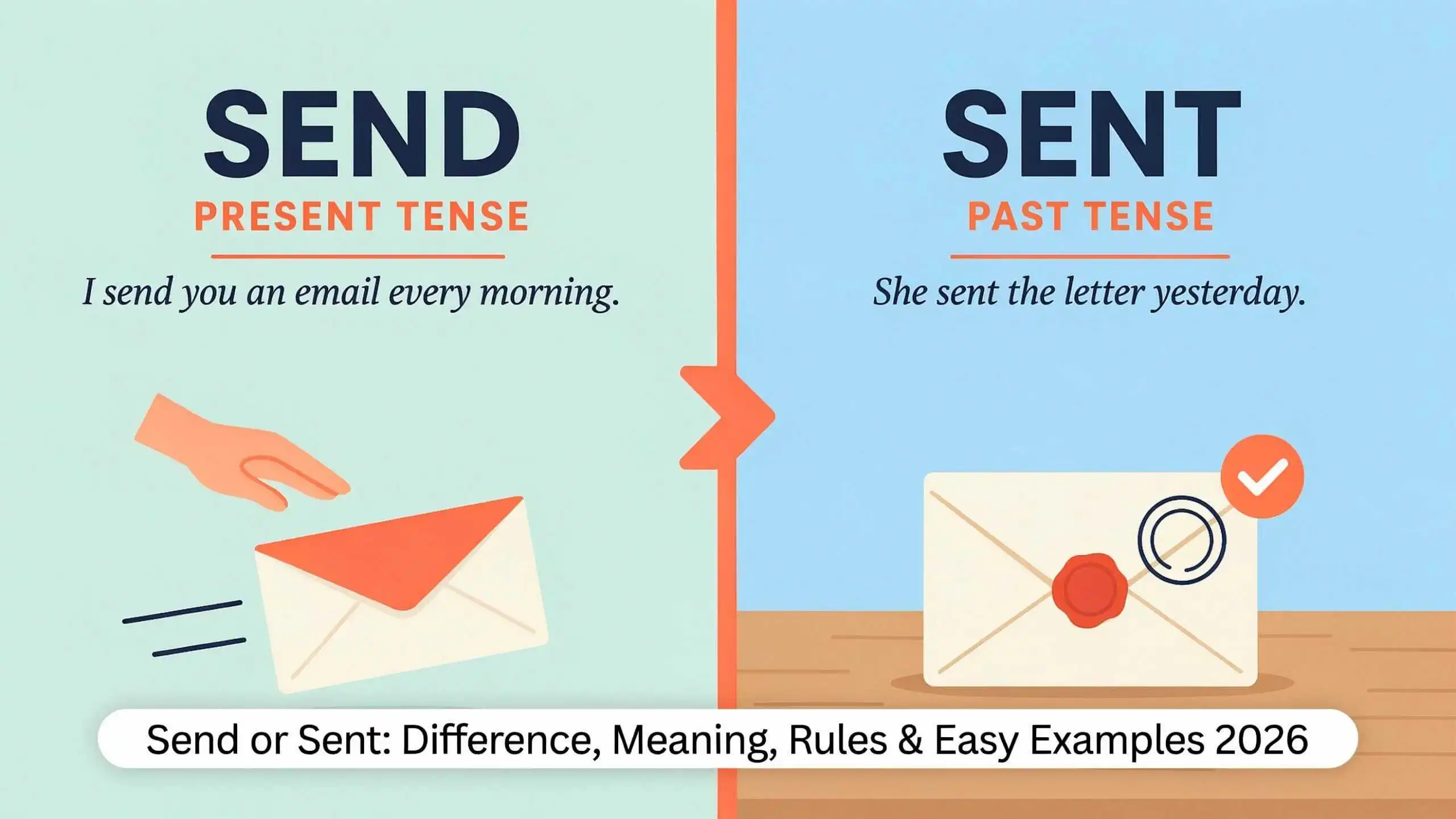
Send or Sent is one of the most common grammar confusions in English. The simple answer is:
“Send” is present tense, while “Sent” is the past tense and past participle of the verb “send.”
So, if you are talking about something happening now or in the future, you use send. If the action already happened, you use sent.
For example:
- I will send you the email today.
- I sent you the email yesterday.
This confusion between send vs sent is very common among English learners, students, and even professionals. In this guide, we will fully explain the sent and send difference, provide examples, tables, and simple rules so you never make mistakes again.
AI Summary Overview: Send or Sent
The confusion between send or sent is a common English grammar issue for learners, especially in writing and speaking. The main rule is simple: the first form is used for present and future actions, while the latter is the past tense and past participle of the verb.
In short, if the action is happening now or will happen later, use the present form. If the action is already completed, use the past variant. For example, “I send emails daily” refers to a habit, while “I sent the email yesterday” refers to a completed action.
Many mistakes happen when learners use incorrect forms like “sended” or mix tenses such as “I already send,” which is incorrect. The correct form is always “I already sent.” Similarly, after modal verbs like “can you,” the base form is required, so “Can you please send me the file?” is correct, not the past tense.
The verb is also irregular, meaning it does not follow the standard “-ed” rule for past tense verbs. Its correct forms across different tenses are send, sends, sending, and sent. Understanding these grammatical forms helps avoid common errors.
Overall, mastering both terms improves clarity, correctness, and confidence in English communication, especially in emails, messages, and professional writing.
What Is the Difference Between Send and Sent?
The main sent vs send difference is related to verb tense.
- Send → Present or future action
- Sent → Completed action in the past
This is why understanding send vs sent grammar rules is important for correct English usage.
Quick Comparison Table
| Word | Tense | Meaning | Example |
|---|---|---|---|
| Send | Present / Future | To deliver or transfer something | I send messages daily |
| Sent | Past / Past Participle | Already delivered or transferred | I sent the message yesterday |
This simple table explains the full sent and send difference in the easiest way.
What Does “Send” Mean?
The word send is a base verb used for actions happening now or in the future.
Definition of Send
To cause something to go or be taken to a place, especially by mail, message, or communication.
When to Use Send
You use send when:
- Talking about present actions
- Talking about future plans
- Giving instructions or commands
Examples of Send
- I send emails every morning.
- She will send the documents tomorrow.
- Please send me your details.
In all these examples, the action is not completed yet, which is why send grammar usage is in present/future form.
What Does “Sent” Mean?
The word sent is the past tense and past participle of send.
Definition of Sent
It means something has already been delivered, transferred, or communicated.
When to Use Sent
You use sent when:
- The action already happened
- Talking about completed communication
- Using perfect tenses
Examples of Sent
- I sent the email yesterday.
- She has sent the invitation.
- They had sent the package before noon.
This is why sent meaning always relates to completed actions.
Send vs Sent: Grammar Rules Explained
Understanding grammar rules is the key to mastering send or sent usage.
1. Send (Present Tense Rule)
Use send when:
- Action is happening now
- Action will happen in the future
Example:
- I send reports every week.
2. Sent (Past Tense Rule)
Use sent when:
- Action already happened
Example:
- I sent the report last week.
3. Sent as Past Participle
Used with helping verbs:
- has sent
- have sent
- had sent
Examples:
- She has sent the application.
- They had sent it before the deadline.
Verb Forms of Send
| Verb Form | Word |
|---|---|
| Base Form | send |
| Third Person | sends |
| Present Participle | sending |
| Past Tense | sent |
| Past Participle | sent |
👉 Notice: “sended” is incorrect English.
Is “Sended” a Correct Word?
No, sended is NOT correct English.
The correct past tense of send is sent, not sended.
Common mistake:
- ❌ I sended the email
- ✅ I sent the email
Why Is Send an Irregular Verb?
The verb send is irregular because it does not follow the standard “-ed” rule.
Normally:
- Walk → Walked
- Talk → Talked
But:
- Send → Sent (irregular)
This is why learners often struggle with sent vs send difference.
When Should You Use Send?
Use send in the following situations:
Present Actions
- I send messages daily.
Future Actions
- I will send the file tomorrow.
Requests or Instructions
- Please send your ID.
When Should You Use Sent?
Use sent when talking about completed actions.
Completed Actions
- I sent the message yesterday.
Present Perfect
- I have sent the email.
Past Perfect
- I had sent the document before the meeting.
Sent vs Send in Different Tenses
Understanding tenses helps master send vs sent difference.
- Simple Present: I send emails
- Simple Past: I sent emails
- Present Perfect: I have sent emails
- Past Perfect: I had sent emails
- Future: I will send emails
Realest or Realist? Meaning, Difference, and Correct Usage Explained
Learn the spelling rules, regional differences, and real-world examples.
Common Expressions Using Send and Sent
Here are real-life examples of send and sent usage:
- Send an email
- Send a message
- Send a letter
- Send a package
- Sent by courier
- Sent via email
- Sent through WhatsApp
These phrases are commonly used in daily communication.
Real-Life Examples of Send and Sent
Workplace Example
- I send daily reports to my manager.
- I sent the report before the deadline.
Student Example
- I send assignments online.
- I sent my homework yesterday.
Business Example
- We send invoices every month.
- We sent the contract last week.
Practice: Choose Send or Sent
Fill in the blanks:
- I ___ the email yesterday.
- She will ___ the file tomorrow.
- They have ___ the package.
Answers:
- sent
- send
- sent
Which is correct, send or sent?
Both are correct, but they are used in different situations.
- Send is used for present and future actions.
- Sent is used for past actions (already completed).
So:
- I send messages every day. (present habit)
- I sent the message yesterday. (past action)
👉 Simple rule: Send = Now/Future, Sent = Past
Is it correct to say “I sent you”?
Yes, “I sent you” is grammatically correct, but it is usually incomplete on its own.
You should always add what you sent:
✔ I sent you an email. ✔ I sent you a message. ✔ I sent you the file.
❌ I sent you. (sounds incomplete)
👉 “Sent” needs an object to be complete.
Can you please send or sent?
The correct form is:
✔ Can you please send…?
Because you are asking someone to do something in the present or future.
Examples:
- Can you please send me the file?
- Can you please send the details?
❌ Can you please sent me the file? (incorrect grammar)
👉 After “can you please,” always use the base form: send
Which is correct, I already send or I already sent?
The correct sentence is:
✔ I already sent it.
❌ I already send it. (wrong tense)
Explanation:
- “Already” refers to a completed action
- So we must use past tense sent
👉 Correct usage:
- I already sent the email.
- I already sent the document.
Is “I sent it” correct?
Yes, “I sent it” is completely correct.
It means the action is finished in the past.
Examples:
- I sent it yesterday.
- I sent it this morning.
- I sent it to your email.
👉 This is one of the most commonly used correct forms of sent.
Is it re-send or re-sent?
The correct form depends on tense:
✔ Re-send = present or future action ✔ Re-sent = past action
Examples:
Re-send
- Please re-send the file.
- I will re-send the email.
Re-sent
- I re-sent the message yesterday.
- He has re-sent the document.
👉 Rule:
- Re-send = base form
- Re-sent = past form
Common Mistakes With Send or Sent
Many learners make errors in sent vs send grammar:
- Using “sended” instead of sent
- Mixing present and past tenses
- Forgetting helping verbs in perfect tense
Incorrect:
- I have send the email
Correct:
- I have sent the email
Easy Trick to Remember Send vs Sent
Here is a simple memory trick:
- Send = Now / Next
- Sent = Past
If it already happened, use sent. If it is happening or will happen, use send.
Send vs Sent for ESL Learners
For English learners, this is a key grammar rule:
- Send = action not completed
- Sent = action completed
This is one of the most important differences in basic English grammar.
Frequently Asked Questions (FAQ)
What is the difference between send and sent?
Send is present tense, while sent is past tense.
Is it send or sent?
It depends on time. Present = send,
What is the past tense of send?
The past tense is sent.
Is sended correct?
No, sended is incorrect English.
Can I say “I have send”?
No, correct form is “I have sent.”
Is “I have sent” correct?
Yes, it is correct present perfect tense.
Quick Summary: Send or Sent
- Send = Present / Future
- Sent = Past / Completed action
- Sended = Incorrect
Conclusion
Understanding send or sent is essential for clear and correct English communication. The main sent and send difference is simple: use send for present or future actions and use sent for completed actions in the past.
Mastering send vs sent will improve your grammar, writing skills, and confidence in English. With practice and examples, you will never confuse send vs sent grammar rules again.
Final Tip:
Always remember — if it’s done, it’s sent; if it’s happening, it’s send.