
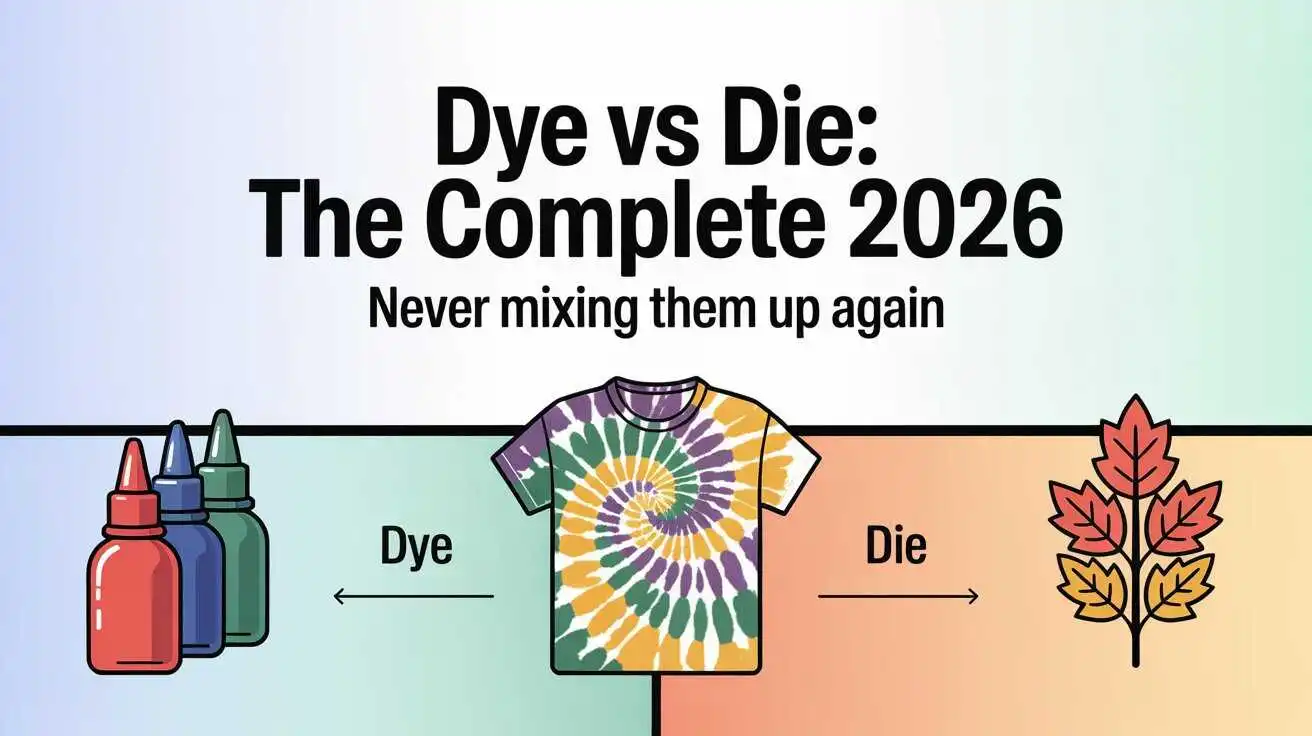
Dye vs Die You’re writing an important email. You pause. Did you just almost write “I died my hair” instead of “I dyed my hair”? You’re not alone. This is one of the most common spelling mistakes in English, and it happens to everyone — students, professionals, even native speakers.
The difference between dye and die is simple once you know the rule, but the confusion is real because they sound exactly the same.
Quick Answer: What’s the Difference?
Die means to stop living or cease existing (e.g., “Plants die without water”). Dye means to change the color of something using pigment (e.g., “She decided to dye her hair blue”). They are homophones with identical pronunciation (/daɪ/) but completely different meanings. Use dye for color, die for death.
That’s it. That’s the rule. But here’s the thing — knowing the rule and remembering it in the moment are two different things. Let’s break this down so you never mix them up again.
AI Overview: Die vs Dye in 2026
Die and dye are homophones that sound identical (/daɪ/) but have opposite meanings. Die refers to death, cessation of life, the singular form of dice in gaming, or a manufacturing tool. Dye refers to coloring agents used to change the color of hair, fabric, or materials. The key distinction: color = dye (with a “y”), death = die (without a “y”). The present participle forms are dying (death) and dyeing (coloring), which is where most confusion occurs.
What Is the Difference Between Dye and Die? (Quick Rule)
Here’s what most people get wrong: they think these words are interchangeable in some contexts. They’re not. The difference between dye and die comes down to one thing: meaning.
Die = death, ending, cessation of life
Dye = color, staining, changing appearance
Die vs Dye in one sentence: Use die when talking about death or ending, and use dye when talking about color or staining.
| Feature | Die | Dye |
|---|---|---|
| Meaning | To stop living, end existence | To change color using pigment |
| Part of Speech | Verb (mostly) | Noun and Verb |
| Example | “The plant will die without water” | “She will dye her shirt red” |
| Present Participle | Dying | Dyeing |
| Past Tense | Died | Dyed |
| Common Contexts | Death, gaming (dice), manufacturing | Hair, fabric, clothing, DIY |
See the pattern? Color = Dye (with “y”), Death = Die (without “y”).
Let’s make this stick.
Die vs Dye: How Do You Pronounce These Words?
What Is the Die vs Dye Pronunciation?
Ready for the frustrating part? The die vs dye pronunciation is identical. Both words are pronounced /daɪ/ — they rhyme with “eye,” “sky,” and “buy.”
This is why they’re called homophones: same sound, different spelling, different meaning.
| Word | IPA Pronunciation | Rhymes With |
|---|---|---|
| Die | /daɪ/ | Eye, sky, fly |
| Dye | /daɪ/ | Eye, sky, fly |
In spoken English, there’s no way to tell them apart by sound. You have to rely on context.
Why Do People Confuse These Words in Speech?
People confuse die and dye in speech because they sound exactly the same. If someone says “I’m going to do it to my hair,” you don’t know if they mean “die” or “dye” until they finish the sentence.
Here’s the expert tip: In spoken English, listen for context clues. If you hear “hair,” “fabric,” “color,” or “shirt” → it’s dye. If you hear “life,” “death,” “plant,” or “engine” → it’s die.
READ MORE >>> Carrer or Career? Which Spelling Is Correct in 2026?
When Do You Use Die? (Death, Gaming, Manufacturing)
Most people think die only means death. That’s true 90% of the time, but there are two other meanings you need to know.
What Does Die Mean When Talking About Death?
Die means to cease living, to pass away, or to end life. This applies to humans, animals, plants, and even metaphorically to machines or systems stopping function.
Examples:
- “The plant will die without water”
- “The old dog will die soon”
- “The engine died on the highway”
- “The company died in 2020″
Past tense: died
Present participle: dying
Mini Case Study: The College Essay Mistake
A student applied for a $10,000 scholarship. In their essay, they wrote: “My grandmother taught me that flowers dye without water.” They meant die. The admissions committee marked it as a critical spelling error. The student didn’t get the scholarship. A $10,000 mistake for one letter.
This isn’t exaggeration. In academic and professional writing, spelling matters.
What Is a Die in Gaming? (Singular of Dice)
In gaming, a die is the singular form of dice. One die, multiple dice. This is standard board game and tabletop RPG terminology.
Examples:
- “Roll a die to start the game”
- “I need one more die for this board game”
- “The die landed on six”
Table: Gaming Terminology
| Term | Meaning | Example |
|---|---|---|
| Die | Singular of dice | “Roll a die” |
| Dice | Plural of die | “Roll the dice” |
| D20 | 20-sided die | “I rolled a natural 20” |
Here’s what most people miss: Gamers are extremely particular about this. Write “dice” when you mean one cube, and you’ll get corrected immediately.
What Is a Die Tool in Manufacturing?
In manufacturing, a die is a specialized tool used to cut, shape, or stamp metal and other materials. This is the rarest usage but appears in industrial contexts.
Examples:
- “The steel die cut the metal sheets”
- “Die casting uses a mold die”
- “The factory replaced the worn die“
Expert Tip: If you see “die” in a factory or metalworking context, it’s the tool meaning — not death or gaming. This usage is technical and industry-specific.
When Do You Use Dye? (Hair, Fabric, Coloring)
Dye always relates to color. If you’re talking about changing the color of something, you’re talking about dye.
What Does Dye Mean for Hair Coloring?
Dye means to change the color of hair using chemical pigment. The past tense is dyed and the present participle is dyeing.
Examples:
- “She decided to dye her hair blue”
- “I dyed my hair last week”
- “She is dyeing her hair today”
Common Mistake Callout:
Wrong: “I died my hair”
Right: “I dyed my hair”
This mistake happens constantly. People write “died” because that’s the past tense of “die,” but dye has its own past tense: dyed.
What Materials Can You Dye?
You can dye fabric, clothing, hair, wood, leather, eggs, and paper. Dye works on porous materials that absorb pigment.
Examples:
- “Dye your shirt red”
- “Easter egg dyeing tradition”
- “Tie-dye curtains for your room”
- “Wood dye for furniture”
Table: Common Dyeing Contexts
| Material | Example Sentence | Past Tense |
|---|---|---|
| Hair | “She will dye her hair” | “She dyed her hair” |
| Fabric | “I’ll dye this shirt” | “I dyed this shirt” |
| Wood | “He dyed the table” | “He dyed the table” |
| Eggs | “We dye eggs at Easter” | “We dyed eggs” |
Dyeing vs Dying vs Dieing: Which Is Correct?
This is where the real confusion happens. Most tutorials skip this, but you need to know it.
What Is the Difference Between Dyeing and Dying?
Dyeing is the present participle of dye (adding color). Dying is the present participle of die (ceasing life). The extra “e” in dyeing keeps the “y” from the root word.
Examples:
- “She is dyeing her hair” (coloring)
- “The plant is dying” (losing life)
Table: Dyeing vs Dying
| Word | Root Word | Meaning | Example |
|---|---|---|---|
| Dyeing | Dye | Adding color | “She is dyeing her shirt” |
| Dying | Die | Losing life | “The plant is dying” |
Memory trick: Keep the “e” in dyeing because you’re keeping the color.
Is Dieing a Real Word?
Dieing is a rare word that means cutting or stamping with a die tool in metalworking. It is NOT used for death or coloring — that’s a spelling error.
Expert Tip: 99% of the time, “dieing” is a typo. Use dying for death or dyeing for color. If you see “dieing” in a document, it’s almost certainly wrong.
Mini Case Study: The $5,000 Brochure Mistake
A marketing agency printed 10,000 brochures. The text said “care for dieing plants” instead of “dying plants.” The client caught the error after printing. The agency ate the $5,000 cost and lost the client. One spelling mistake, one missing “e,” and five grand gone.
British vs American English: Does Spelling Change?
Is There a Difference Between British and American English for Die and Dye?
No. The spelling of die and dye is identical in British and American English. Both regions use the same rules for these words.
Table: British vs American Usage
| Region | Spelling | Example |
|---|---|---|
| British | Die / Dye | “The plant will die” |
| American | Die / Dye | “The plant will die” |
No exceptions. No regional variations. The rule is universal.
Common Mistakes When Using Die and Dye
What Are the 5 Most Common Die vs Dye Mistakes?
The 5 most common mistakes are: 1) writing “die” when you mean color, 2) writing “dye” when you mean death, 3) confusing dying/dyeing, 4) using “dieing” incorrectly, 5) mixing up past tense (died vs dyed).
Here they are with corrections:
- Wrong: “I will die my hair” → Right: “I will dye my hair”
- Wrong: “Plants dye without water” → Right: “Plants die without water”
- Wrong: “She is dieing” → Right: “She is dying” or “She is dyeing“
- Wrong: “I died my shirt” → Right: “I dyed my shirt”
- Wrong: “The died plant” → Right: “The dead plant”
Here’s what most people get wrong: They think “die” can mean color in some contexts. It cannot. Ever.
Real-World Stakes: When Does This Mistake Cost You?
Can a Spelling Mistake Really Cost You a Job?
Yes. A spelling mistake between die and dye can cost you a job interview, client trust, or professional credibility — especially in writing-intensive roles.
Mini Case Study: The Marketing Agency Rejection
A marketing agency rejected a candidate whose resume said “I specialize in dying brands” instead of “I specialize in designing brands.” The hiring manager thought it was unprofessional. The candidate never got the interview. Another candidate with the same experience but better spelling got the job.
Three Real-World Scenarios:
- College essay rejection: Spelling “die” instead of “dye” in a creative writing piece
- Client email embarrassment: Writing “I’ll die your logo blue” instead of “dye“
- Social media post gone viral: A brand posted “Our shirts won’t dye” when they meant “fade” — and the internet roasted them
Memory Trick: How to Remember the Difference Forever
What Is The Color-Y Rule for Remembering Die vs Dye?
The Color-Y Rule is simple: If it has a “y,” it’s for color. Dye has a “y” → dye is for color. Die has no “y” → die is for death.
Memory Palace Tip: Think of yellow hair dye — the “y” in dye connects to yellow.
What Is the 3-Second Test for Choosing Die or Dye?
Ask yourself: “Am I talking about color or death?” If color → use dye. If death → use die. This 3-second question eliminates 99% of mistakes.
Die vs Dye in Context: Example Sentences
What Are 10 Correct Examples of Die and Dye in Sentences?
Here are 10 correct examples showing both words in real context. Each example clearly demonstrates the proper usage.
Table: 10 Correct Examples
| Sentence | Word Used | Why It’s Correct |
|---|---|---|
| “The flowers will die without rain” | Die | Talking about death |
| “She bought blue hair dye“ | Dye | Coloring agent |
| “Roll a die to start” | Die | Gaming cube |
| “I dyed my curtains green” | Dyed | Past tense of dye |
| “The company died in 2020″ | Died | Past tense of die |
| “She is dyeing her hair today” | Dyeing | Present participle of dye |
| “The plant is dying“ | Dying | Present participle of die |
| “This die is made of steel” | Die | Manufacturing tool |
| “Dye this shirt red” | Dye | Command to color |
| “Without water, plants die“ | Die | Death without water |
Frequently Asked Questions (Die vs Dye)
Are Dye and Die Homophones?
Yes, dye and die are homophones. They are pronounced identically (/daɪ/) but have completely different spellings and meanings.
Which Word Is Used for Hair Coloring?
Use dye for hair coloring. Examples: “I will dye my hair,” “hair dye,” “I dyed my hair last week.”
Is “Die My Hair” Correct?
No, “die my hair” is incorrect. The correct phrase is “dye my hair” because you are changing color, not ending life.
What Is the Present Participle of Die and Dye?
The present participle of die is dying (for death). The present participle of dye is dyeing (for coloring). The extra “e” keeps the “y” in dyeing.
Can Die Ever Mean Color?
No, die can never mean color. Die always means death, the singular of dice, or a manufacturing tool. Use dye for any coloring context.
What Is the Past Tense of Die and Dye?
The past tense of die is died. The past tense of dye is dyed. They sound the same but are spelled differently.
Conclusion: The One-Sentence Rule for Die vs Dye
Here’s the truth: you will forget this rule if you don’t use it. But if you remember one thing, let it be this.
The one-sentence rule is: Color = Dye (with “y”), Death = Die (without “y”). If you remember nothing else, remember this and you’ll never mix them up again.
Before you send that important email, ask yourself the 3-second question: “Am I talking about color or death?” If color → dye. If death → die.
Bookmark this page. Test yourself before sending important emails. And when you catch yourself about to write “I died my hair,” you’ll thank yourself for learning this now instead of later.
Your future self will appreciate it.