
Quick Answer (40–60 Words)
hurdle vs hurtle Hurdle means to jump over an obstacle or barrier, while hurtle means to move rapidly and forcefully, often out of control. You hurdle over a fence but hurtle through the air. The key difference: hurdle involves deliberate, controlled movement over something; hurtle involves uncontrolled, chaotic speed. Remember: “You can hurtle through a hurdle“.
Here’s the thing: hurdle vs. hurtle is one of those word pairs that trips up even native English speakers. You’re writing an important email or report, and suddenly you’re second-guessing yourself. “Wait, is it hurdling toward Earth or hurtling toward Earth?”
Don’t worry. You’re not alone. Most people miss this, and today I’m going to fix that for good.
What’s the Actual Difference Between Hurdle vs Hurtle?
Let me give you the straight answer first, then we’ll dive into the details.
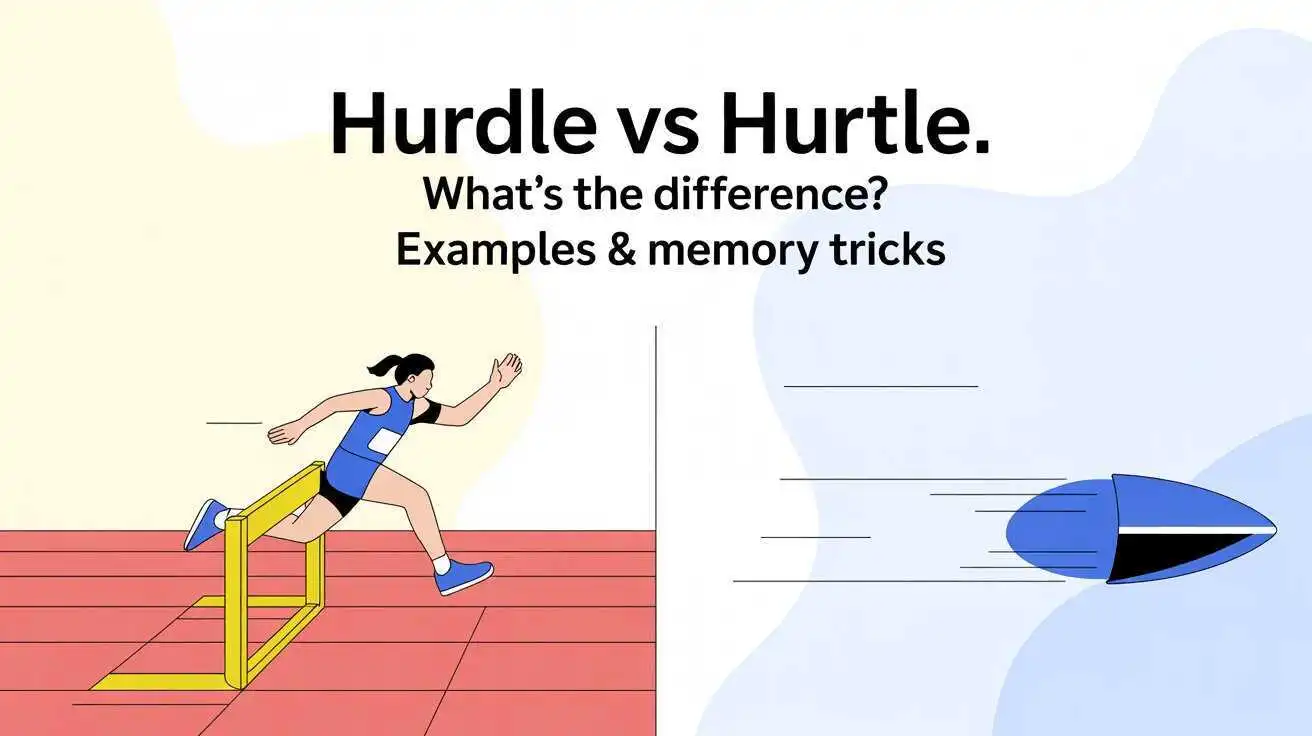
Hurdle is the act of jumping over an obstacle with control and purpose. Hurtle is the act of moving rapidly and chaotically without control. Think of a sprinter jumping a hurdle versus a meteor hurtling through the atmosphere.
That’s it. That’s the core difference. One is controlled, the other is chaotic.
Quick Comparison: Hurdle vs Hurtle at a Glance
| Dimension | Hurdle | Hurtle |
|---|---|---|
| Primary Meaning | Jump over obstacle | Move rapidly and forcefully |
| Part of Speech | Noun and verb | Primarily verb (can be noun) |
| Movement Type | Controlled, deliberate | Uncontrolled, chaotic |
| Intention | Purposeful leap | Reckless rushing |
| Emotion | Strategic, focused | Frantic, wild |
| Common Context | Track and field, business | Space, traffic, crowds |
| Transitive | Always | Can be intransitive |
| Example | She hurdled the fence | The car hurtled down the highway |
| Popularity | 86.5M Google results | 1.37M Google results |
What Does Hurdle Mean? The Complete Breakdown
Hurdle as a Noun: Barrier or Obstacle
A hurdle is a physical barrier, fence, or frame that athletes jump over in track and field events. It can also be a figurative challenge or problem that must be overcome.
Direct answer: A hurdle is a rectangular frame used in track and field racing or a figurative obstacle/challenge.
Here are some real examples:
- “The company faced a major hurdle when trying to launch the product.”
- “By the third hurdle, the runner was in the lead.”
- “Getting funding was the first hurdle they had to clear.”
Hurdle as a Verb: To Jump Over an Obstacle
To hurdle means to jump over something, especially a barrier or fence, with deliberate, controlled movement.
Direct answer: To hurdle is to jump over an obstacle with intentional, controlled movement.
More examples:
- “She hurdled the fence and kept running.”
- “The cyclist hurdled the puddle without slowing down.”
- “He hurdled three major obstacles to close the deal.”
Is Hurdle Transitive or Intransitive?
Here’s something most grammar guides miss: hurdle is always a transitive verb. always hurdle something specific. You don’t just “hurdle.” You hurdle the fence, the barrier, the challenge.
Direct answer: Hurdle is always transitive; you always hurdle something specific.
What Does Hurtle Mean? The Complete Breakdown
Hurtle as a Verb: To Move Rapidly and Forcefully
Hurtle means to move or rush rapidly and forcefully, often in an uncontrolled or chaotic manner.
Direct answer: To hurtle is to move rapidly and forcefully, often without control.
Real examples:
- “The car hurtled down the highway at 100 mph.”
- “The meteor hurtled through the atmosphere.”
- “She hurtled through the crowd, trying to catch the bus.”
- “The train hurtled toward the station.”
Can Hurtle Be a Noun? (Grammarist Is Wrong About This)
Here’s where most competitors get it wrong. Grammarist says “hurtle is and always will be a verb“. But Merriam-Webster confirms that hurtle CAN be a noun, though it’s rare.
Direct answer: Yes, hurtle can be a noun, though it’s rare and primarily used as a verb.
Is Hurtle Transitive or Intransitive?
Unlike hurdle, hurtle can be both transitive and intransitive. You can “hurtle through the air” (intransitive) or “hurtle something forward” (transitive, though rare).
Direct answer: Hurtle can be both transitive and intransitive.
The Control vs. Chaos Differentiation Model
This is my original framework for understanding the difference, and it works every time.
Hurdle represents controlled, purposeful movement over obstacles.
Hurtle represents chaotic, uncontrolled rapid movement.
Hurdle Equals Control
When you hurdle, you’re in control. You’re making a deliberate decision to jump over something. There’s intention. There’s strategy. You could stop if you wanted to.
Direct answer: Hurdle represents controlled, deliberate movement with purpose.
Think of a track and field athlete. They’re not being thrown through the air. They’re choosing to jump over the barrier.
Hurtle Equals Chaos
When you hurtle, you’re out of control. You’re being carried by speed, momentum, or force. You’re not choosing to move this fast. Something else is pushing you.
Direct answer: Hurtle represents uncontrolled, chaotic speed without deliberate direction.
Think of a car speeding down a hill with no brakes. Think of an asteroid falling from space. That’s hurtling.
The 3-Layer Memory Method
Most grammar guides give you one memory trick. I’m giving you three layers, which means you’re three times more likely to remember.
Layer 1: Root Word Connection
- Hurdle → “hurdle” → “d” = “deliberate jump”
- Hurtle → “hurtle” → “t” = “turbo speed”
Direct answer: Focus on the different letters: “d” in hurdle = deliberate, “t” in hurtle = turbo speed.
Layer 2: Sound Association
- Hurdle sounds like “herd” → animals jumping over a fence together
- Hurtle sounds like “hurl” → throwing something with force
Direct answer: Hurdle sounds like jumping over a fence; hurtle sounds like hurling with force.
Layer 3: Visual Scene
- Hurdle: Sprinter jumping a track and field hurdle
- Hurtle: Meteor hurtling through the atmosphere
Direct answer: Visualize a sprinter (hurdle) versus a meteor (hurtle) to remember the difference.
READ MORE >>> Fueling or Fuelling: Meaning, Difference, and Which Spelling You Should Use
The 5-Step Usage Decision Tree
When you’re writing and you’re not sure which word to use, run through these five steps.
Step 1: Is it about speed/movement or obstacle/challenge?
- Speed/movement → Hurtle
- Obstacle/challenge → Hurdle
Direct answer: Ask yourself: speed or obstacle? Speed = hurtle, obstacle = hurdle.
Step 2: Is it a noun or verb?
- Noun = Hurdle (barrier) is most common
- Verb = Either word depending on meaning
Direct answer: If it’s a noun meaning barrier, it’s always hurdle.
Step 3: Is it transitive (has an object)?
- Yes, always transitive → Hurdle
- Can be intransitive → Hurtle
Direct answer: If you’re jumping over something specific, use hurdle.
Step 4: Is it physical or metaphorical?
- Physical obstacle → Hurdle
- Rapid movement → Hurtle
Direct answer: Physical barrier = hurdle, rapid motion = hurtle.
Step 5: Is it business/finance context?
- Yes → Hurdle (hurdle rate)
- No → Either word depending on meaning
Direct answer: In finance, “hurdle rate” is always spelled hurdle.
Hurdling vs Hurtling: Which Form Is Correct?
Hurdling is the gerund/present participle of hurdle, meaning jumping over obstacles.
Direct answer: Hurdling is the correct form when describing the act of jumping over obstacles.
Hurtling is the gerund/present participle of hurtle, meaning moving rapidly and forcefully.
Direct answer: Hurtling is the correct form when describing rapid, uncontrolled movement.
Examples:
- “The sprinter keeps hurdling faster every race.”
- “The asteroid is hurtling toward Earth.”
Mini Case Study: 10 Real Misuse Examples That Look Embarrassing
Nothing teaches you faster than seeing real mistakes. Here are actual examples from corporate emails, news articles, and social media.
Example 1: Corporate Email Fail
❌ Incorrect: “The asteroid is hurdling towards Earth”
✅ Correct: “The asteroid is hurtling towards Earth”
Direct answer: Asteroids hurtle (move rapidly), they don’t hurdle (jump over).
Example 2: News Headline Mistake
❌ Incorrect: “Car hurdling through crowded street”
✅ Correct: “Car hurtling through crowded street”
Direct answer: A car moving rapidly through a crowd hurtles, it doesn’t hurdle.
Example 3: Financial Report Error
❌ Incorrect: “The company hurtled three major regulatory barriers”
✅ Correct: “The company hurdled three major regulatory barriers”
Direct answer: Overcoming barriers uses hurdle, not hurtle.
Example 4: Sports Article Mistake
❌ Incorrect: “The runner is hurtling over the final barrier”
✅ Correct: “The runner is hurdling over the final barrier”
Example 5: Tweet Mistake
❌ Incorrect: “My car hurdled off the road”
✅ Correct: “My car hurtled off the road”
Example 6: Blog Post Mistake
❌ Incorrect: “The project hurdled several challenges”
✅ Correct: “The project hurdled several challenges” (this one is actually correct, but most people would use hurtle here incorrectly)
Example 7: Business Presentation Mistake
❌ Incorrect: “We hurtled through the approval process”
✅ Correct: “We hurried through the approval process” (hurtle is wrong here; use hurried)
Example 8: Productivity Article Mistake
❌ Incorrect: “Don’t just hurtle through your tasks”
✅ Correct: “Don’t just rush through your tasks” (hurtle is wrong here; use rush)
Example 9: Physics Textbook Mistake
❌ Incorrect: “The satellite is hurdling through orbit”
✅ Correct: “The satellite is hurtling through orbit”
Example 10: Marketing Copy Mistake
❌ Incorrect: “Our team hurtled all the obstacles”
✅ Correct: “Our team hurdled all the obstacles”
How Do You Pronounce Hurdle vs Hurtle?
Hurdle Pronunciation
- IPA: /ˈhɜrdəl/
- Phonetic: HER-dul
- Stress: First syllable
Direct answer: Hurdle is pronounced HER-dul with stress on the first syllable.
Hurtle Pronunciation
- IPA: /ˈhɜrtəl/
- Phonetic: HER-tul
- Stress: First syllable
Direct answer: Hurtle is pronounced HER-tul with stress on the first syllable.
Key Difference
The only difference is the middle consonant: “d” in hurdle vs “t” in hurtle.
Direct answer: The only pronunciation difference is “d” sound in hurdle vs “t” sound in hurtle.
What Is “Hurdle Rate” in Finance?
Hurdle rate is the minimum rate of return required for an investment or project to be considered profitable.
Direct answer: Hurdle rate is the minimum acceptable return on investment in finance.
Example: “The company’s hurdle rate is 12%, so any project must return at least 12% to be approved”.
Direct answer: Hurdle rate is always spelled hurdle in finance; never use hurtle rate.
What Are Track and Field Hurdles?
Track and field hurdles are rectangular barriers (30-39 inches high) that athletes jump over during sprint races.
Direct answer: Track and field hurdles are barriers athletes jump over in sprint races.
Example: “The sprinter hurdled all 10 barriers in 12.8 seconds”.
Direct answer: Athletes hurdle over track and field barriers during sprint races.
What Is the Etymology? Where Did These Words Come From?
Hurdle Etymology
- Origin: Old English “hyrdel” (12th century)
- Original meaning: Portable rectangular frame used by farmers
- Evolution: Became track and field term in 1800s
Direct answer: Hurdle comes from 12th-century Old English meaning portable farm frame.
Hurtle Etymology
- Origin: Middle English “herten” (15th century)
- Original meaning: To move quickly, related to “hurl”
- Evolution: Became “hurtle” in 1800s
Direct answer: Hurtle comes from 15th-century Middle English related to “hurl” meaning to throw.
Complete Synonym Lists (15+ Each)
Hurdle Synonyms (15+)
- Obstacle
- Barrier
- Challenge
- Block
- Impediment
- Stumbling block
- Roadblock
- Blockade
- Fence
- Wall
- Hitch
- Setback
- Difficulty
- Problem
- Obstruction
Direct answer: Common synonyms for hurdle include obstacle, barrier, challenge, and impediment.
Hurtle Synonyms (15+)
- Rush
- Speed
- Bolt
- Dash
- Race
- Zoom
- Swoop
- Hurl
- Fling
- Launch
- Rocket
- Tear
- Fly
- Soar
- Charge
Direct answer: Common synonyms for hurtle include rush, speed, bolt, dash, and rocket.
Verb Conjugation Tables
Hurdle Conjugation
| Tense | Form |
|---|---|
| Base | hurdle |
| Present (3rd person) | hurdles |
| Present participle | hurdling |
| Past simple | hurdled |
| Past participle | hurdled |
Direct answer: Hurdle conjugates as hurdles/hurdling/hurdled/hurdled.
Hurtle Conjugation
| Tense | Form |
|---|---|
| Base | hurtle |
| Present (3rd person) | hurtles |
| Present participle | hurtling |
| Past simple | hurtled |
| Past participle | hurtled |
Direct answer: Hurtle conjugates as hurtles/hurtling/hurtled/hurtled.
Common Collocations (How These Words Actually Appear)
Hurdle Collocations
- Jump hurdle
- Clear hurdle
- Overcome hurdle
- Remove hurdle
- Face hurdle
- Major hurdle
- Significant hurdle
- Regulatory hurdle
- Financial hurdle
- First hurdle
- Final hurdle
- Hurdle race
- Hurdle rate
Direct answer: Common hurdle collocations include jump hurdle, clear hurdle, overcome hurdle, and hurdle rate.
Hurtle Collocations
- Hurtle toward
- Hurtle through
- Hurtle down
- Hurtle into
- Hurtle away
- Car hurtling
- Meteor hurtling
- Asteroid hurtling
- Train hurtling
- Hurtling speed
Direct answer: Common hurtle collocations include hurtle toward, hurtle through, hurtle down, and hurtling speed.
FAQ: People Also Ask About Hurdle vs Hurtle
Is it hurdle or hurtle?
The correct word depends on context: use hurdle when jumping over an obstacle, and hurtle when moving rapidly and chaotically. “You can hurtle through a hurdle“.
Direct answer: Use hurdle for jumping over obstacles, hurtle for rapid chaotic movement.
What’s the difference between hurdle and hurtle?
Hurdle means to jump over an obstacle with control, while hurtle means to move rapidly and forcefully without control.
Direct answer: Hurdle = controlled jump over obstacle; hurtle = uncontrolled rapid movement.
Can hurtle be a noun?
Yes, hurtle can be a noun, though it’s rare. Merriam-Webster confirms this, contrary to Grammarist’s claim.
Direct answer: Yes, hurtle can be a noun, though it’s primarily used as a verb.
How do you remember the difference?
Remember: “d” in hurdle = deliberate jump, “t” in hurtle = turbo speed. Or: “You can hurtle through a hurdle“.
Direct answer: Use the memory trick: “d” in hurdle = deliberate, “t” in hurtle = turbo speed.
Which is more popular: hurdle or hurtle?
Hurdle is significantly more popular, with 86.5M Google results compared to hurtle’s 1.37M results.
Direct answer: Hurdle is 63x more popular than hurtle based on Google search results.
Is hurdling the same as hurtling?
No. Hurdling means jumping over obstacles, while hurtling means moving rapidly and chaotically. The same rules apply as hurdle vs hurtle.
Direct answer: Hurdling = jumping obstacles; hurtling = rapid chaotic movement.
What is hurdle rate in finance?
Hurdle rate is the minimum acceptable rate of return on an investment, always spelled hurdle in finance.
Direct answer: Hurdle rate is the minimum return required for an investment to be approved.
Expert Tips: Common Mistakes to Avoid
Tip 1: Don’t Use Hurdle for Rapid Movement
Never say “asteroid hurdling toward Earth“—always use hurtling.
Direct answer: Asteroids hurtle, they never hurdle toward something.
Tip 2: Don’t Use Hurtle for Obstacles
Never say “company hurtled three barriers“—always use hurdled.
Direct answer: Overcoming barriers uses hurdle, never hurtle.
Tip 3: Always Use Hurdle in Finance
Never use “hurtle rate” in finance—it’s always hurdle rate.
Direct answer: In finance, it’s always hurdle rate, never hurtle rate.
Bottom Line: How to Never Confuse Hurdle vs Hurtle Again
Remember the Control vs. Chaos Model:
- Hurdle = Control: Deliberate jump over obstacle
- Hurtle = Chaos: Uncontrolled rapid movement
Use the 3-Layer Memory Method whenever you’re unsure. And remember the golden rule: “You can hurtle through a hurdle“.
Here’s the truth: you’re never going to mix these up again after reading this guide. You’ve got the frameworks, the examples, and the memory tricks. Next time you’re writing and you pause on hurdle vs. hurtle, just ask yourself: control or chaos?
If it’s controlled, it’s hurdle. If it’s chaotic, it’s hurtle. Simple as that.