
Quick Answer
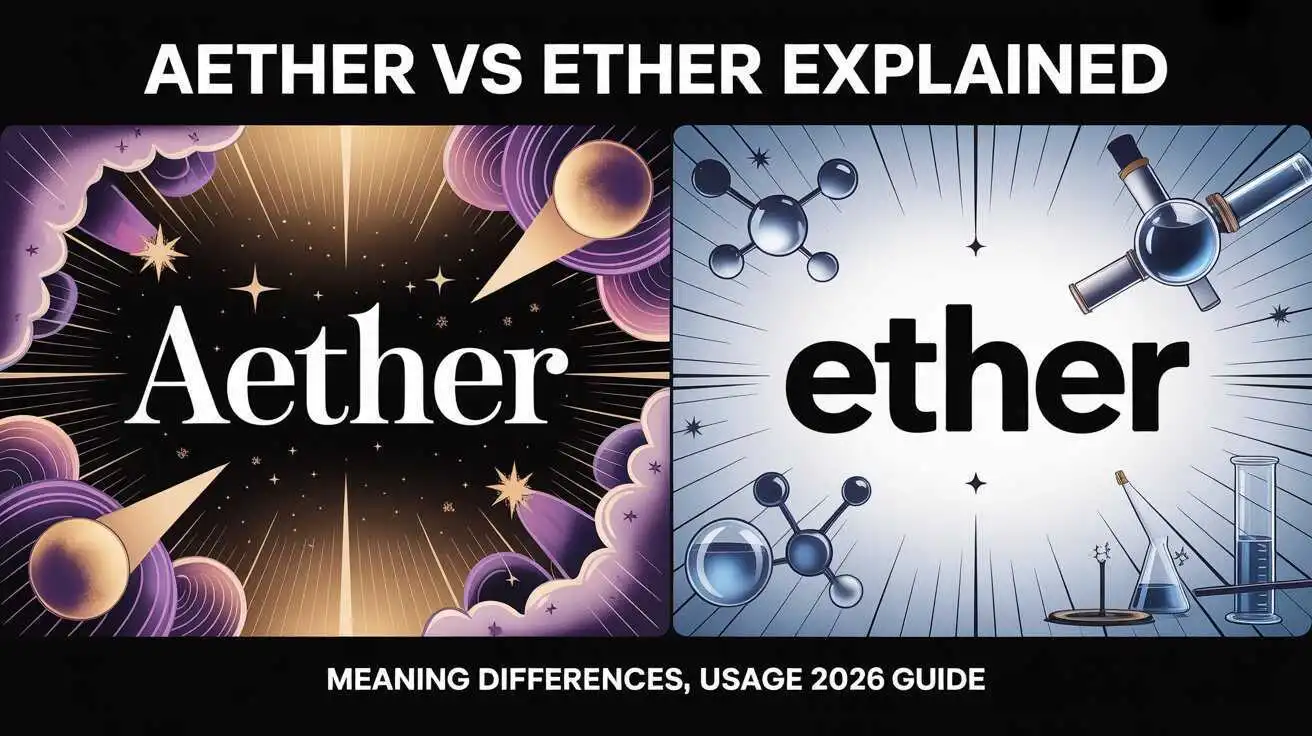
Aether vs ether refers to two words with the same ancient Greek origin but different modern uses. “Ether” is the standard modern spelling used in science, chemistry, and everyday English. “Aether” is mostly used in mythology, fantasy writing, and historical contexts. The meaning depends on tone, discipline, and context rather than a strict difference in definition.
AI Overview Summary
- Aether and ether come from the same Greek root (aithēr), meaning “upper air” or “pure sky.”
- “Ether” is the modern scientific and grammatical standard.
- “Aether” is used in mythology, philosophy, literature, and fantasy worlds.
- The scientific “ether theory” was replaced by Einstein’s relativity.
- Writers choose “aether” for mystical tone and “ether” for accuracy and modern clarity.
Aether vs Ether: What’s the Real Difference?
Here’s the thing most people think this is just a spelling issue. It’s not.
The difference between aether and ether is really about context, not meaning. Both words trace back to the same ancient idea: something pure, high, and invisible above the earth.
But over time, English split them into two different identities.
- Aether became the poetic, mythological, and fantasy version
- Ether became the scientific, modern, and practical version
Same root. Different worlds.
And that’s where most confusion begins.
What Does “Aether” Mean?
At its core, aether is an ancient concept.
It originally referred to the upper sky or heavenly substance in Greek philosophy. Think of it as the “pure air of the gods.”
Most people miss this part:
Aether was never just a word. It was a worldview.
Aether in mythology and philosophy
In ancient thinking:
- The sky wasn’t empty
- It was filled with a divine, pure substance
- That substance was called aether
Philosophers like Aristotle described it as the fifth element, beyond earth, water, fire, and air.
Why fantasy writers love “aether”
Fast forward to today, and you’ll see “aether” everywhere in fantasy games and novels.
Why?
Because it feels magical.
It carries:
- mystery
- elegance
- ancient energy vibes
For example:
- “Aether crystals power the kingdom”
- “She controlled raw aether energy”
Compare that to “ether energy” — it instantly feels more scientific and less magical.
That emotional difference is the key.
What Does “Ether” Mean?
Now let’s switch gears.
Ether is the modern, practical form of the word.
It shows up in science, chemistry, and historical physics.
Ether in chemistry
In chemistry, ether refers to a type of organic compound used in:
- solvents
- industrial processes
- chemical reactions
A common example is diethyl ether.
Ether in medicine
Before modern anesthesia techniques, ether was used to:
- numb patients
- perform surgeries
- reduce pain during operations
It played a major role in early medicine.
Ether in physics (historical concept)
Here’s where it gets interesting.
Scientists once believed in something called luminiferous ether.
The idea was:
Light needed a medium to travel through space.
But later experiments (like Michelson–Morley) showed this wasn’t true.
Einstein’s theory of relativity replaced the idea completely.
So today:
- ether in physics = historical concept only
READ MORE >>> Days or Day’s? Grammar Rules, Meaning, and Simple Examples You Can Use Instantly
Why Do Both Words Exist?
This is where language gets fascinating.
Both words come from the Greek “aithēr”, meaning upper air or pure sky.
Over time:
- Ancient Greek: aithēr
- Latin influence: aether
- Modern English simplified: ether
So the difference isn’t meaning.
It’s evolution.
Think of it like this:
One word stayed ancient and artistic. The other became modern and scientific.
Aether vs Ether: Simple Comparison Table
| Feature | Aether | Ether |
|---|---|---|
| Origin | Greek mythology | Greek root → modern science |
| Tone | Mystical, poetic | Scientific, technical |
| Usage today | Fantasy, literature | Chemistry, medicine |
| Status | Archaic/creative | Standard modern English |
| Example | Aether energy in games | Ether compound in labs |
Aether vs Ether in Real Life Usage
Let’s make this practical.
If you’re writing fantasy…
Use aether.
Example:
- “The mage absorbed pure aether from the sky.”
It sounds magical, ancient, powerful.
If you’re writing science or academics…
Use ether.
Example:
- “Diethyl ether is used as a solvent in laboratories.”
It sounds precise and correct.
If you mix them…
Here’s the mistake many beginners make:
Using “aether” in scientific writing
That can make your writing feel:
- outdated
- incorrect
- overly dramatic
Most people miss this nuance.
Aethereal vs Ethereal: A Common Confusion
Now let’s clear another related confusion.
These words look similar, but they are not equal in modern usage.
- Aethereal → archaic, rarely used today
- Ethereal → modern standard adjective
Meaning of ethereal
“Ethereal” means:
- light
- delicate
- heavenly
- almost unreal
Example:
- “She had an ethereal glow in the sunlight.”
Why “aethereal” disappeared
English gradually simplified spelling patterns.
So “aethereal” became:
- less common
- replaced by “ethereal”
Today, “aethereal” only appears in older literature or stylistic writing.
Mini Case Study: Why Ether Theory Disappeared from Science
This is where the story gets real.
In the 19th century, scientists believed in luminiferous ether.
They thought:
Space must be filled with a medium for light to travel.
But then came the Michelson–Morley experiment.
They tried to detect ether—but found nothing.
This changed everything.
Later:
- Einstein’s relativity explained light without ether
- The concept was abandoned in physics
So what happened to “ether”?
It didn’t disappear completely.
It shifted meaning:
- from physics theory → to chemistry compound
That’s a rare example of a word surviving even after a theory dies.
Why “Aether” Feels More Powerful Than “Ether”
Most people feel this instinctively, even if they can’t explain it.
Here’s why:
1. Letter structure
“Ae” looks ancient and elegant.
2. Cultural exposure
Fantasy media uses “aether” for magic systems.
3. Emotional tone
- Aether = imagination
- Ether = laboratory reality
This is called semantic emotional bias.
It’s not logical. It’s psychological.
And it heavily influences how writers choose words.
Common Mistakes People Make
Let’s clear a few misunderstandings.
Mistake 1: Thinking they are unrelated words
They are actually the same root word.
Mistake 2: Assuming “aether” is wrong
It’s not wrong—it’s just contextual.
Mistake 3: Using “ether” in fantasy writing
It can weaken the mystical tone.
Mistake 4: Thinking ether is only chemistry
It also has historical scientific meaning.
Which Should You Use: Aether or Ether?
This is the decision point most readers are looking for.
Use “aether” when:
- writing fantasy stories
- describing mythology
- building magical worlds
- creating poetic or artistic tone
Use “ether” when:
- writing science or academic content
- discussing chemistry
- using modern English standards
- aiming for clarity and correctness
Simple rule:
Aether belongs to imagination. Ether belongs to reality.
Real-Life Style Examples
Let’s see the difference in action.
Fantasy context
- “The hero absorbed aether from the ancient ruins.”
Scientific context
- “Ether compounds are used as solvents in chemistry.”
Mixed misuse example
- “Ether magic flows through the universe.” (sounds scientific, not fantasy)
This shows why context matters more than spelling.
What Most People Get Wrong About Aether vs Ether
Here’s the truth:
People assume this is a grammar issue.
But it’s actually a contextual language evolution issue.
The real difference is:
- how words evolved
- how culture shaped them
- how modern usage separated meaning by tone
Once you see that, the confusion disappears.
Frequently Asked Questions (Aether vs Ether)
Are ether and aether the same?
Yes and no. Aether and ether come from the same ancient Greek root, but they are not used the same way today. “Ether” is the modern standard term used in science, chemistry, and medicine. “Aether” is mostly used in mythology, philosophy, fantasy writing, or historical contexts. So they are historically connected, but contextually different in modern English.
What are the three forms of aether?
The idea of “three forms of aether” is not a strict scientific classification, but in philosophy and historical interpretations, aether is often discussed in three conceptual forms:
- Mythological aether – the pure upper sky or heavenly substance in ancient Greek belief
- Philosophical aether – Aristotle’s “fifth element” beyond earth, water, fire, and air
- Scientific aether (historical) – the outdated idea of luminiferous ether once thought to carry light waves
So the “three forms” are better understood as evolutionary stages of one concept, not separate substances.
What does aether mean?
Aether originally means the “upper air” or “pure, bright sky” in ancient Greek philosophy. It was believed to be the divine substance that filled the heavens above Earth. In modern usage, it often appears in fantasy stories or literature to represent mystical energy or celestial forces.
In simple terms:
Aether = ancient concept of a pure, heavenly substance above the physical world.
What is the aether in humans?
There is no scientific concept of “aether in humans.” However, in metaphysical, spiritual, and fictional interpretations, “aether in humans” is sometimes used to describe:
- life energy
- spiritual aura
- inner energy force
In reality, this is symbolic or philosophical language, not biological science. Human biology does not contain or require any form of aether.
Did Nikola Tesla believe in ether?
Nikola Tesla did reference and show interest in ideas similar to ether theories, especially the concept of a medium filling space. During his time, many scientists still debated whether “luminiferous ether” existed as a carrier for light and electromagnetic waves.
However:
- Tesla’s ideas were speculative and philosophical
- Modern physics (after Einstein’s relativity) rejected the need for ether
So, Tesla did not “prove” ether, but he explored ideas aligned with older scientific thinking before it was abandoned.
What kind of god is ether?
In Greek mythology, Aether (not Ether as a god in modern science) is the personification of the upper sky and pure light. Aether is not a traditional anthropomorphic god like Zeus or Poseidon, but a primordial deity representing the bright, pure air breathed by the gods.
In mythology:
- Aether = the divine upper atmosphere
- Associated with light, purity, and the heavens
- Part of early cosmic creation concepts
So, Aether is best understood as a cosmic force or primordial god rather than a human-like deity.
Final Conclusion
The debate of aether vs ether isn’t about right or wrong spelling.
It’s about how language evolved to serve different worlds.
One word stayed tied to:
- mythology
- imagination
- fantasy storytelling
The other moved into:
- science
- chemistry
- modern communication
So next time you see these words, don’t think “which one is correct?”
Think:
“What world am I trying to create—magic or science?”
That’s the real difference.