
Quick Answer
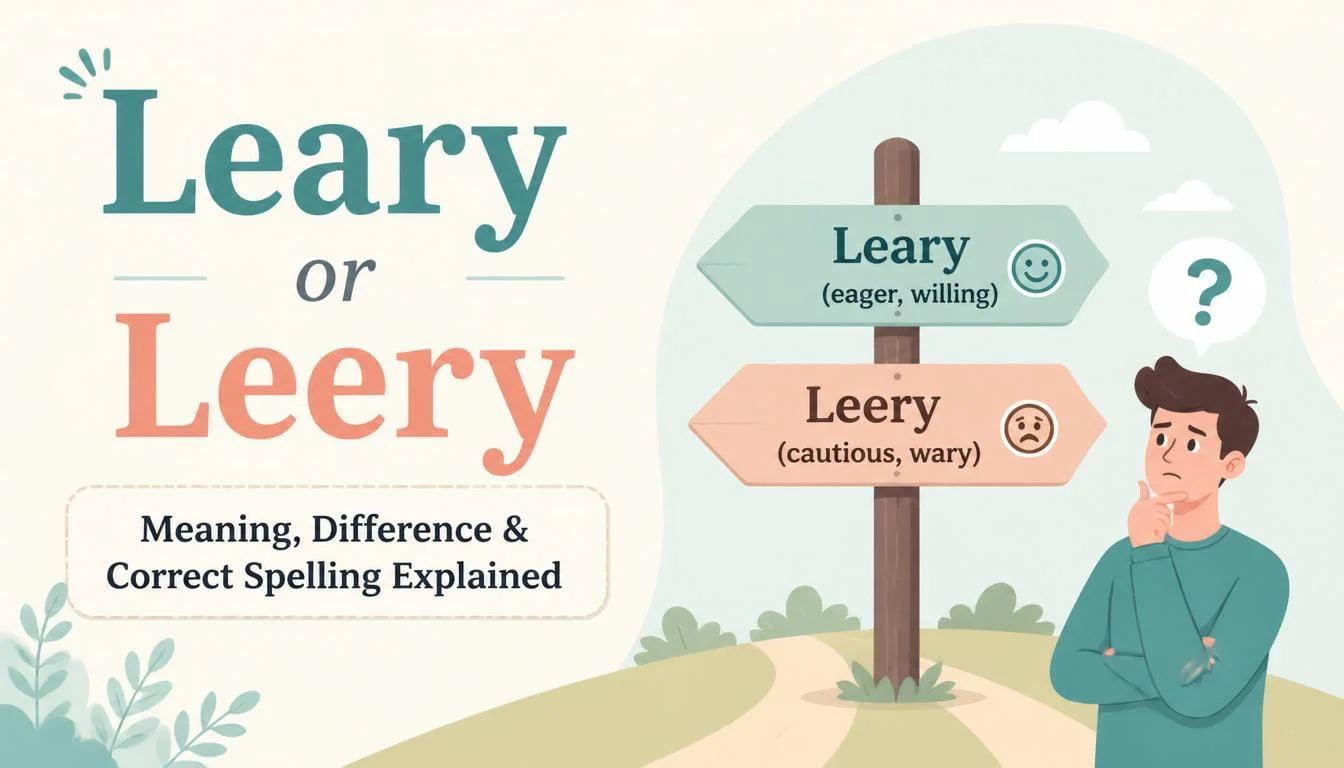
“Leary or Leery” Leery is the correct and widely accepted spelling in modern English. It means feeling cautious, suspicious, or doubtful about something. “Leary” is a less common variant that appears in informal usage or spelling mistakes. In professional writing, business communication, and academic work, “leery” is the safest and most credible choice.
AI Overview Summary
Leery means being cautious or suspicious of someone or something. The correct spelling is “leery,” while “leary” is an informal or nonstandard variation. Both are linked to the idea of distrust or hesitation, but only “leery” is recognized in standard English dictionaries. It is often confused with “wary” and “weary” due to similar pronunciation.
Leary or Leery: What Does It Actually Mean?
Let’s clear this up in the simplest way possible.
When people search leary or leery meaning, they’re usually stuck between two spellings that sound identical but don’t carry equal weight in English usage.
Here’s the truth:
“Leery” means suspicious, cautious, or not fully trusting something.
It describes that feeling you get when something just doesn’t feel right—but you can’t exactly prove it yet.
For example:
- You might be leery of online deals that look too good to be true
- Or leery of someone giving inconsistent information
Now here’s the key point most people miss…
The feeling behind the word is more important than the word itself.
It’s not just vocabulary—it’s human instinct captured in language.
Leery or Leary Definition (Simple Breakdown)
If you searched for leery or leary definition, here’s the clean version:
- Leery (adjective): feeling cautious or suspicious
- Leary: nonstandard spelling of leery, rarely used in formal writing
In plain English:
It’s the mental pause you take before trusting something.
Not fear. Not rejection. Just hesitation.
That small difference matters more than people realize.
Leary or Leery: Which One Is Correct?
Let’s settle this once and for all.
“Leery” is correct. “Leary” is not standard.
But here’s where it gets interesting…
You’ll still see “leary” online, especially in casual posts or older writing. That’s why people get confused.
Why this confusion exists:
- Both words sound identical
- People type what they hear
- Autocorrect sometimes reinforces mistakes
- Informal writing spreads the variant
Simple rule to remember:
If you’re writing anything serious—emails, essays, content—always use “leery.”
Why People Get Confused Between Leary or Leery
Here’s the thing…
English is full of words that sound the same but behave differently on paper.
And “leery” sits right in that confusion zone.
The real reasons behind the confusion:
1. Sound similarity “Leery” and “leary” are pronounced the same way in most accents.
2. Mental overlap with other words People also mix it with:
- wary (cautious)
- weary (tired)
3. Fast typing behavior Most people type based on sound, not spelling rules.
What most people miss:
This isn’t just a spelling issue—it’s a listening-to-writing translation problem.
READ MORE >>> Seemless vs Seamless: Which Spelling Is Correct and Why People Get Confused
Leery vs Wary vs Weary (The Confusion Nobody Explains Clearly)
Let’s break this down properly because this is where most content fails.
| Word | Meaning | Emotional Tone |
|---|---|---|
| Leery | suspicious, doubtful | distrust |
| Wary | careful, alert | caution |
| Weary | tired, exhausted | fatigue |
Simple way to remember:
- Leery = “Something feels off”
- Wary = “I’m being careful”
- Weary = “I’m tired of this”
These words get mixed up constantly because they sit close in sound—but far apart in meaning.
Real-Life Examples of Leery or Leery Meaning
Let’s make this practical.
You don’t really “understand” a word until you see it in action.
Examples:
- I’m leery of websites asking for too much personal information.
- She felt leery about accepting the job offer without details.
- He became leery after hearing conflicting stories.
Notice something?
The word always shows a pause before trust.
Not rejection—just hesitation.
That’s the emotional core of it.
Mini Case Study: Why People Misuse “Leary”
Here’s a real-world style example that shows how this confusion actually happens.
Imagine this scenario:
A student is writing an email:
“I am leary of submitting this assignment through a new portal.”
The student heard the word in a conversation and typed it exactly how it sounded.
Later, Grammarly flags it.
Now the confusion begins:
- “Did I spell it wrong?”
- “Is leary even a word?”
- “Why does it look correct when spoken?”
What actually happened:
This is a classic case of phonetic memory override.
The brain stored the sound, not the spelling.
So when writing, it reconstructs the word incorrectly based on sound patterns.
This is exactly why “leary” spreads even though “leery” is correct.
Is “Leary” Ever Acceptable?
Short answer: technically, it appears—but it’s not recommended.
You might see it in:
- informal writing
- older texts
- casual online posts
But here’s the reality:
Using “leary” in professional writing can subtly reduce your credibility.
People may not consciously notice it—but they feel it.
And in writing, perception matters.
Expert Insight: The Confusion Triangle
Let’s go deeper than most explanations.
There’s a hidden pattern behind this confusion.
I call it the Confusion Triangle Model.
It includes:
- Leery → Suspicion
- Wary → Caution
- Weary → Fatigue
These three words form a mental triangle where sound similarity creates interference.
Why this matters:
Your brain doesn’t store them separately—it groups them.
So when you recall one, the others get mixed in.
That’s why spelling mistakes happen even to good writers.
Usage Risk: When Should You Be Careful?
Not all writing contexts are equal.
Here’s a simple breakdown:
| Context | Best Choice | Risk Level |
|---|---|---|
| Academic writing | leery | High precision required |
| Business emails | leery | credibility matters |
| Casual texting | leery / leary | low impact |
| Social media | leery | optional correction |
Key insight:
In formal settings, spelling is not just correctness—it’s trust signaling.
Why “Leary” Feels Correct (But Isn’t)
This is the part almost nobody explains properly.
Even though “leary” is technically incorrect, it feels right to many people.
Why?
Because English pronunciation is messy.
We don’t always write what we hear.
What’s happening in your brain:
- Sound → stored correctly
- Spelling rules → not activated
- Fast typing → shortcuts form
So your brain builds a “phonetic version” of the word.
That’s how “leary” survives even without official support.
Expert Tip: How to Never Confuse It Again
Here’s a simple trick:
Always link “leery” with “suspicious” in your mind.
- Leery = suspicious = double “e”
- Double “e” = stronger emphasis = stronger caution
It’s a memory anchor.
And it works surprisingly well.
Frequently Asked Questions (FAQs)
“Leary” is a nonstandard spelling variant of “leery.” It is sometimes used informally, but it is not the preferred or widely accepted spelling in standard English. In most cases, writers should use “leery” instead.
“Leery” is the correct modern English spelling meaning suspicious or cautious, while “leary” is an informal or incorrect variant. Both refer to the same idea, but only “leery” is accepted in formal writing, academic work, and professional communication.
“Leary” is not a recognized British slang word in standard usage. In British English, people typically use “leery” to describe someone who is suspicious or cautious. However, in informal contexts, “leary” may appear as a misspelling rather than a slang term.
Both “wary” and “leery” are correct, but they are not identical in meaning.
Wary means being careful and alert to possible danger.
Leery means feeling suspicious or distrustful, often because something seems off.
Leery means feeling suspicious, cautious, or not fully trusting something or someone. It describes a mental hesitation before accepting or believing something, especially when something feels uncertain or questionable.
“Leary” does not officially mean cautious in standard English. The correct word is “leery,” which does mean cautious or suspicious. “Leary” is simply a variant spelling and is generally avoided in formal writing.
Final Thoughts: Leary or Leery Isn’t Just a Spelling Question
At first glance, this looks like a simple grammar issue.
But once you dig deeper, it’s not about spelling at all.
It’s about how humans:
- hear language
- process sound
- and reconstruct meaning under speed
Leery is the correct form, yes—but the real story is why people keep getting it wrong.
And that tells you something important:
Language isn’t just rules.
It’s behavior.
So next time you pause before using the word, remember this:
You’re not just choosing a spelling.
You’re choosing clarity, precision, and how confidently your writing is perceived.
And in communication, that small choice makes a big difference.