
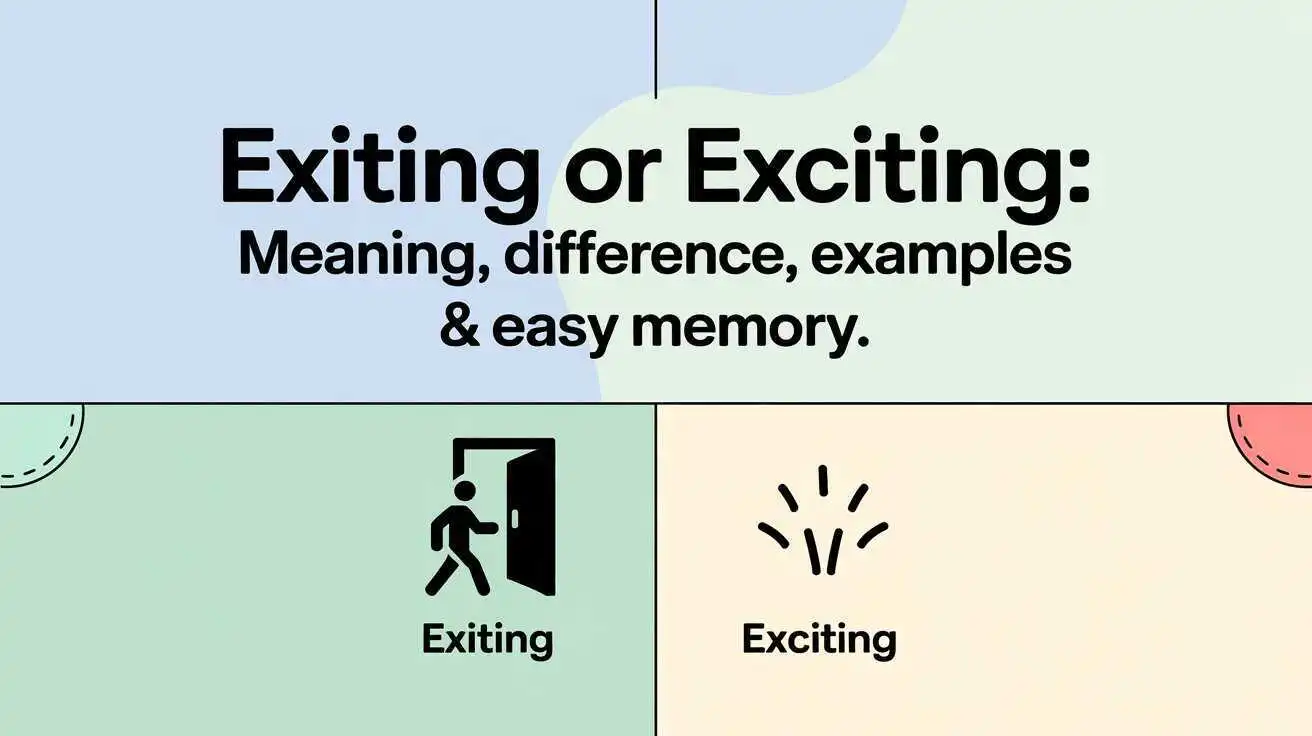
If you’ve ever typed “exiting or exciting” and paused for a second, you’re not alone. These two words confuse millions of English learners and even native speakers. They look similar, sound close, and appear in everyday writing but their meanings are completely different.
Here’s the thing: choosing the wrong one can completely change your sentence meaning.
Let’s fix that once and for all.
Quick Answer
“Exiting” means leaving or going out of a place, while “exciting” describes something that creates strong positive emotions or interest. The confusion happens because both words look similar, but “exiting” is related to physical movement, and “exciting” is related to feelings or emotional reaction.
AI Overview Summary
Exiting = physically leaving a place or situation. Exciting = something that creates interest, happiness, or emotional energy. They are often confused due to similar spelling, but they belong to different grammar categories: “exiting” is a verb form and “exciting” is an adjective. The correct usage depends on whether you mean movement or emotion.
What Does “Exiting” Mean?
Let’s start simple.
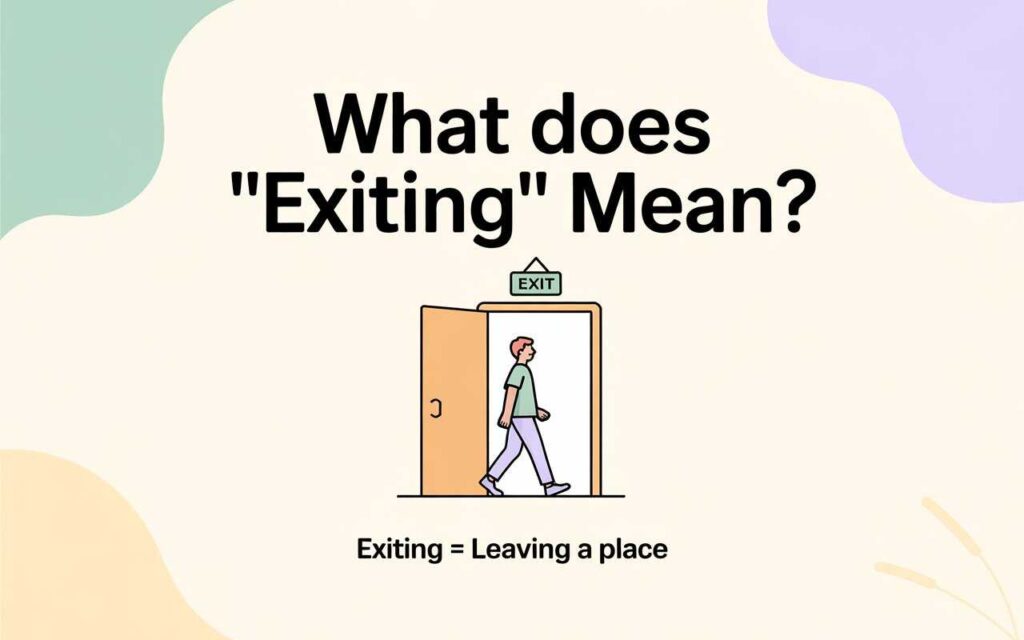
Exiting means leaving a place, building, or situation.
It comes from the verb “exit,” which means to go out.
In plain words:
If someone is moving out or going away from somewhere, they are exiting.
Examples of “Exiting”:
- He is exiting the room quietly.
- The passengers are exiting the bus.
- Fire exits are used for exiting the building in emergencies.
Here’s what most people get wrong:
People think “exiting” is just a random variation of “exciting.” It’s not. It is strictly about movement or leaving.
What Does “Exciting” Mean?
Now let’s switch gears.
Exciting means something that creates interest, happiness, or strong emotional reaction.
It describes feelings, experiences, events, or opportunities.
In simple terms:
If something makes you feel happy, thrilled, or curious—it is exciting.
Examples of “Exciting”:
- This is an exciting opportunity for you.
- The match was very exciting.
- She shared exciting news today.
Key insight:
“Exciting” is about emotion, not movement.
That’s the core difference.
READ MORE >>> Ingrained or Engrained: Which Spelling Is Correct and What’s the Real Difference?
Exiting vs Exciting: The Real Difference
This is where everything becomes clear.
| Feature | Exiting | Exciting |
|---|---|---|
| Meaning | Leaving a place | Creating emotion or interest |
| Word Type | Verb (action) | Adjective (description) |
| Focus | Physical movement | Emotional response |
| Example | Exiting the building | Exciting experience |
Simple rule:
If you can physically “go out,” use exiting. If you feel something inside you, use exciting.
Why Do People Confuse Exiting and Exciting?
This is actually more interesting than it looks.
Most people don’t confuse these words because they don’t know English—they confuse them because of how the brain processes fast typing and similar patterns.
Here’s why it happens:
1. Similar spelling pattern
Both start with “ex-” and end with “-ing.”
2. Fast typing errors
When typing quickly on mobile, your fingers often skip precision.
3. Sound similarity in speech
In fast conversation, they can sound slightly similar.
4. Context switching
If your brain is thinking about “opportunity” or “movie,” it may auto-pick “exciting” even when you meant “exiting.”
The 2-Second Decision Rule (Simple Framework)
Most grammar explanations make this complicated. Let’s fix that.
Use this:
Movement vs Emotion Rule
- If the sentence is about movement or leaving → Exiting
- If the sentence is about feelings or interest → Exciting
Example:
- He is ___ the building → Exiting
- This is an ___ movie → Exciting
Simple. Instant clarity.
Real-Life Examples (Where Most People Make Mistakes)
Let’s make this practical.
Example 1: Job Application
❌ This is an exiting job opportunity ✔ This is an exciting job opportunity
Example 2: Travel
❌ We are exciting the airport now ✔ We are exiting the airport now
Example 3: Social Media Caption
❌ Feeling so exiting about this trip ✔ Feeling so exciting about this trip
Wait—this is tricky.
Actually, correct version is: ✔ I am feeling excited about this trip (not exciting)
This shows another hidden layer: exciting vs excited confusion, which often overlaps with this topic.
Mini Case Study: Why This Mistake Matters
Let’s look at a real-world style scenario.
A student applies for a scholarship and writes:
“This is an exiting opportunity for me.”
Now imagine the evaluator reading this.
Even though the meaning is understandable, it creates a problem:
- It looks like careless writing
- It reduces perceived language skill
- It affects professionalism subtly
Now correct version:
“This is an exciting opportunity for me.”
Same idea. Completely different impression.
Here’s the insight most people miss: Small grammar mistakes don’t break communication—but they change perception of credibility.
Expert Tip: How Native Speakers Avoid This Mistake
Native speakers don’t memorize rules here.
They rely on mental shortcuts:
- Exit = doors, buildings, movement
- Excite = emotions, reactions, experiences
That’s it.
When you think in images instead of grammar rules, confusion disappears.
Common Usage Patterns You Should Know
“Exiting” is commonly used in:
- Travel situations
- Safety instructions
- Navigation systems
- Formal instructions
“Exciting” is commonly used in:
- Marketing
- Entertainment
- Social media
- Personal expressions
Quick Memory Trick (Easy Recall Method)
If you still mix them up, use this:
- EXITING = EXIT the place
- EXCITING = EXCITE your emotions
Short. Visual. Easy to remember.
Why This Confusion Is So Common Today
Here’s something most guides don’t mention.
With AI writing tools, autocorrect, and fast mobile typing:
- People rely less on grammar thinking
- More on prediction tools
- Errors pass through unnoticed
That’s why confusion between words like exiting/exciting is actually increasing, not decreasing.
Frequently Asked Questions
It is exciting opportunity, because it describes something positive and emotionally engaging.
It means leaving or going out of a place or situation.
Because they look and sound similar and are often typed quickly without checking context.
Think: exit = physical movement, excite = emotional feeling.
Direct answer: A better word for exiting is usually “leaving”, but you can also use “departing,” “going out,” or “walking out” depending on the situation.
Final Conclusion
At first glance, exiting or exciting looks like a tiny grammar issue. But once you understand it, you realize something bigger.
Language mistakes like this don’t happen because people don’t know English—they happen because the brain processes similar patterns too quickly.
And that’s the real takeaway.
If you remember just one thing, make it this:
Exiting is about leaving. Exciting is about feeling.
Simple. Clean. Unforgettable.
Once that clicks, you’ll never confuse them again—even when typing fast, even when writing under pressure.