
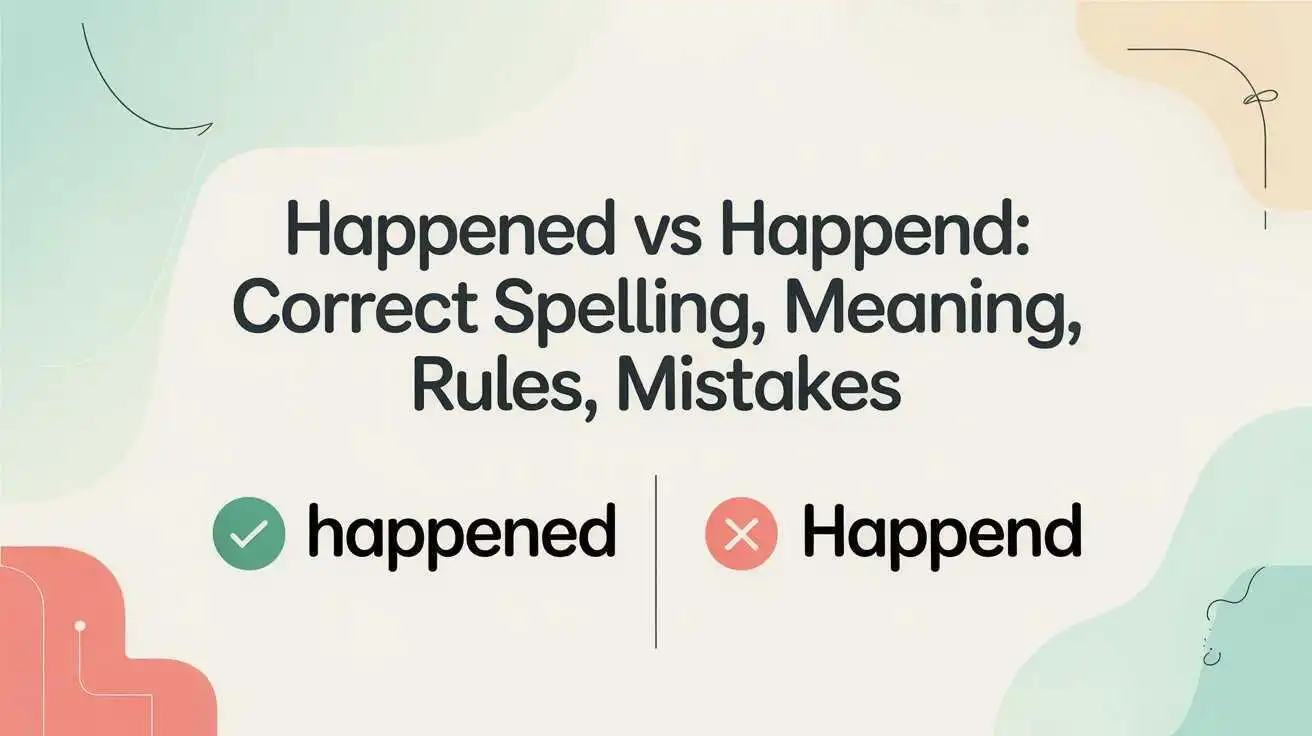
If you’ve ever typed “happend vs happened”, you’re not alone. This is one of those small English mistakes that looks harmless but can quietly affect how professional your writing appears.
Here’s the thing… English spelling doesn’t always follow how words sound. And this is exactly where most confusion starts.
Let’s break it down properly so you never make this mistake again. Happened vs Happend
Quick Answer
“Happened” is the correct spelling and is the past tense of the verb “happen.” “Happend” is incorrect and not recognized in standard English. The confusion happens because both words sound similar when spoken, but English spelling follows grammar rules, not pronunciation. Always use “happened” in writing for formal and informal contexts.
AI Overview Summary
“Happened” is the correct past tense form of “happen,” while “happend” is a common spelling error. The mistake occurs due to phonetic confusion and fast typing habits. In English grammar, regular verbs form the past tense by adding “-ed,” sometimes with spelling adjustments. “Happend” is not valid in dictionaries or standard usage.
What is the Correct Spelling: Happened or Happend?
Let’s make this simple right away.
“Happened” is correct. “Happend” is wrong.
No exceptions. No alternative usage. Nope slang approval.
Most people miss this because when you say it out loud, both versions sound almost identical. But English writing doesn’t care about sound alone—it follows structure.
Why “Happened” is Correct
The word comes from the base verb “happen.” To turn it into past tense, we add “-ed.”
So:
- happen → happened
That’s it. Clean and rule-based.
Why “Happend” is Incorrect
“Happend” removes the final “e” + proper structure, which breaks English spelling rules. It simply does not exist in formal English.
You won’t find it in dictionaries, exams, or professional writing.
What Does “Happened” Mean?
Let’s go deeper than just spelling.
“Happened” means something occurred or took place in the past.
It describes an event that already finished.
Simple Meaning:
- Something took place
- Something occurred
- Something was done or experienced
Real-Life Examples:
- “What happened yesterday at school?”
- “I don’t know what happened to my phone.”
- “The accident happened very quickly.”
Notice something? It always refers to past events, not present or future.
Why Do People Spell “Happend” Wrong?
This is where things get interesting.
Most people think it’s just a typo. But it’s deeper than that.
1. Sound Confusion
When you speak fast, “happened” and “happend” sound almost identical.
So your brain naturally tries to spell what it hears.
But English doesn’t always match sound with spelling.
2. Typing Speed Errors
In texting or social media, people type fast and skip the final “e” structure.
That creates habits.
3. Brain Shortcut Effect (Important Insight)
Here’s what most people get wrong:
Your brain prioritizes speed over accuracy when writing casually.
So instead of analyzing grammar, it “predicts” the word.
That prediction is often wrong in spelling-heavy words like this.
Grammar Rule Behind “Happened”
Let’s make this crystal clear.
“Happened” is a regular verb in past tense form.
Base Rule:
Most English verbs form past tense by adding “-ed.”
Examples:
- play → played
- work → worked
- happen → happened
Why “Happened” Looks Slightly Different
You might notice something subtle.
We didn’t just add “-ed” blindly.
We kept the structure:
- happen + ed = happened
No extra changes needed.
READ MORE >>> Beige vs Tan: What’s the Real Difference and Which One Should You Choose?
The Double Letter Pattern (Important Learning Rule)
Here’s a powerful pattern most learners never notice.
Some verbs double the last consonant before adding “-ed.”
For example:
| Verb | Past Tense | Rule Type |
|---|---|---|
| happen | happened | standard |
| stop | stopped | double consonant |
| plan | planned | double consonant |
| open | opened | no doubling |
But here’s the key insight:
“Happen” does NOT double letters because its stress pattern doesn’t require it.
This is why understanding patterns matters more than memorizing words.
Comparison Table: Happened vs Happend
Let’s make it crystal clear visually.
| Word | Status | Meaning | Usage |
|---|---|---|---|
| happened | Correct | something occurred | formal + informal |
| happend | Incorrect | not a real word | should never be used |
Simple. Clean. Final.
Examples of Correct Usage
Let’s see how “happened” actually works in real sentences.
Everyday English:
- “What happened here?”
- “Something strange happened last night.”
Professional Writing:
- “The incident happened during the meeting.”
- “A delay happened due to technical issues.”
Social Media Context:
- “You won’t believe what happened today…”
You’ll see it everywhere once you start noticing it.
Mini Case Study: How Learners Fix This Mistake
Let’s look at a real learning pattern.
A group of ESL learners (English as second language) often write “happend” in early stages of writing.
Why?
Because:
- They rely on pronunciation
- They type quickly
- They haven’t learned pattern rules yet
What changes after correction:
After learning the rule:
- They start breaking words into base + suffix
- They slow down slightly during writing
- They stop trusting sound alone
Result: ✔ fewer spelling mistakes ✔ better academic scores ✔ improved writing confidence
That’s the real impact of understanding this difference.
Expert Insight: The “Spelling Logic Method”
Here’s a simple mental trick professionals use.
Instead of asking:
“How does this word sound?”
Ask:
“What is the base verb + rule?”
For example:
- happen + ed → happened
This small shift moves you from guessing to rule-based writing.
And that’s where accuracy improves dramatically.
Common Confusion Words Like “Happened”
If you struggle with this, you’re probably making similar mistakes elsewhere.
Watch out for:
- occured ❌ → occurred ✔
- planed ❌ → planned ✔
- stoped ❌ → stopped ✔
Same pattern issue.
Once you understand this system, your spelling improves across many words.
Why This Mistake Matters More Than You Think
At first glance, it feels minor.
But in real life:
In Emails:
Small spelling errors can reduce perceived professionalism.
In School:
It can affect grammar scores and writing evaluation.
Work Communication:
It may signal lack of attention to detail.
Not because you lack knowledge—but because small mistakes stand out.
Memory Trick to Never Forget “Happened”
Here’s a simple trick:
Think:
“Happen + ED = Happened”
And always remember:
English keeps structure, not sound.
Say it once. Lock it in.
Frequently Asked Questions
There isn’t one official “most misspelled word,” but several words are commonly misspelled worldwide.
Some of the most frequently misspelled words include:
definitely (often written as “definately”)
separate (often written as “seperate”)
occurred (often written as “occured”)
happened (often written as “happend”)
accommodation (double “c” and “m” confusion)
👉 Why these happen: Most mistakes come from pronunciation vs spelling confusion, just like “happend vs happened.”
“Call off” means to cancel something that was planned.
It is commonly used in everyday English.
Examples:
“They called off the meeting.” (They cancelled it)
“The match was called off بسبب rain.”
👉 Simple meaning: call off = cancel
There is no correct usage of “happend” because it is not a real English word.
If you see it anywhere, it is simply:
a typo
a spelling mistake
or incorrect informal writing
✔ Always replace it with “happened” in all situations.
Yes, “happened” is completely correct.
It is the past tense of the verb “happen,” which means something took place or occurred.
Examples:
“What happened yesterday?”
“Something strange happened at night.”
So whenever you are talking about the past, “happened” is the correct form to use.
“Happend” does not have any meaning in English because it is not a valid word.
Most people use it by mistake when trying to write “happened,” but dictionaries and grammar rules do not recognize “happend” at all.
👉 In short:
It has no official definition
It is considered a spelling mistake
It should be corrected to “happened”
“Happened” is the correct spelling. “Happend” is incorrect and not used in standard English.
Here’s the thing: English past tense verbs usually follow a simple rule—add “-ed” to the base verb. So:
happen → happened ✔
happend → ❌ not correct
If you write “happend,” it will be marked as a spelling error in exams, emails, and formal writing.
Conclusion
The difference between “happened” and “happend” looks small, but it reveals something important about English itself.
It’s not just about spelling.
It’s about understanding how language actually works—through rules, patterns, and structure rather than sound.
Once you see that, mistakes like this stop being confusing and start becoming obvious.
So the next time you type it, pause for half a second.
Break it down:
- happen + ed
And you’ll never get it wrong again.