
Quick Answer
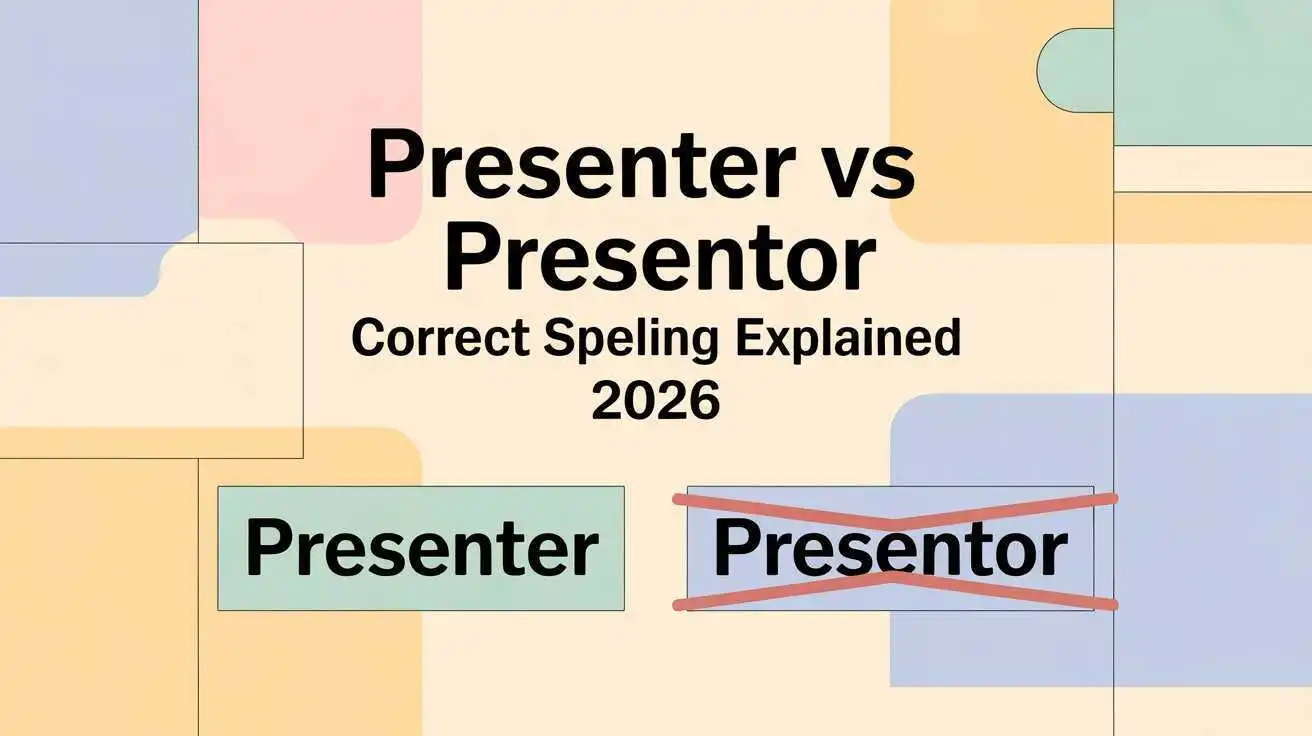
‘presentor or presenter‘ Presenter is the correct spelling in English. Presentor is a common spelling mistake and not accepted in standard dictionaries. A presenter is someone who delivers information, hosts events, or speaks publicly in media, education, or professional settings. The confusion happens because many English words end in “-or,” but this word follows the verb-based “-er” formation rule.
AI Overview Summary
Correct spelling: Presenter Incorrect spelling: Presentor
Meaning: A presenter is a person who presents information in events, shows, meetings, or broadcasts.
Grammar rule: Words derived from verbs like “present” usually take the “-er” ending (present → presenter).
Common confusion: People assume “presentor” is correct because similar words like actor or doctor end in “-or.”
Example: She works as a news presenter on television.
What Is the Correct Spelling: Presenter or Presentor?
Here’s the thing — this is one of those English questions that looks simple but confuses a lot of people.
The correct spelling is presenter. The word presentor is not accepted in standard English and is considered a spelling mistake.
You might still see “presentor” online, but that doesn’t make it correct. In formal writing, exams, job applications, or professional communication, only “presenter” is used.
So if you’ve ever paused and wondered which one is right, now you have your answer.
What Does “Presenter” Mean?
A presenter is someone who delivers or presents information to an audience.
That could be:
- A TV news host
- A conference speaker
- A webinar host
- A teacher presenting a lesson
- A host at an event or award show
In simple terms, a presenter is the person who stands in front of others and explains, shares, or delivers content.
For example:
- The presenter explained the new product clearly.
- She is a popular TV presenter in the morning show.
It’s a professional word used in media, education, and corporate environments.
Presenter vs Presentor: Key Differences
Let’s clear the confusion once and for all.
| Feature | Presenter | Presentor |
|---|---|---|
| Correct spelling | Yes | No |
| Dictionary usage | Accepted | Not recognized |
| Professional use | Common | Incorrect |
| Formal writing | Required | Avoid |
The truth is simple: only “presenter” is grammatically correct.
If you use “presentor” in a resume or email, it may look like a spelling error — not a variation.
Why Do People Write “Presentor” Instead of “Presenter”?
Most people don’t randomly make this mistake. There’s a pattern behind it.
Here’s what’s really happening.
1. Word pattern confusion
You already know words like:
- actor
- doctor
- editor
So your brain naturally assumes “presentor” should also follow the same pattern.
But English doesn’t always stay consistent.
2. Sound-based spelling
When you say “presenter” quickly, it almost sounds like “presentor.”
So people write what they hear instead of what is correct.
3. Overgeneralization mistake
English learners often apply one rule everywhere.
They think:
“If many words end in -or, this one should too.”
But that assumption is incorrect here.
The Simple Rule Behind “Presenter”
This is where most explanations online fall short. Let’s fix that.
The -ER vs -OR Rule
There is a hidden pattern in English word formation.
Words ending in “-er”
These usually come from verbs (action words):
- present → presenter
- teach → teacher
- speak → speaker
Words ending in “-or”
These usually come from Latin-based formal titles:
- act → actor
- direct → director
- inspect → inspector
Now here’s the key insight:
“Present” follows English verb-based structure, so it becomes “presenter,” not “presentor.”
That’s the rule most people never learn — and that’s why the confusion keeps repeating.
READ MORE >>> Finalized or Finalised: Which Is Correct and When Should You Use Each?
When Do You Actually Use “Presenter”?
You use “presenter” in both formal and informal situations where someone is delivering information.
Real-life uses:
- Television broadcasting
- Business presentations
- Academic lectures
- Online webinars
- Award shows or events
Example sentences:
- The presenter introduced the guest speaker.
- She is the main presenter of the science program.
- He worked as a webinar presenter for a tech company.
In all these cases, “presenter” fits naturally.
Does Spelling Really Matter?
Here’s the honest answer: yes — especially in professional situations.
If you write “presentor” in:
- a resume
- LinkedIn profile
- academic paper
- business email
…it can reduce credibility.
Not because people don’t understand it, but because it signals a lack of attention to detail.
Simple rule:
- Casual chat → not a big issue
- Professional writing → spelling must be correct
This small difference can affect how polished your communication looks.
Mini Case Study: A Real-World Mistake
Let’s look at a real-style scenario.
A student applying for a media internship writes:
“Event Presentor at college seminar”
The recruiter immediately notices the spelling issue. Even though the experience is good, the spelling mistake creates doubt about attention to detail.
Later, after correction:
“Event Presenter at college seminar”
The profile looks clean, professional, and credible.
Same experience. Different impression.
That’s the power of correct spelling in real-world communication.
Why This Confusion Is So Common
Most grammar mistakes don’t happen because people don’t know English.
They happen because English is inconsistent.
Here’s the deeper truth:
Your brain tries to simplify language patterns.
So when it sees:
- actor
- doctor
- editor
It assumes everything follows that same structure.
But English is a mix of rules from different language origins. That’s why exceptions like “presenter” exist.
Once you understand this, the confusion becomes easier to avoid.
Why Do People Get Confused Between Presenter and Presentor?
People get confused because English spelling often feels inconsistent. Your brain tries to match new words with familiar patterns you already know. Since many job-related words end in “-or” like actor, doctor, and editor, it feels natural to assume “presentor” should also be correct.
But “present” is a verb, and in English, verbs that turn into job roles usually take “-er.” That’s why we get “presenter,” not “presentor.”
Another reason is pronunciation. When spoken quickly, “presenter” and “presentor” sound almost identical, so learners often write what they hear instead of what is actually correct.
Here’s the thing: it’s not about logic alone—it’s about pattern confusion. English learners apply the wrong mental rule to a word that doesn’t fol
Why Does “Presentor” Look Correct but Isn’t?
“Presentor” feels correct because it follows a familiar visual pattern in English. You’ve seen words like:
- actor
- director
- inspector
- creator
So your brain builds a shortcut:
“If it describes a person, it should end in -or.”
But English doesn’t work on a single rule. It has multiple word-origin systems.
“Presenter” comes from the verb present, which follows the -er rule for action-based words:
- teach → teacher
- speak → speaker
- present → presenter
So even though “presentor” looks structurally believable, it breaks the actual grammar formation rule.
Most people miss this because they rely on visual similarity, not word origin. English often punishes that shortcut.
The Hidden Grammar Pattern Behind Presenter
There is a deeper system behind this word that most learners never notice.
English uses two main patterns for naming “a person who does something”:
1. The “-ER” Pattern (Verb-based actions)
Used when the word comes directly from an action:
- present → presenter
- build → builder
- teach → teacher
This pattern is active, simple, and modern English usage.
The “-OR” Pattern (Latin-based formal roles)
Used for words borrowed from Latin or older formal structures:
- act → actor
- direct → director
- inspect → inspector
These often relate to formal, institutional, or historical roles.
The key insight most people miss:
“Presenter” belongs to the action-based system, not the Latin-based system.
That’s why it ends in -er, even though it looks like it could fit either pattern.
Simple way to remember it:
If the word comes from a doing action, it will almost always use -er.
So:
- present → presenter (someone who presents)
- not presentor (which breaks the rule system)
Simple Memory Trick to Never Forget It
If you want a quick way to remember:
If it comes from an action (verb), it usually ends in -er
So:
- present → presenter
- teach → teacher
- speak → speaker
Just remember this one idea and you’ll avoid most mistakes like this in the future.
Simple. But powerful.
Expert Insight: The Hidden Pattern Most People Miss
Most explanations stop at “this is correct, this is wrong.”
But here’s what really helps you remember it long-term:
English spelling is not random — it follows origin rules.
Words based on actions tend to use “-er” because they describe someone doing something.
So a presenter is literally:
a person who presents
That’s why the spelling makes sense when you understand the structure behind it.
Once you see the system, you don’t just memorize it — you understand it.
Conclusion
The confusion between “presentor” and “presenter” is common, but the answer is simple.
Presenter is the correct spelling in English.
The mistake usually happens because people assume it follows the same pattern as words like actor or doctor. But English has its own structure rules, and in this case, action-based words like “present” form agent nouns using “-er.”
Here’s the key takeaway:
You don’t need to memorize hundreds of spelling rules. You just need to understand the pattern behind them.
Once you see that pattern, mistakes like this stop feeling confusing — and start feeling obvious.
And that’s the real difference between guessing English… and actually understanding it.