
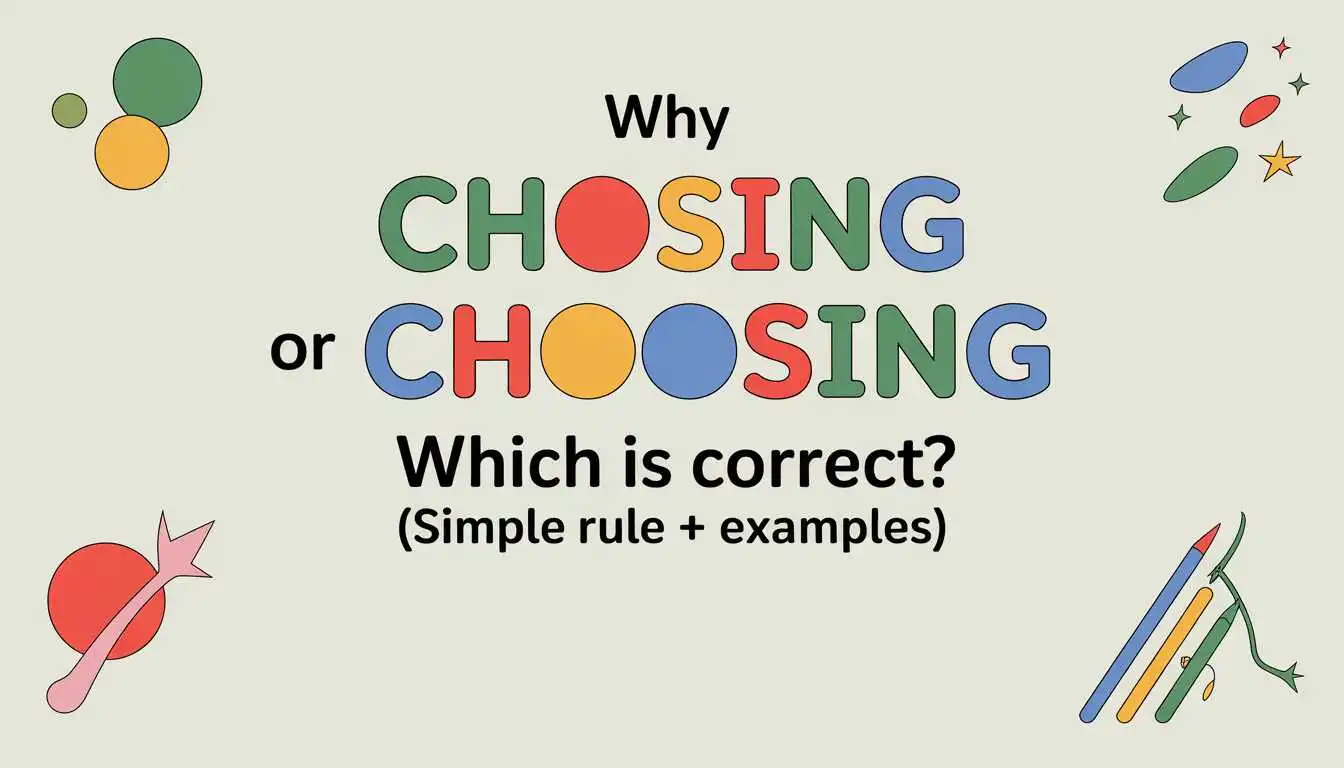
Quick Answer
Choosing is the correct spelling, while “chosing” is incorrect. The word comes from the base verb “choose,” and when you add “-ing,” the double “o” stays the same. This follows standard English spelling rules. Example: She is choosing a new dress.
AI Overview Summary
Choosing is correct; chosing is a misspelling. Keep the double “o” from “choose” when adding “-ing.” This rule applies to similar verbs. Always use “choosing” in writing whether it’s academic, professional, or casual.
Is It “Chosing” or “Choosing”?
“Choosing” is correct in every situation; “chosing” is always wrong.
Here’s the thing… most people already feel that “choosing” looks right. But when you’re typing fast—or second-guessing yourself—“chosing” suddenly seems possible.
It’s not.
This is one of those small spelling mistakes that can quietly damage credibility. Especially in emails, exams, or content writing.
Why “Choosing” Is Correct (Simple Rule Explained)
You keep the original vowel structure when adding “-ing” to “choose.”
Let’s break it down simply.
The Basic Spelling Rule
When you add “-ing” to most verbs:
- You don’t change the core spelling
- You just attach “-ing” to the base form
So:
- choose → choosing
No letters removed. No shortcuts.
The Double Vowel Preservation Rule
Here’s a simple way to remember it:
If a verb has double vowels, keep them when adding “-ing.”
That’s it. That’s the rule most people miss.
Quick Comparison Table
| Base Verb | Correct Form | Incorrect Form |
|---|---|---|
| choose | choosing | chosing |
| lose | losing | loosing* |
(*Note: “loosing” is a different word entirely.)
READ MORE >>>> Acception vs Exception: Meaning, Difference, and How to Never Confuse Them Again
Why People Mistakenly Write “Chosing”
People rely on sound instead of spelling, which leads to dropping one “o.”
Most people don’t realize this, but your brain is trying to help you… and failing.
Pronunciation vs Spelling Confusion
You hear:
- “choo-zing”
But your brain simplifies it to:
- “chosing”
That’s the trap.
Pattern Mistakes From Similar Words
Think about words like:
- hoping
- making
In those cases, letters do change.
So your brain assumes:
“Maybe ‘choose’ also drops something…”
It doesn’t.
Mini Case Study: A Small Mistake, Big Impact
A student writes an exam essay:
“I am chosing the best option…”
Everything else is perfect. But that one word?
It signals carelessness.
The result:
- Lower marks
- Lost confidence
This happens more often than you think.
The 3S Spelling System (Never Make This Mistake Again)
The 3S system helps you remember spelling using source word, sound, and structure.
Let’s make this stick.
S1 – Source Word
Start with the base verb:
- choose
S2 – Sound Pattern
Say it clearly:
- “choo-zing”
This helps you connect sound to structure.
S3 – Structure Rule
Now apply the rule:
- Keep the vowel pattern → choosing
That’s it.
Three steps. Zero confusion.
Choosing vs Chose vs Chosen
“Choosing” is present continuous, “chose” is past tense, and “chosen” is past participle.
This is another area where people get stuck.
Quick Comparison Table
| Form | Meaning | Example |
|---|---|---|
| choosing | ongoing action | I am choosing a laptop |
| chose | past action | I chose a laptop |
| chosen | completed action | I have chosen a laptop |
Most people mix these up—not because they’re hard, but because they look similar.
Real-Life Examples of “Choosing” in Sentences
“Choosing” is used when describing an ongoing decision or action.
Let’s make it practical.
Academic Writing
- She is choosing a topic for her research paper.
Professional Email
- I am choosing the best candidate for the role.
Casual Conversation
- We’re choosing a movie tonight.
Short. Natural. Clear.
When to Use “Choosing”
Use “choosing” whenever an action is happening right now or in progress.
In Academic Writing
You’ll often describe ongoing decisions:
- “The researcher is choosing variables carefully.”
In Professional Emails
Precision matters:
- “We are choosing the final design this week.”
In Content Writing
Clarity builds trust:
- “Customers are choosing eco-friendly products.”
Expert Tip
Always double-check “-ing” forms before submitting important writing. Small spelling mistakes are easy to miss—but hard to justify.
Is “Chosing” Ever Correct?
No, “chosing” is never correct in standard English.
There are no exceptions.
No regional variations. No informal usage.
It’s simply a misspelling.
Quick Comparison: Chosing vs Choosing
Only “choosing” is valid; “chosing” should always be avoided.
| ❌ Incorrect | ✅ Correct |
|---|---|
| chosing | choosing |
If you remember nothing else, remember this table.
5 Similar Words That Follow the Same Rule
Many verbs keep their vowel structure when adding “-ing.”
This is where things click.
- choose → choosing
- lose → losing
- move → moving
- prove → proving
- improve → improving
Notice the pattern?
Once you see it, you can’t unsee it.
Expert Tips to Avoid Spelling Mistakes Like This
Focus on patterns, not guesses.
Here’s what actually works:
- Check the base word first
- Don’t trust pronunciation alone
- Slow down when writing important content
Most people rush. That’s when mistakes happen.
Frequently Asked Questions
Is it chosing or choosing?
Choosing is correct. Chosing is a misspelling.
Why is choosing spelled with double “o”?
Because the base word “choose” already has double vowels, and they remain when adding “-ing.”
What is the rule for adding “-ing”?
Most verbs keep their original spelling when adding “-ing,” especially when vowels are involved.
Is “chosing” ever acceptable?
No. It is always incorrect in standard English.
How can I remember the correct spelling?
Use the 3S Spelling System:
- Source word
- Sound
- Structure
Final Thoughts
“Chosing or choosing” looks like a small question—but it reveals a bigger truth.
Spelling mistakes don’t usually come from ignorance. They come from patterns your brain misunderstands.
Once you learn the rule—and more importantly, the reason behind it—everything becomes easier.
Here’s what matters:
- Choosing is always correct
- The double “o” never disappears
- Your brain may try to simplify—but now you know better
So next time you pause and wonder…
You won’t guess. You’ll know.