
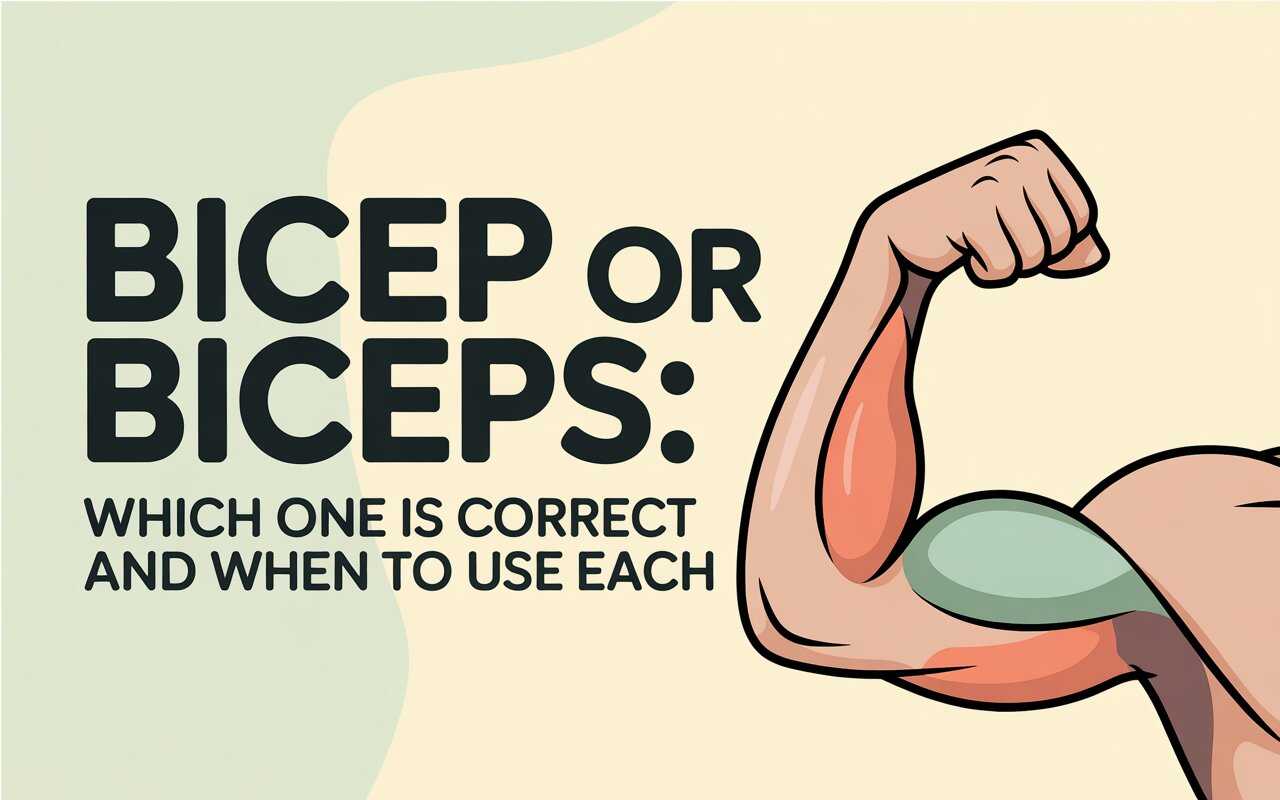
Quick Answer
Bicep or Biceps “Biceps” is the correct grammatical and anatomical term for the upper arm muscle and is used in both singular and plural sense. “Bicep” is an informal shortened version commonly used in gyms and casual speech. In formal writing, academic work, and medical language, “biceps” is always the correct choice.”
AI Overview Summary
- “Biceps” is the standard and correct term in English and anatomy
- “Bicep” is an informal variation created from everyday speech
- Both refer to the same upper arm muscle
- Formal contexts always require “biceps”
- “Bicep” is widely used in fitness culture but not grammatically standard
- Meaning does not change, only usage context does
Bicep or Biceps: Let’s Clear This Confusion Once and for All
You’ve probably seen both words—bicep and biceps—used everywhere.
In gym conversations, people say “I trained my bicep.” In textbooks, you’ll read “biceps brachii muscle.”
So here’s the thing… which one is actually correct?
The answer is not as simple as it looks. And most explanations online barely scratch the surface.
Let’s fix that.
What Does “Biceps” Actually Mean?
Biceps refers to the large muscle at the front of your upper arm that helps you bend your elbow and rotate your forearm.
It is one of the most well-known muscles in the human body, especially in fitness culture.
But here’s what most people miss…
The word “biceps” comes from Latin, meaning “two-headed muscle.”
Breakdown:
- Bi = two
- ceps = heads
That’s why it describes a muscle with two points of origin (two heads).
So even though it sounds plural, “biceps” is actually a single muscle name in anatomy.
Is “Bicep” a Correct Word?
Let’s be honest—this is where confusion starts.
“Bicep” is not technically correct in formal English or anatomy.
But it still exists in real life.
Why?
Because language evolves.
Most people naturally shorten “biceps” to “bicep” in casual speech. It feels easier, faster, and more natural to say.
Here’s what’s important:
- Bicep = informal usage
- Biceps = correct standard usage
Think of “bicep” as slang that became widely accepted, but not officially correct.
READ MORE >>> Puting or Putting: Which Is Correct? Meaning, Rule, and How to Never Get It Wrong
Bicep vs Biceps: The Real Difference
The key point is this:
👉 There is no difference in meaning—only in correctness and context.
Let’s break it down simply:
| Context | Correct Term | Why |
|---|---|---|
| Gym conversation | bicep | informal speech |
| Medical textbook | biceps | anatomical accuracy |
| Academic writing | biceps | grammar standard |
| Social media captions | bicep | casual tone |
| Fitness blogs | both (depends on tone) | audience-based |
Here’s the thing most people get wrong
People assume:
“Bicep” is wrong and should never be used.
That’s not fully accurate.
In reality:
- It’s not standard English
- But it is widely understood and socially accepted
So you’re not “wrong” in conversation—but you are technically incorrect in formal writing.
When Should You Use Bicep or Biceps?
This is where clarity really matters.
Use “biceps” when:
- Writing essays or academic content
- Referring to anatomy or biology
- Speaking in professional or medical contexts
- Wanting to sound precise and correct
Use “bicep” when:
- Talking casually in the gym
- Writing social media captions
- Using informal speech
- Speaking with fitness communities
Simple rule you can always rely on:
👉 If you’re unsure, always choose “biceps”
It is the safer option in every situation.
The BICEP Decision Matrix (Simple Rule System)
Let’s make this even easier.
This framework helps you decide instantly:
BICEP Decision Matrix™
- B → Biology or academic writing = biceps
- I → Informal conversation = bicep
- C → Content writing (SEO/blogs) = biceps preferred
- E → Exercise/gym talk = bicep commonly used
- P → Professional/medical context = biceps only
Final rule:
If it sounds formal → use biceps If it sounds casual → bicep is acceptable
Why Do Both Words Exist?
This is where language gets interesting.
The existence of both “bicep” and “biceps” comes from something called back-formation.
That sounds complex, but here’s the simple idea:
People heard “biceps” and assumed the “-s” meant plural. So they removed it and created “bicep.”
That’s how informal language is born.
In real life:
- “biceps” = original anatomical term
- “bicep” = simplified modern version
This happens in English more often than you think.
Gym Language vs Grammar Language (Important Insight)
Let’s talk real-world usage.
In gyms:
You’ll hear:
- “My bicep is sore”
- “Train your bicep today”
In medical or academic contexts:
You’ll see:
- “Biceps brachii muscle”
- “Biceps strength assessment”
Why the difference?
Because language adapts to environment.
- Gym talk = fast, simple, motivational
- Academic talk = precise, standardized
Neither is “wrong” socially—but only one is grammatically standard.
Mini Case Study: Why Fitness Influencers Say “Bicep”
Let’s look at a real-world pattern.
A fitness influencer posts:
“Best bicep workout for size gains”
Why not “biceps”?
Because:
- Short words perform better in captions
- “Bicep” feels more conversational
- Audience engagement increases with simple language
Now compare that with a medical article:
“Activation of the biceps brachii during resistance training”
That difference tells you everything.
Insight:
Context controls correctness perception in modern language.
Common Mistakes People Make
Here are the most common errors:
- Assuming “bicep” is grammatically correct everywhere
- Thinking “biceps” must be plural only
- Using “bicep” in academic writing
- Mixing both in formal essays
Important truth:
👉 The meaning never changes—only the correctness level changes.
Examples in Real Life
Let’s make this practical.
Informal usage:
- “My bicep hurts after the workout.”
- “Nice bicep pump today.”
Formal usage:
- “The biceps muscle is responsible for elbow flexion.”
- “Biceps strength is measured in clinical testing.”
Notice the shift?
Same muscle. Different tone.
Expert Insight (What Most People Miss)
Here’s something important:
Google and AI systems prefer “biceps” in formal contexts because it is standardized in anatomy and dictionaries.
But they still recognize “bicep” because:
- It is widely used in real-world speech
- It appears in fitness content
- It is understood globally
So what does this mean for you?
👉 “Biceps” is always the safest, most professional choice 👉 “Bicep” is acceptable in casual environments
Frequently Asked Questions
Is bicep a real word?
Yes, but it is informal and not considered standard English in formal writing.
Is biceps singular or plural?
“Biceps” is a Latin-origin word that refers to a single muscle with two heads, used in both singular and plural sense.
Why do people say bicep instead of biceps?
Because it is a simplified spoken version that developed naturally in everyday language.
Can I use bicep in academic writing?
No. You should always use “biceps” in academic, medical, or professional writing.
What is the correct spelling: bicep or biceps?
The correct and standard spelling is “biceps.”
Is biceps a muscle or muscles?
It refers to a single muscle with two heads in the upper arm.
Conclusion
Here’s the real takeaway.
The debate between bicep or biceps isn’t really about meaning. It’s about context, correctness, and confidence in usage.
If you strip everything down:
- Biceps is the correct, professional, and anatomically accurate term
- Bicep is an informal shortcut used in everyday speech
And here’s the part most people finally realize:
You were never confused about the muscle. You were confused about the language rules around it.
So next time you write or speak, just remember:
👉 If precision matters, say biceps 👉 If conversation is casual, “bicep” won’t hurt
Simple. Clear. No confusion.