
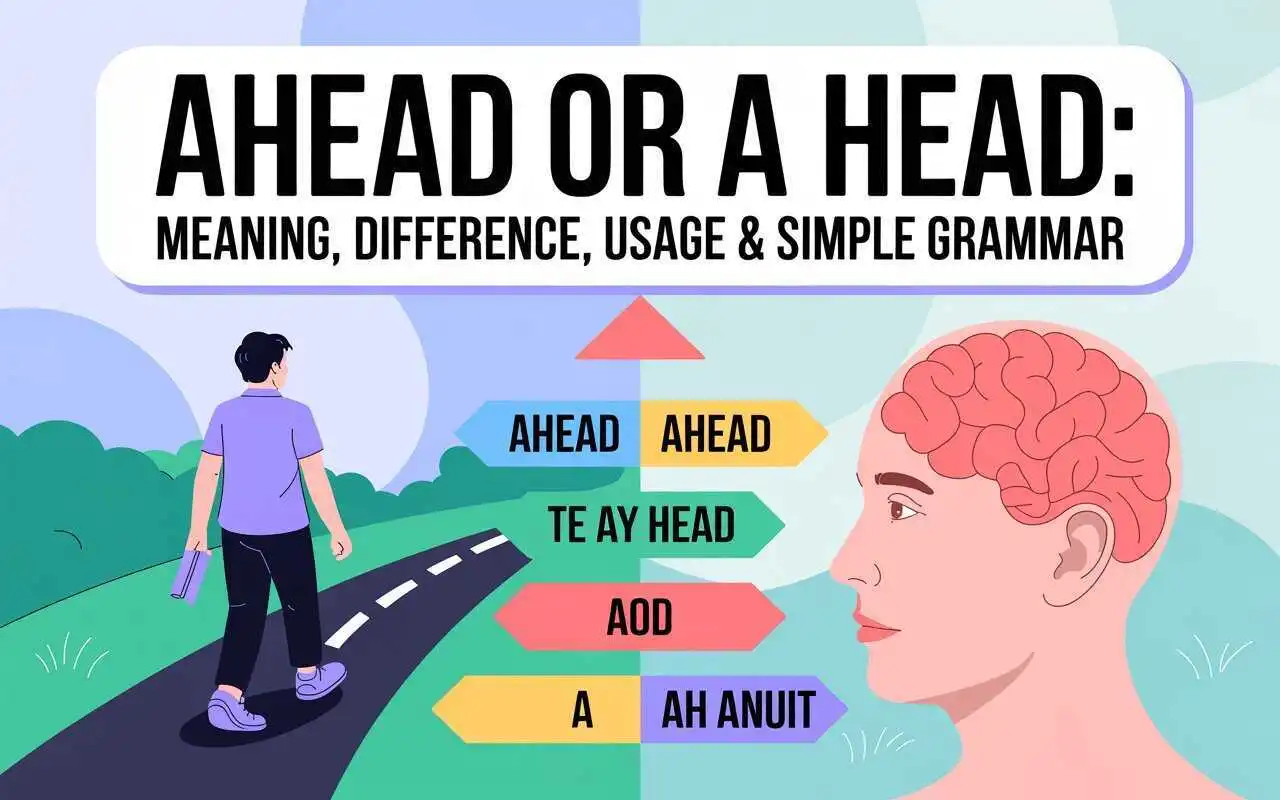
If you’ve ever paused while writing and thought, “Is it ahead or a head?” you’re not alone. This is one of those small English doubts that can instantly make your confidence drop while typing an email, message, or assignment.
Here’s the thing—this confusion is actually very common, especially for learners who are trying to write fast and naturally. The good news? The difference is simple once you see it clearly.
Quick Answer
“Ahead” means forward, in front, or earlier in time. “A head” refers to a physical mind or a person in a leading position. The correct usage depends on context: use “ahead” for direction, movement, or time, and use “a head” only when talking about a noun like a body part or leader.
AI Overview Summary
“Ahead” is an adverb meaning forward, earlier, or in a leading position. “A head” is a noun phrase referring to a physical mind or someone who leads. The confusion happens because they sound similar. In most cases, “ahead” is the correct word in modern English usage.
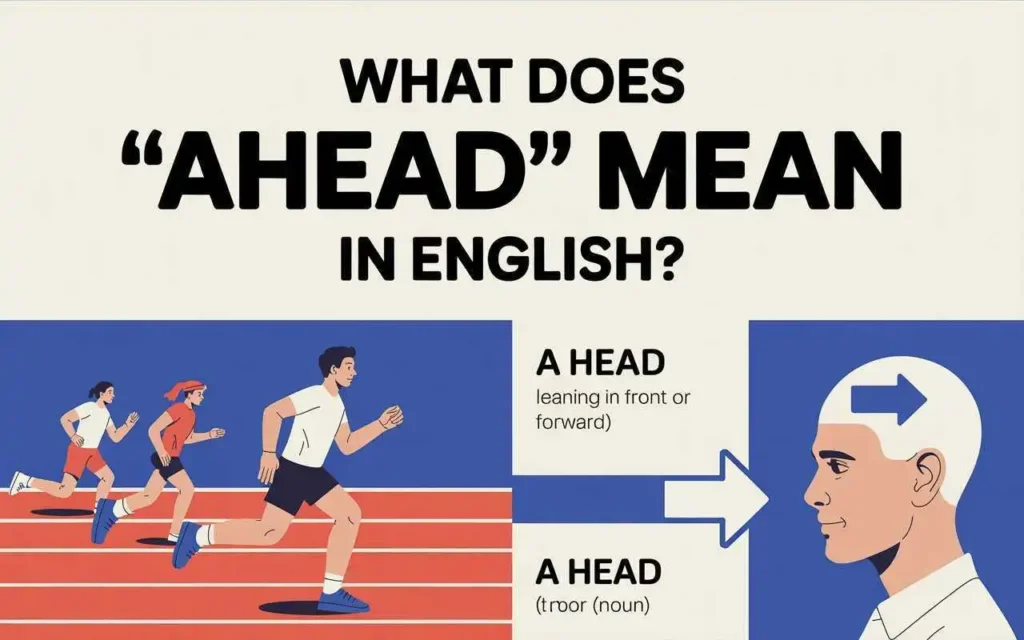
What Does “Ahead” Mean in English?
Let’s keep this simple.
“Ahead” means forward in space, time, or progress.
You use it when something is in front of you or happening in the future.
Simple meaning breakdown:
- Forward direction
- Earlier in time
- In a leading position
Examples:
- We walked ahead of the group.
- The deadline is ahead of us.
- She is far ahead in studies.
Here’s what most people miss: “ahead” is not a noun—it describes movement or position, not a thing.
What Does “A Head” Mean?
Now let’s break the second part.
“A head” is a noun phrase. It usually refers to a physical mind or a leader.
Yes, it’s completely different from “ahead,” even though it looks similar.
Two meanings:
1. Physical meaning
- A head (body part)
Example:
- He nodded his mind.
2. Leadership meaning
- A head of department (leader)
Example:
- She is a head of the marketing team.
Important insight:
If you can “touch” or “identify a person/thing,” it’s usually a head, not ahead.
Ahead or a Head: What Is the Correct Usage?
This is where most confusion happens.
Let’s make it crystal clear.
Use “ahead” when you mean forward or time. Use “a head” when you mean a physical object or leader.
Quick comparison:
| Situation | Correct Word | Why |
|---|---|---|
| Move forward | ahead | direction |
| Future plans | ahead | time |
| Body part | a head | noun |
| Leader of team | a head | person |
Simple rule you can remember:
If you can replace the word with “forward”, use ahead.
If you are talking about a person or body part, use a mind
How Do You Spell Ahead Correctly?
This is another common search confusion.
The correct spelling is:
👉 ahead (one word)
Common mistake:
- ❌ a head (wrong in this context)
Why this happens:
People visually split the word into “a + mind,” but in grammar, it is a single adverb.
What’s Ahead? Meaning in Real Life
You’ve probably seen this phrase a lot.
“What’s ahead” refers to the future or what is coming next.
Examples:
- We don’t know what’s ahead in life.
- Let’s see what’s ahead in the journey.
- Challenges lie ahead.
Here’s a simple insight: When people say “what’s ahead,” they are not talking about space—they are talking about future time.
Please Go Ahead and Meaning in Conversation
This is where English becomes practical.
“Please go ahead” means you are giving someone permission to continue.
Real-life use:
- In meetings: “Please go ahead with your presentation.”
- In conversation: “Can I ask a question?” → “Yes, please go ahead.”
- In messaging: “Should I start?” → “Go ahead.”
Important point:
This phrase is very common in polite English. It has nothing to do with “a mind”
READ MORE >>> Says vs Sais: Which Spelling Is Correct and Why This Confusion Happens
Why Do People Confuse Ahead and A Head?
Here’s the interesting part most guides skip.
There are 3 main reasons:
1. Visual confusion
The word “ahead” looks like “a + mind.”
2. Sound similarity
When spoken quickly, they sound almost identical.
3. Grammar overlap confusion
Learners often think English always uses “a + noun” structure, so they incorrectly split “ahead.”
👉 This is not a grammar mistake—it’s a pattern recognition error.
Common Mistakes with Ahead or A Head
Let’s fix real-world errors.
Wrong vs Correct:
- ❌ I am a head of the queue ✔ I am ahead of the queue
- ❌ Move a head quickly ✔ Move ahead quickly
- ❌ What is a head in the plan ✔ What is ahead in the plan
Key insight:
Most mistakes happen because learners insert a space where it doesn’t belong.
Mini Case Study: Student Writing Mistake
Let’s look at a real-world style example.
A student wrote in an exam:
“The students were a head in the competition.”
The teacher marked it wrong.
Why?
The student meant position in ranking, not a body part.
Correct version:
“The students were ahead in the competition.”
Lesson:
Whenever you are talking about progress, ranking, or position, you almost always need “ahead,” not “a mind.”
Expert Tip: Never Confuse Ahead and A Head Again
Here’s a simple mental shortcut used by English tutors:
The Forward Test
Ask yourself:
👉 Can I replace it with “forward”?
- Yes → use ahead
- No → check if it’s a noun → use a mind
This works in 90% of real-life cases.
Comparison Table (Quick Revision)
| Feature | Ahead | A Head |
|---|---|---|
| Word type | Adverb | Noun phrase |
| Meaning | forward, time, progress | body part, leader |
| Usage | movement, future | physical reference |
| Example | go ahead | a head of department |
Real-Life Usage Examples
Let’s make this practical.
In texting:
- “Go ahead, send it.”
studies:
- “What’s ahead in the next chapter?”
workplace:
- “He is a head of HR department.”
daily life:
- “We are ahead of schedule.”
Notice how ahead is used much more frequently in modern English.
Common Question Patterns You Might See
You may still wonder:
- how do you spell ahead correctly in fast writing?
- what’s ahead in life or exams?
- is “a head” ever used in conversation?
Here’s the truth:
👉 “ahead” is extremely common 👉 “a mind” is rare and context-specific
Final Clarity Section
Let’s lock it in once and for all:
- Ahead = forward, progress, time
- A mind = physical object or leader
If you remember only one thing, remember this:
👉 “Ahead is about movement. A mind is about a thing.”
Frequently Asked Question
A heading is used to organize written content into sections.
Use headings when:
Breaking content into topics
Improving readability
Structuring articles or essays
👉 Example:
“Introduction” is a heading in an article.
“Conclusion” is another heading.
👉 Simple rule: If you are organizing text, use heading, not head.
In writing, “head” usually refers to a leader or person in charge, not a formatting element.
👉 Example:
The head of the department approved the report.
👉 Important: In writing structure, we normally use “heading,” not “head.”
Head:
A noun or verb
Means a person in charge or the top/front of something
👉 Example:
She is the head of the team.
Heading:
A title or section name in writing
Used to organize content
👉 Example:
The heading of the article is clear.
👉 Key difference:
mind = person/position
Heading = title in writing
Correct phrase: “go ahead”
“Go ahead” means to proceed or continue.
👉 Examples:
“Can I start?” → “Yes, go ahead.”
Please go ahead with your work.
❌ “Go head” is incorrect in this context.
You use “ahead” when talking about direction, progress, or time.
Use “ahead” for:
Moving forward
Future events
Progress or ranking
👉 Examples:
The road goes ahead.
We are ahead of schedule.
What’s ahead in life?
Correct form: “ahead” is used in most situations.
“Ahead” means forward, in front, or earlier in time. “A head” is only used when referring to a physical head or a person in a leadership position.
👉 Example:
We are moving ahead in the project.
He is a head of department.
Conclusion
The confusion between ahead or a head is not really about difficulty—it’s about visual similarity and pattern misunderstanding. Once you understand the logic, it becomes one of the easiest grammar distinctions in English.
Here’s the real takeaway:
You don’t need to memorize rules. You just need to understand context.
Because in real English, meaning always wins over spelling confusion.
And once you see it that way, you’ll never mix ahead and a mind again.