
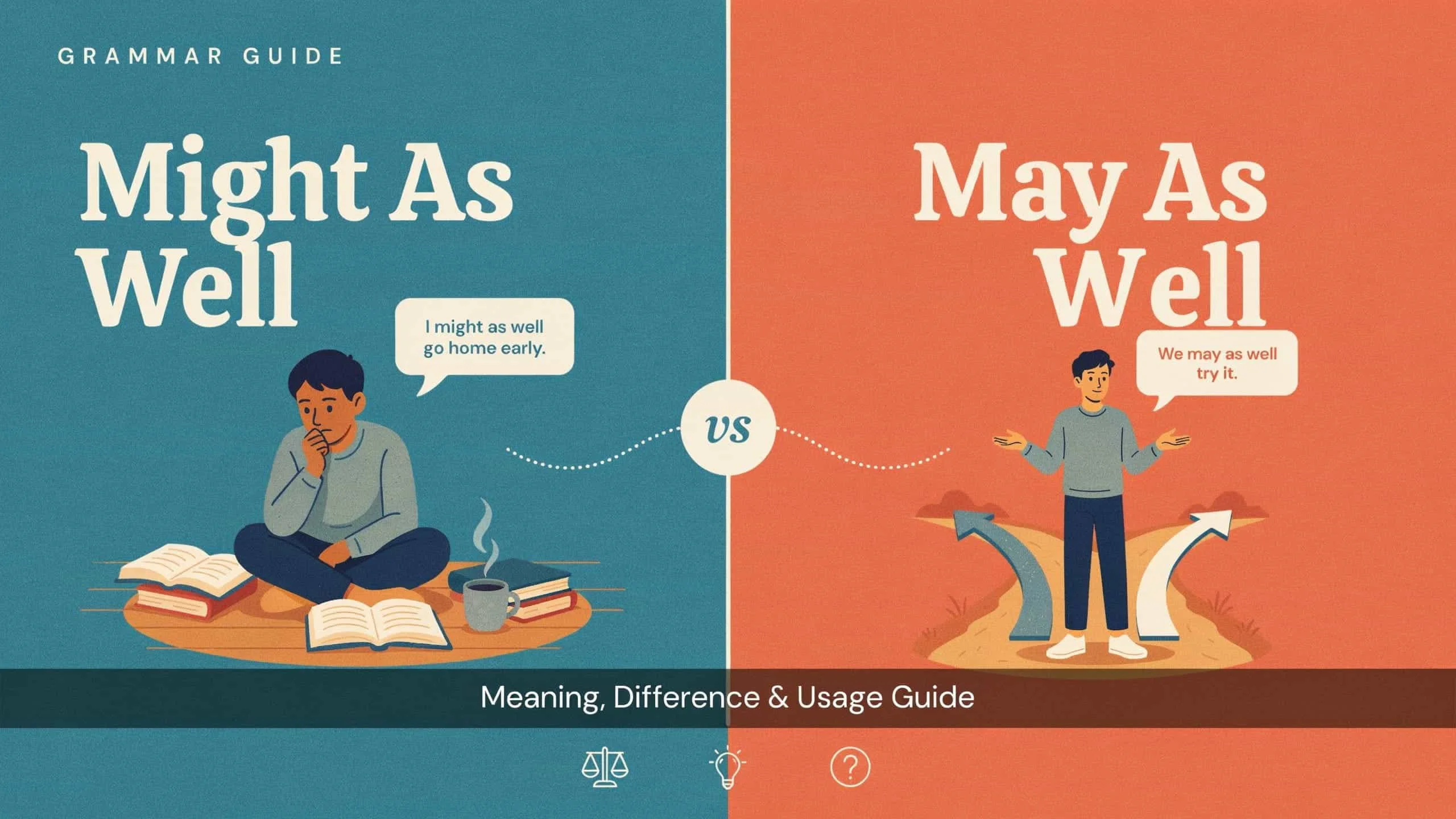
Mine as Well or Might as Well is a common English grammar confusion, but the correct expression is “might as well.” The phrase “mine as well” is usually a mistake caused by how the phrase sounds in spoken English, not how it is actually written. People often wonder is it mine as well or might as well, or even ask is it might as well or mine as well, but grammatically, only might as well is correct in standard English. It is used to show that something is the best or only reasonable option in a situation. In short, when comparing mine as well vs might as well, the correct choice is always might as well unless “mine” is used in a very rare possessive context.
Quick Answer: Is It Mine as Well or Might as Well?
The correct phrase is “might as well.”
“Mine as well” is usually incorrect and comes from mishearing the phrase in spoken English.
Why?
- Might as well = correct idiomatic expression meaning “there is no better option.”
- Mine as well = incorrect in most cases because “mine” is a possessive pronoun and does not fit grammatically.
Quick Summary Table
| Phrase | Correct? | Meaning | Usage |
|---|---|---|---|
| Might as well | ✅ Yes | No better option / suggestion | Common |
| Mine as well | ❌ Usually No | Misheard form | Rare / incorrect |
AI Summary Overview
The confusion between “mine as well or might as well” is a common English grammar mistake, but the correct phrase is “might as well.” It is an idiomatic expression used to suggest that something is the most reasonable or only available option in a situation. The incorrect form “mine as well” usually comes from mishearing spoken English, where “might as well” sounds similar due to fast pronunciation.
The phrase “might as well” is grammatically correct and follows a simple structure: subject + might as well + base verb. It is widely used in both spoken and written English to express suggestion, acceptance, or lack of better alternatives. For example, “We might as well leave now” means there is no strong reason to wait.
On the other hand, “mine as well” is only correct in rare cases where “mine” refers to possession in a conversational reply, but it is not used in standard grammar. Learners often confuse it due to phonetic similarity, making it one of the most common English misinterpretations.
Additionally, the phrase “as well as” is different and means “in addition to,” often used to add extra information in sentences. It is commonly used in formal writing and professional communication, with alternatives like “in addition to,” “along with,” and “not only… but also.”
In summary, “might as well” is the correct and standard expression, while “mine as well” is generally incorrect. Understanding this difference helps improve grammar accuracy, avoid common mistakes, and enhance both written and spoken English fluency.
Is It Mine as Well or Might as Well?
This is one of the most searched grammar confusion queries online. The simple answer is that “might as well” is the only standard and correct phrase in English writing and speech.
Many learners type or say mine as well because English pronunciation often blends sounds together, making “might as” sound like “mine as.”
Is It Might as Well or Mine as Well?
To clear the confusion completely, “might as well” is always correct in standard English usage.
The phrase works as a modal expression and cannot be replaced with “mine” because:
- “Might” shows possibility or suggestion
- “Mine” shows possession
These two words serve completely different grammatical roles.
What Does “Might as Well” Mean?
The phrase might as well means:
There is no better option available, so this action is acceptable or reasonable.
It is often used when:
- You are slightly unsure but decide to do something anyway
- There is no strong reason not to do it
- You are making a practical suggestion
Example meanings:
- We might as well leave now → There is no reason to wait
- I might as well finish it today → It makes sense to complete it
This phrase is extremely common in everyday conversational English.
Why Do People Say “Mine as Well”?
People often confuse this phrase due to pronunciation similarity. This is known as an eggcorn, where a misheard phrase is written incorrectly but sounds logical to the speaker.
Key reasons:
- Fast speech blends “might as well” → sounds like “mine as well”
- Non-native speakers write what they hear
- Lack of exposure to written grammar rules
- Informal spoken English influence
Important Insight
In linguistics, this is called a phonetic misinterpretation, not a grammar rule.
Mine as Well vs Might as Well: What’s the Difference?
The comparison mine as well vs might as well is essential for understanding correctness.
Comparison Table
| Feature | Might as Well | Mine as Well |
|---|---|---|
| Grammar correctness | ✔ Correct | ❌ Incorrect |
| Usage | Idiomatic expression | Misheard phrase |
| Meaning | Suggestion / option | No valid meaning |
| Writing | Formal & informal | Not recommended |
| Acceptance | Standard English | Non-standard |
Only might as well should be used in writing, exams, and professional communication.
Is “Mine as Well” Ever Correct?
In very rare cases, “mine as well” can appear grammatically correct when “mine” refers to possession.
Example:
- A: Your hands are cold?
- B: Mine as well. (meaning my hands are also cold)
However:
- This usage is extremely rare
- It is not the same as the idiomatic phrase “might as well”
So in 99.9% of cases, avoid it completely.
Get Past or Get Passed: Which Phrase Is Correct in English?
Learn the spelling rules, regional differences, and real-world examples.
How to Use “Might as Well” Correctly
The phrase follows a simple structure:
Subject + might as well + base verb
Examples:
- I might as well go home early
- We might as well start the meeting
- You might as well tell the truth
This structure is used in both spoken and written English.
Examples of “Might as Well” in Sentences
Everyday Use:
- It’s raining, we might as well stay inside
- Since we are already here, we might as well eat
Formal Use:
- We might as well proceed with the current plan
- The team might as well finalize the proposal today
Informal Use:
- I might as well grab a coffee
- You might as well join us
Is it “you might as well” or “mine as well”?
The correct phrase is “you might as well.” “Mine as well” is not correct in this context and is usually the result of mishearing the phrase in spoken English.
Why “you might as well” is correct:
- Might as well expresses a suggestion or the best available option
- Adding “you” simply makes it directed at someone
- Example: You might as well start now if you’re ready.
Why “mine as well” is wrong here:
- “Mine” is a possessive pronoun
- It does not function as a modal verb like “might”
- So it cannot form this structure in standard grammar
Is mine as well correct?
In most cases, “mine as well” is NOT correct.
Correct usage (rare exception):
It can only be correct when “mine” replaces a noun in a conversational reply.
Example:
- A: My hands are cold
- B: Mine as well (meaning: my hands are also cold)
But in general usage:
- ❌ We mine as well go home
- ✔ We might as well go home
👉 So in 99% of cases, avoid “mine as well.”
Is “might as well” grammatically correct?
Yes, “might as well” is completely grammatically correct and widely used in English.
Grammar structure:
Subject + might as well + base verb
Meaning:
It shows:
- No better option exists
- A logical or practical suggestion
Examples:
- I might as well stay home today
- We might as well finish the work now
- You might as well ask him directly
How to use “as well as” correctly?
“As well as” is used to add extra information. It means “in addition to.”
Structure:
A as well as B
Examples:
- She speaks English as well as French
- He is talented as well as hardworking
- The shop sells clothes as well as shoes
Important rule:
- The verb agrees with the first subject, not the second
- Example: The teacher as well as the students is present.
How to professionally say “as well as”?
In formal or professional writing, you can replace “as well as” with more polished alternatives:
Formal alternatives:
- In addition to
- Along with
- Together with
- Not only… but also
- Plus
- Coupled with
Examples:
- In addition to marketing, she handles sales
- Not only skilled but also experienced
- He manages HR along with finance
👉 “In addition to” is the most professional replacement.
What are 10 examples of sentences?
Here are 10 correct and natural English sentences using different structures:
- You might as well finish the task today.
- We might as well leave early since it’s raining.
- She speaks Spanish as well as English.
- He is smart as well as creative.
- In addition to studying, he works part-time.
- You might as well tell the truth now.
- The team as well as the manager is ready.
- I might as well try my luck.
- She is kind as well as helpful.
- They might as well cancel the meeting.
Examples of Incorrect Usage
Understanding mistakes helps avoid them:
❌ We mine as well leave now ❌ You mine as well call her ❌ I mine as well try it
Correct versions:
✔ We might as well leave now ✔ You might as well call her ✔ I might as well try it
May as Well vs Might as Well
These two are often interchangeable.
- May as well = slightly more formal
- Might as well = more common in spoken English
Example:
- You may as well start now
- You might as well start now
Both are correct, but might as well is more widely used.
Mind as Well vs Might as Well
Another common mistake is mind as well, which is incorrect.
Why it’s wrong:
- “Mind” has no grammatical connection to the phrase
- It is simply a spelling misinterpretation
Correct phrase: ✔ Might as well
Why Does “Might as Well” Sound Like “Mine as Well”?
This confusion happens due to connected speech in English.
Key factors:
- Rapid pronunciation in casual speech
- Weak emphasis on “t” sound in “might”
- Blending of sounds in natural conversation
This is why spoken English often differs from written English.
Is “Might as Well” an Idiom?
Yes, “might as well” is an English idiomatic expression.
Meaning:
It expresses a practical decision when no better option exists.
Idioms like this often confuse learners because:
- They do not translate word-for-word
- They depend on context
Common Grammar Mistakes Like “Mine as Well”
English learners often confuse similar expressions:
| Incorrect | Correct |
|---|---|
| should of | should have |
| could care less | couldn’t care less |
| alot | a lot |
| suppose to | supposed to |
| bare with me | bear with me |
These mistakes behave similarly to mine as well vs might as well confusion.
Tips to Remember the Correct Phrase
To avoid mistakes:
- Remember: “might” = possibility, not possession
- Focus on structure, not sound
- Think: “no better option” = might as well
- Read more written English to reduce phonetic errors
Can You Use “Might as Well” in Formal Writing?
Yes, but carefully.
Usage:
- ✔ Acceptable in essays and reports
- ✔ Common in business writing
- ✔ Natural in conversational tone
However:
- Avoid overusing it in academic writing
Synonyms and Alternatives
Instead of repeating “might as well,” you can use:
- may as well
- it would be best to
- there is no harm in
- why not
- no better option
Frequently Asked Questions
Is it mine as well or might as well?
The correct phrase is might as well.
Is it might as well or mine as well?
Might as well is correct.
Mine as well vs might as well?
Only might as well is grammatically correct.
What does might as well mean?
It means there is no better option available.
Why do people say mine as well?
Because of pronunciation confusion in spoken English.
Is mine as well ever correct?
Rarely, only in possessive contexts.
Conclusion
The confusion between mine as well or might as well is very common, but the correct expression is always might as well in standard English. The phrase is used to show that something is the most reasonable or only available option. While “mine as well” may appear in speech due to pronunciation, it is not grammatically correct in most situations.
If you remember one rule, let it be this:
“Might” expresses possibility — “Mine” expresses possession — only one belongs in this phrase.
Mastering this difference will instantly improve your grammar accuracy and help you avoid one of the most common English mistakes in both writing and speaking.