
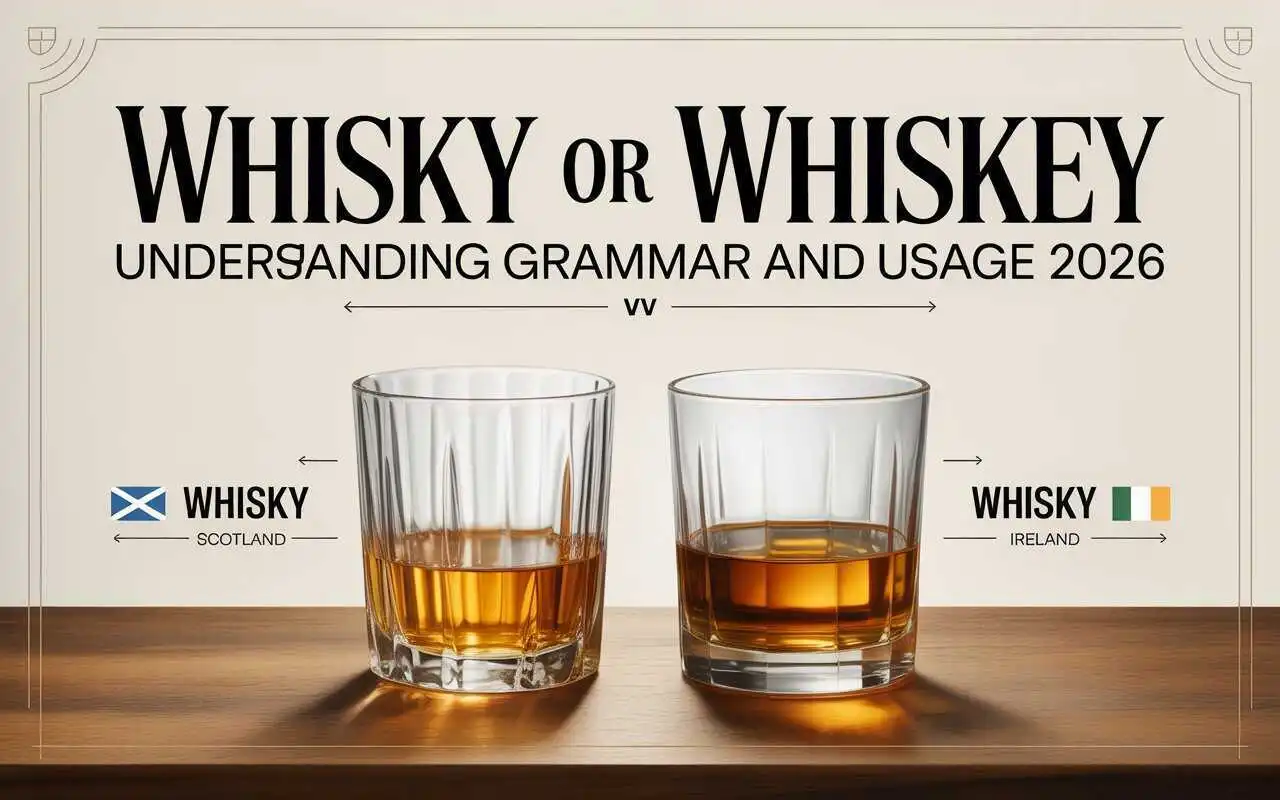
If you’ve ever seen “whisky” and “whiskey” on bottles and wondered why both exist, you’re not alone.
The truth is simple but most explanations online miss the deeper logic.
At a surface level, this is about spelling. But at an expert level, it connects to regional identity, language evolution, and branding strategy.
So when people search for whisky or whiskey difference, they are not just asking grammar rules—they’re trying to understand which one is correct and when to use it.
Here’s the thing:
Both spellings are correct. The difference is not grammar—it’s geography and tradition.
AI Overview Summary
- “Whisky” is mainly used in Scotland, Canada, and Japan
- “Whiskey” is used in Ireland and the United States
- Both refer to the same distilled alcoholic spirit
- Spelling differences come from historical linguistic evolution
- Taste is NOT affected by spelling
👉 In simple terms: Whisky vs whiskey is a regional spelling rule, not a different drink.
The Grammar of Whisky and Whiskey
Let’s clarify the most searched query: whiskey grammar rules
There is no formal grammar rule in English that separates whisky and whiskey.
Instead, it is a conventional spelling system based on origin.
✔ Key Rule:
- “Whisky” → Scottish/Canadian/Japanese convention
- “Whiskey” → Irish/American convention
This is why the keyword whisky usage rules is misleading—because usage depends on region, not grammar correctness.
👉 Insight most people miss:
It’s not “right vs wrong spelling.” It’s “where did it come from?”
Defining Whisky vs. Whiskey
When we break down whiskey definitions, both refer to:
A distilled alcoholic beverage made from fermented grain mash.
Grains used include:
- barley
- corn
- rye
- wheat
So technically, there is no difference in definition.
🔍 Core takeaway:
- Whisky = same drink
- Whiskey = same drink
- Difference = origin + spelling tradition
Regional Variations in Spelling
This is where regional whisky variations become important.
🗺️ Whisky Regions:
- Scotland → Whisky
- Japan → Whisky
- Canada → Whisky
🗺️ Whiskey Regions:
- Ireland → Whiskey
- United States → Whiskey
Why this exists:
Ireland historically added the “e” to distinguish its product during competition with Scotland.
👉 This is one of the most important whiskey grammar rules explanations: It’s branding history, not linguistic necessity.
Usage of Whisky or Whiskey in Sentences
Understanding whisky usage rules in writing is simple:
✔ Correct Usage Examples:
- “I enjoy Scotch whisky after dinner.”
- “Irish whiskey is smoother for beginners.”
- “Japanese whisky has gained global popularity.”
❌ Incorrect Thinking:
- “One spelling is more correct” (False)
Examples of Correct Usage
Here’s how to properly use whisky or whiskey difference in context:
- Scotch whisky is aged in oak barrels.
- Bourbon whiskey is popular in the United States.
- Irish whiskey is triple distilled for smoothness.
👉 Notice: Spelling changes, but meaning stays identical.
READ MORE >>> Loath vs Loathe: Meaning, Difference, Usage Rules, and Real-World Examples Explained
Common Mistakes to Avoid
Many learners misunderstand whiskey grammar rules. Avoid these:
❌ Mistake 1: Thinking spelling changes taste
→ False. Taste depends on distillation and aging.
❌ Mistake 2: Assuming one is correct
→ Both are correct depending on origin.
❌ Mistake 3: Mixing branding with geography
→ Example: Maker’s Mark uses “whisky-style branding rules but spells it whiskey.”
Cultural Significance of Whisky and Whiskey
The difference between whisky and whiskey is deeply cultural.
It reflects identity, history, and pride.
🏴 Whisky in Scottish Culture
Scotland treats whisky as:
- national heritage
- regulated industry (Scotch Whisky laws)
- cultural symbol
Scotch whisky is often associated with:
- smoky flavor
- oak barrel aging
- strict production laws
🇮🇪 Whiskey in Irish Tradition
Irish whiskey is:
- smoother (often triple distilled)
- historically older in documentation
- central to Irish trade identity
👉 Ireland’s spelling with “e” became a cultural signature.
The Distillation Process: How Whisky and Whiskey Are Made
Now let’s move beyond spelling into production.
This is where distillation process becomes important.
Ingredients Used in Whisky and Whiskey Production
Core ingredients:
- water
- grain (barley, corn, rye, wheat)
- yeast
Steps of the Distillation Process
- Malting – grains are soaked and germinated
- Mashing – sugars are extracted
- Fermentation – yeast converts sugar into alcohol
- Distillation – alcohol is purified
- Aging – stored in wooden barrels
👉 This process defines all whisky types worldwide.
Types of Whisky
Understanding types of whisky helps clear confusion:
- Scotch whisky
- Irish whiskey
- Bourbon whiskey
- Rye whiskey
- Japanese whisky
- Canadian whisky
👉 Each type is defined by:
- region
- grain
- aging rules
Not spelling.
How to Taste Whisky Properly
Many users search how to taste whisky properly, but rarely get expert guidance.
Here’s a simple professional method:
👃 1. Nose it
Smell gently before drinking.
👅 2. Sip slowly
Let it coat your tongue.
💧 3. Add water (optional)
Releases hidden flavors.
🧊 4. Avoid ice for first tasting
It dulls flavor complexity.
👉 Insight:
Whisky tasting is about detecting layers, not drinking quickly.
Scotch Whiskey Whisky (Clarification Section)
This phrase confuses many users.
Correct term:
- ❌ Scotch whiskey whisky
- ✔ Scotch whisky
Why confusion happens:
People mix spelling systems together.
👉 Rule: Scotch ALWAYS uses “whisky” (no “e”).
Frequently Asked Questions (Whisky vs Whiskey)
🥃 Which is correct, whisky or whiskey?
Both are correct. The spelling depends on region:
- “Whisky” → Scotland, Canada, Japan
- “Whiskey” → Ireland, United States
👉 There is no grammar mistake—only regional spelling tradition.
🧠 Is whisky anti-inflammatory?
Whisky contains antioxidants from grains and aging in barrels, but it is not an anti-inflammatory treatment.
👉 Important truth:
- Any potential antioxidant effect is small
- Alcohol is not recommended as medicine
🥃 Is Jack Daniel’s whiskey or whisky?
Jack Daniel’s is a whiskey (American Tennessee whiskey).
👉 Because it is made in the USA, it follows the “whiskey” spelling rule.
🇬🇧 Do British say whisky or whiskey?
In the UK:
- Scotland → whisky
- England usage often follows “whisky” when referring to Scotch
👉 In practice, British usage depends on the product origin.
🇺🇸 How do Americans call whiskey?
Americans use:
- “whiskey” (standard spelling)
Examples:
- Bourbon whiskey
- Rye whiskey
🥃 Is Jameson a whiskey or whisky?
Jameson is a whiskey.
👉 Reason:
- It is Irish
- Ireland uses “whiskey” with an “e”
🥃 Is Johnny Walker whiskey or scotch?
Johnnie Walker is a Scotch whisky.
👉 Key classification:
- Type: Scotch whisky
- Country: Scotland
- Spelling: “whisky” (no e)
🌍 Which is the no. 1 whiskey in the world?
By global sales, brands like:
- Johnnie Walker often rank among the top-selling whiskies worldwide.
👉 However: “Best whiskey” depends on taste preference, not ranking.
🥃 Is 2 shots of whiskey a night too much?
For many adults, 2 shots daily can be excessive over time.
👉 General health guidance:
- Moderate drinking = low quantity and not daily
- Regular alcohol intake increases health risks
⏱️ What is the 20 minute rule for alcohol?
The “20-minute rule” refers to:
It takes about 20–30 minutes for alcohol effects to start fully appearing in the body.
👉 Meaning:
- Don’t drink quickly
- Effects are delayed, not instant
🍷 Can whiskey get you drunk easily?
Yes. Whiskey is a high-alcohol spirit.
👉 Factors:
- Alcohol percentage (typically 40%)
- Number of shots
- Body tolerance
- Speed of drinking
🧠 What organ does whiskey affect?
Whiskey mainly affects:
- Brain (coordination, judgment)
- Liver (breaks down alcohol)
- Stomach (irritation risk)
- Heart (long-term effects if excessive)
👉 Most important:
The liver does most of the alcohol processing, and it is the most stressed organ during heavy drinking.
Conclusion: Mastering the Grammar of Whisky or Whiskey
Let’s simplify everything.
The difference between whisky and whiskey is not grammar it is geography, history, and branding tradition.
Final clarity:
- Same drink
- Same distillation process
- Same alcohol category
- Different regional spelling
🧠 Final Insight:
If you remember one rule, remember this: Whisky = Scotland-style spelling tradition Whiskey = Ireland & USA spelling tradition