
Quick Answer
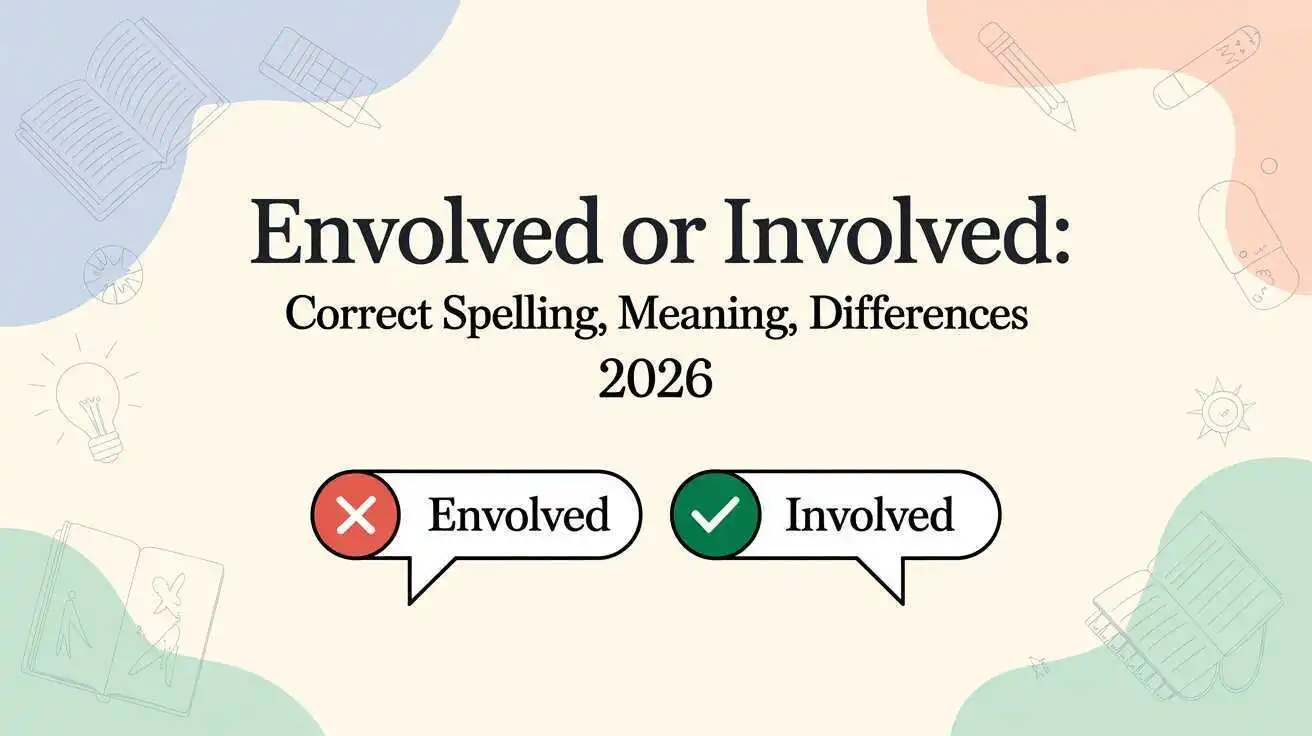
“Envolved or Involved” “Involved” is the correct spelling in English. “Envolved” is a common spelling mistake caused by pronunciation confusion and typing habits. You should always use “involved” in writing, whether formal or casual. The same rule applies to “involve” and “involvement,” while “envolved,” “envolve,” and “envolvement” are not standard English words.
AI Overview Summary
If you only remember a few things, remember this:
- “Involved” is correct; “envolved” is incorrect
- The mistake comes from how the word sounds in fast speech
- English pronunciation often misleads spelling
- “Involve” and “involvement” follow the same pattern
- “Envolved” is not found in standard dictionaries
In short: sound tricks your brain, spelling corrects it.
Envolved or Involved: Let’s Clear the Confusion
Here’s the thing—this is one of those grammar doubts almost everyone has typed into Google at least once.
You’re writing something important… maybe a message, an email, or even an assignment… and suddenly you pause:
Is it envolved or involved?
It feels like both could be right. But only one actually is.
And once you understand why, you’ll never make this mistake again.
Let’s break it down properly.
Is It Envolved or Involved?
The correct spelling is involved.
“Envolved” is simply a spelling error that happens when people write words based on how they sound instead of how they are structured in English.
Simple rule:
- Correct: involved
- Incorrect: envolved
Most people miss this because English pronunciation can be misleading. You hear “in-volved” quickly in speech, and your brain sometimes turns it into “en-volved.”
But in writing, that doesn’t work.
What Does “Involved” Mean?
Before we go deeper, let’s understand the word itself.
Involved generally means:
- being part of something
- participating in an activity
- being connected to something
- something complicated or detailed
Examples:
- She is involved in the project.
- He got involved with the wrong crowd.
- It’s an involved process that takes time.
Notice something? The word changes meaning slightly depending on context—but the spelling stays the same.
Why “Envolved” Feels Correct (But Isn’t)
This is where things get interesting.
Your brain is not bad at spelling—it’s actually too smart in a shortcut way.
Here’s what happens:
When you hear the word in fast speech:
- “involved” can sound like “envolved”
- your brain maps it to familiar patterns
- “en-” words exist (enjoy, enter, enable)
So it creates a false match.
That’s why envolved or involved confusion is so common, especially for learners and fast typists.
READ MORE >>> Companywide or Company Wide: Meaning, Grammar Rule, and When to Use Each Form
Involve or Envolve: Which One Should You Use?
Let’s clear another common confusion while we’re here.
The correct form is:
👉 involve
“Envolve” is not standard English.
Examples:
- We want to involve everyone in the discussion.
- Try to involve students in group work.
Why people get confused:
Because verbs often change forms:
- involve → involved → involving
But “envolve” never existed in standard English usage.
Involvement or Envolvement: What’s Correct?
Same pattern again.
- Correct: involvement
- Incorrect: envolvement
Examples:
- Her involvement in the case was confirmed.
- Student involvement improves learning.
If you remember one rule, remember this:
If the root is “involve,” everything stays inside that structure.
No “e” prefix ever enters.
Why This Mistake Happens So Often
Most grammar guides don’t explain this part properly, but it’s actually the key to understanding everything.
1. Sound-based spelling habit
You write what you hear.
But English doesn’t always follow sound rules.
2. Fast typing psychology
When typing quickly:
- your brain skips checking structure
- it relies on “feels right” spelling
3. Pattern interference
Words like:
- envelope
- enclose
- enable
all start with “en-”, so your brain assumes similarity.
That’s why envolved looks visually acceptable—even though it’s wrong.
The Sound-to-Spelling Trap Framework
Let’s make this simple and memorable.
Step 1: You hear the word
You hear “involved” in conversation.
Step 2: Your brain simplifies sound
It becomes “en-volved” mentally.
Step 3: Pattern bias kicks in
Your brain picks a familiar prefix (“en-”).
Step 4: You write the wrong form
“Envolved” appears on screen.
Step 5: Spellcheck corrects it
But only if you’re lucky.
Key Insight
You are not confused about meaning—you are confused by sound.
That’s the real issue.
Quick Comparison Table Envolved or Involved
| Word | Correct? | Meaning |
|---|---|---|
| involved | Yes | connected, participating, complicated |
| envolved | No | incorrect spelling |
| involve | Yes | to include or participate |
| envolve | No | not standard English |
| involvement | Yes | participation or connection |
| envolvement | No | incorrect spelling |
Different Meanings of “Involved”
This word is more flexible than most people realize.
1. Participation meaning
She is involved in community work.
2. Emotional meaning
He became emotionally involved.
3. Complexity meaning
It’s an involved explanation.
Real Insight
Most learners only know one meaning.
But in real English usage, “involved” changes meaning based on context, which is why it appears so often in writing.
Mini Case Study: A Real Writing Mistake Envolved or Involved
A student once submitted a college application essay with the sentence:
“I was envolved in many school activities.”
Everything else in the essay was strong. Good structure, good ideas.
But that one spelling mistake changed the perception.
The result?
The teacher’s comment was simple:
“Spelling needs attention.”
That’s it.
No explanation. No debate.
Lesson here:
Even small spelling errors like envolved vs involved can quietly affect credibility.
Not because the idea is wrong—but because attention to detail matters.
When This Mistake Becomes a Problem
Let’s be real.
You won’t get judged for this in casual texting.
But it matters in:
- job applications
- academic writing
- professional emails
- LinkedIn posts
Because in those contexts, people expect precision.
And spelling is the first signal of that precision.
Expert Tip: How to Never Misspell It Again
Here’s a simple trick that actually works.
The “IN = Inside” Memory Trick
- “involved” = being inside something
- if you are inside, you are involved
So:
👉 IN = correct 👉 EN = wrong
It’s simple, but it sticks.
Another Pattern Trick
Think of:
- involve → involved → involvement
All forms stay inside the same root word.
No prefix change. No “en-” variation.
Envolved or Involved: Final Clarity
Let’s settle it cleanly.
- Involved is correct in all contexts
- Envolved is always incorrect
- Same rule applies to involve and involvement
If you ever feel unsure again, just remember:
English spelling is based on structure, not sound.
Frequently Asked Questions
What is the correct way to spell “involved”?
The correct spelling is involved. “Envolved” is not correct English and should not be used in writing.
Direct answer: Always use involved in all contexts, including academic, professional, and casual writing.
What does “involved” mean?
“Involved” means being part of something or connected to something.
It can also mean something that is complicated or detailed.
Examples:
- She is involved in the project.
- The situation is very involved (meaning complex).
Direct answer: “Involved” means participating, connected, or complex depending on context.
What’s the difference between involve and include?
These two are related but not the same.
- Involve = something is necessary or part of a process
- Include = something is added as part of a group
Examples: Envolved or Involved
- This job involves teamwork (required part)
- The course includes three modules (added parts)
Direct answer: “Involve” means participation or requirement, while “include” means addition or listing.
What’s the difference between Envolved or Involved?
There is no standard English word “envolve.”
- Involve = correct verb
- Envolve = spelling mistake or typo
Direct answer: “Involve” is correct; “envolve” is not used in English.
Is “envolved” a commonly used word?
No, “envolved” is not a real or commonly used English word.
It appears only as:
- a spelling mistake
- a typing error
- confusion from pronunciation
Direct answer: “Envolved” is incorrect and not used in standard English.
What can I say instead of “involved”?
Depending on context, you can use:
Alternatives:
- participated
- engaged
- included
- connected
- part of
- entangled (for complex situations)
- committed (for emotional or serious involvement)
Examples: Envolved or Involved
- She was engaged in the discussion.
- He was part of the team.
Direct answer: Use alternatives like engaged, part of, connected, depending on meaning.
What does evolved and involved mean?
These are two completely different words:
- Evolved = developed or changed over time
- Involved = connected, participating, or complicated
Examples:
- Humans have evolved over time.
- He is involved in the project.
Direct answer: “Evolved” means development over time; “involved” means participation or connection.
What does “evolved” mean?
“Evolved” means something has gradually developed or changed into a more advanced form.
Examples: Envolved or Involved
- Technology has evolved quickly.
- Species have evolved over millions of years.
Direct answer: “Evolved” means gradual development or change over time.
Final Thoughts
This confusion between envolved or involved is actually more common than most grammar mistakes.
And honestly, it’s not about intelligence—it’s about how English tricks your ears.
But once you understand the pattern, it becomes effortless.
So next time you type it, don’t second guess yourself.
You already know the answer.
It’s always involved.