
Quick Answer
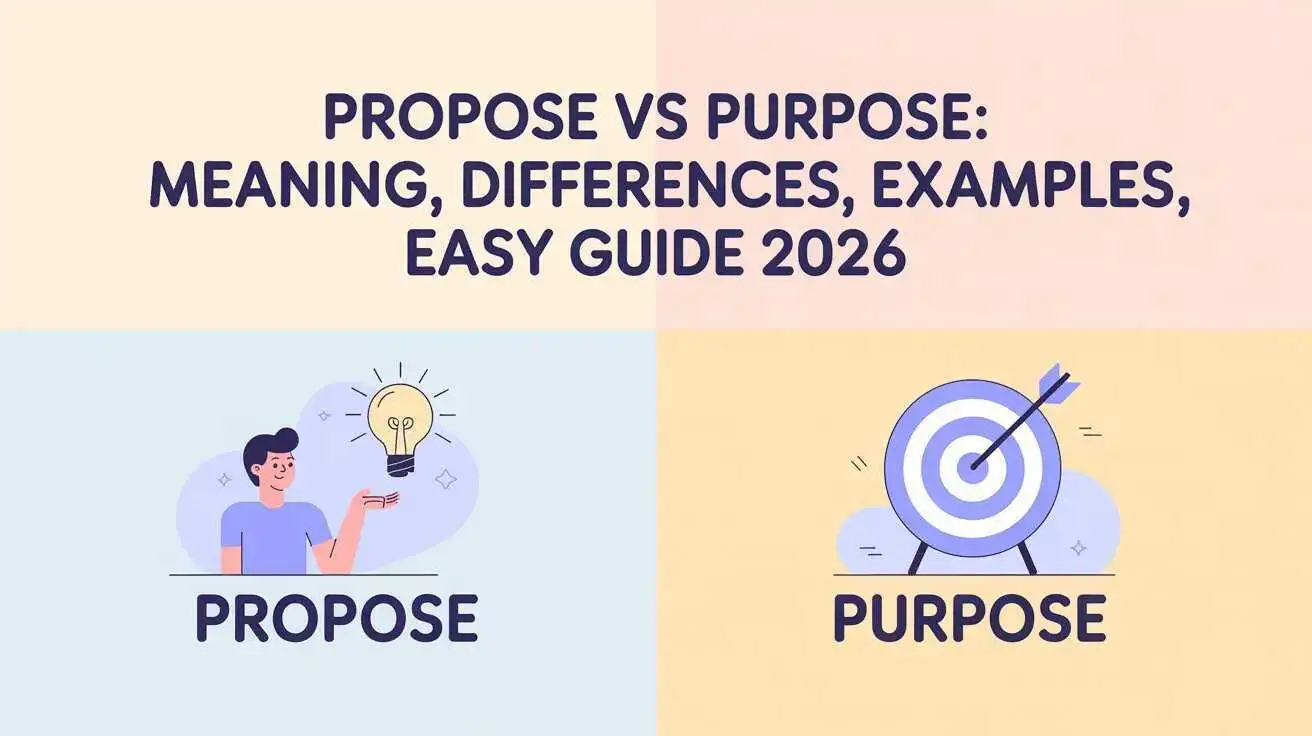
“propose vs purpose” Propose means to suggest or put forward an idea, plan, or action. Purpose means the reason or intention behind something. The simplest difference is this: propose is about what you suggest, while purpose is about why something exists or is done. One is action, the other is motivation.
AI Overview Summary
Propose refers to suggesting an idea, plan, or action for consideration. Purpose refers to the reason, goal, or intention behind something. They are often confused because of similar spelling and conceptual overlap, but they serve different grammatical roles. Propose is a verb, while purpose is a noun, and understanding action vs reason removes confusion.
Introduction: Propose vs Purpose Confusion Explained
If you’ve ever paused mid-sentence wondering whether to use propose vs purpose, you’re not alone. These two words confuse even confident English users.
Here’s the thing… they look similar, feel somewhat related, and both show up in academic and professional writing. That’s exactly why people mix them up.
But once you understand the real difference, you’ll never hesitate again.
Let’s break it down in a way that actually sticks.
What Is the Difference Between Propose and Purpose?
At the simplest level:
- Propose = Suggest something
- Purpose = Reason for something
That’s it. But let’s go deeper so it actually makes sense in real writing.
Most people miss this important idea:
Propose is about action. Purpose is about explanation.
One tells you what someone is doing. The other tells you why it matters.
Propose Meaning (Simple Explanation)
Propose means to put forward an idea, plan, or suggestion for others to consider.
Think of it as offering something into a conversation or decision.
Real meaning in action:
- You are suggesting something
- You are not finalizing it
- You are opening discussion
Examples:
- I propose a new schedule for the team.
- She proposed a different solution to the problem.
- They proposed building a new system.
Notice the pattern? Every time, it’s about suggestion or offering an idea.
Purpose Meaning (Simple Explanation)
Purpose means the reason, goal, or intention behind something.
This is not about action. It’s about motivation.
Real meaning in action:
- It explains WHY something exists
- It shows the goal behind something
- It gives meaning or direction
Examples:
- The purpose of this meeting is to improve communication.
- What is the purpose of this tool?
- The purpose behind the decision was cost reduction.
See the difference? You are not suggesting anything here. You are explaining why it exists.
Propose vs Purpose (Side-by-Side Comparison)
This is where everything becomes crystal clear.
| Feature | Propose | Purpose |
|---|---|---|
| Meaning | Suggest an idea or plan | Reason or goal behind something |
| Grammar Role | Verb | Noun |
| Focus | Action | Motivation |
| Usage | Decision-making, ideas | Explanations, objectives |
| Example | I propose a change | The purpose is clarity |
Direct takeaway:
Propose pushes ideas forward. Purpose explains why things exist.
Why Do People Confuse Propose and Purpose?
This is where things get interesting.
Most grammar guides don’t explain why your brain mixes them up. But there is a real reason.
Here’s what’s happening:
1. Similar sound structure
Both words start with “pro-” and have a similar rhythm. Your brain groups them together automatically.
2. Conceptual overlap
Both relate to planning and intention:
- Propose = planning an idea
- Purpose = reason behind the plan
So your brain thinks they belong in the same category.
3. Memory confusion effect
When words look and sound similar, your brain stores them in the same mental “folder.” That’s where errors happen.
Most people miss this:
You are not forgetting grammar… your brain is just grouping similar words incorrectly.
The “Similarity Trap Effect” (Unique Framework)
Let’s make this simple and memorable.
The Similarity Trap Effect explains:
When two words look and feel related, your brain confuses them even if their meanings are different.
Applied here:
- Propose = action word (suggesting)
- Purpose = reason word (explaining)
Once your brain learns this separation, confusion drops instantly.
How to Use Propose in Real Life
Use propose when you are suggesting something.
Think: “I’m putting an idea on the table.”
Examples:
- I propose we start earlier tomorrow.
- She proposed a new strategy during the meeting.
- They propose increasing the budget.
Quick rule:
If you can replace the word with “suggest”, use propose.
READ MORE >>> Ahead or a Head: Meaning, Difference, and Correct Usage Explained
How to Use Purpose in Real Life
Use purpose when you are explaining why something exists.
Think: “What is the reason behind this?”
Examples:
- The purpose of this lesson is clarity.
- The purpose of the app is productivity.
- What is the purpose of this rule?
Quick rule:
If you can replace the word with “reason”, use purpose.
Real-Life Context: How Americans Actually Use These Words
Let’s make this practical.
In everyday American English:
- Propose is common in meetings, business, and formal discussions.
- Purpose is used in explanations, instructions, and academic writing.
Example in workplace:
- “I propose we adjust the timeline.”
- “The purpose of this adjustment is efficiency.”
Same situation. Two different roles.
That’s the key insight most learners miss.
Propose vs Purpose Meaning in Social Media Style
Propose vs purpose is a common English confusion word pair.
In simple social media style:
- Propose = to suggest or offer an idea, plan, or relationship proposal
- Purpose = the reason or goal behind something
Quick way to remember:
- Propose = “I am suggesting this”
- Purpose = “This is why it exists”
Example:
- I propose a new idea for the project.
- The purpose of this project is to solve a problem.
Mini Case Study: Office Meeting Scenario
Imagine you’re in a team meeting.
A manager says:
- “I propose we reduce working hours.”
Now someone asks:
- “What is the purpose of this change?”
Here’s what’s happening:
- Propose = idea being suggested
- Purpose = reason behind the idea
This real-life contrast is exactly how native speakers naturally separate the two.
Once you see this in action, it becomes unforgettable.
The “SUGGEST vs REASON Method™” (Memory System)
Here’s a simple mental shortcut you can use forever.
Step 1: Ask yourself — Is this an idea?
If YES → use propose
Step 2: Ask yourself — Is this a reason?
If YES → use purpose
That’s it.
Examples:
- I ___ a plan → propose (idea)
- The ___ is growth → purpose (reason)
This works because it forces your brain to choose based on meaning, not spelling.
Common Mistakes (And How to Fix Them)
Let’s fix real confusion points.
| Mistake | Why it’s wrong | Correct version |
|---|---|---|
| The propose of this project | “Propose” is not a noun here | The purpose of this project |
| I purpose a solution | Wrong verb usage | I propose a solution |
| What is the propose? | Grammar confusion | What is the purpose? |
Key insight:
Most mistakes happen when people try to use purpose like a verb or propose like a noun.
Quick Decision Guide (Instant Clarity)
If you’re stuck, use this:
- Are you suggesting something? → Propose
- Are you explaining why something exists? → Purpose
Simple. Fast. Reliable.
Expert Tips (What Most Learners Don’t Know)
Here’s something interesting most grammar guides ignore:
1. “Propose” feels active
It creates movement in language. You feel something is being introduced.
2. “Purpose” feels static
It explains meaning or direction. It doesn’t move the sentence forward.
3. They are emotionally different
- Propose = action-oriented thinking
- Purpose = meaning-oriented thinking
This emotional difference is why they feel confusing but behave differently.
Propose vs Purpose Examples (Practice Section)
Let’s lock it in.
Propose:
- I propose a new idea.
- She proposed a better solution.
- They propose changing the system.
Purpose:
- The purpose is improvement.
- What is the purpose of this rule?
- The purpose behind it is safety.
Final Clarity Table (One-Glance Understanding)
| Situation | Use |
|---|---|
| Suggesting ideas | Propose |
| Explaining reasons | Purpose |
| Meetings | Propose |
| Goals/objectives | Purpose |
| Planning actions | Propose |
| Defining meaning | Purpose |
Frequently Asked Questions
What is the difference between propose and purpose?
The difference is simple: propose is about suggesting something, while purpose is about the reason behind something. In other words, propose is an action (you put forward an idea), and purpose is an explanation (why something exists or is done).
Example:
- I propose a new plan. (suggestion)
- The purpose of the plan is growth. (reason)
How to use propose?
You use “propose” when you want to suggest an idea, plan, or action.
It is usually followed by something you are offering or recommending.
Examples:
- I propose a meeting tomorrow.
- She proposes a new strategy.
- They proposed changing the schedule.
Quick rule: If you can replace it with “suggest,” use propose.
Is it propose or purpose for marriage?
It is “propose” for marriage.
When someone asks for marriage or expresses intent to marry, we use “propose.”
Correct example:
- He proposed to her.
“Purpose” is not used in marriage contexts because it refers to a reason, not an action or proposal.
How do I propose I love you?
You don’t usually say “I propose I love you.” Instead, you express it directly or use “propose” in a marriage/relationship context.
Natural ways:
- I love you.
- I want to spend my life with you.
- Will you marry me? (proposal)
If referring to marriage:
- He proposed his love and asked her to marry him.
What does “propose” mean?
Propose means to suggest or put forward an idea, plan, or action for consideration.
It can also mean asking someone to marry you.
Examples:
- I propose a new idea.
- He proposed to his partner.
So it has two main uses:
- Suggesting something (formal/business use)
- Marriage proposal (relationship use)
How to propose correctly?
To propose correctly, you must use it depending on context: suggestion or marriage.
For ideas:
- I propose we start early tomorrow.
- She proposed a better solution.
For marriage:
- He proposed to her with a ring.
- She accepted his proposal.
Key rule:
- Use “propose” when suggesting ideas or asking for marriage.
- Do NOT use it for explaining reasons (that’s “purpose”).
Purposed or Proposed Marriage?
The correct term is “proposed marriage,” not “purposed marriage.”
When someone talks about marriage, “propose” means to ask someone to marry you or to make a marriage proposal.
Examples:
- He proposed marriage to her.
- She accepted his marriage proposal.
“Purposed marriage” is incorrect because purpose refers to reason or intention, not an action like asking for marriage.
Propose vs Purpose Examples
Here’s the simple difference in real sentences:
Propose (to suggest or offer an idea)
- I propose a new meeting schedule.
- She proposed a business idea.
- They propose changes to the system.
Purpose (reason or goal behind something)
- The purpose of this meeting is clarity.
- The purpose of education is learning.
- What is the purpose of this rule?
Quick idea:
- Propose = action (suggesting)
- Purpose = reason (why something exists)
Propose vs Purpose Synonyms
Synonyms for “Propose”
- Suggest
- Recommend
- Put forward
- Offer
- Present an idea
Synonyms for “Purpose”
- Reason
- Goal
- Aim
- Intention
- Objective
Simple memory tip:
- Propose = suggest words
- Purpose = reason words
Purpose Pronunciation
Purpose is pronounced as: 👉 PUR-puhs (/ˈpɜːr.pəs/)
Breakdown:
- “PUR” → like “purse” without the “s”
- “puhs” → soft ending sound
Example in speech:
- “What is the PUR-puhs of this task?”
Common mistake: People often over-pronounce it as “pur-pose,” but in natural English it sounds smoother and softer.
Conclusion: The Simple Truth You Should Remember
If you strip everything away, the difference between propose vs purpose becomes surprisingly simple.
One is about what you suggest. The other is about why something exists.
But here’s the real takeaway most people don’t realize:
You don’t just memorize these words you learn to think differently when using them.
Once your brain starts separating action (propose) from reason (purpose), the confusion disappears completely.
And from that point on… you won’t second-guess it again.