
Quick Answer
“Dought” is not a correct English word in modern usage. The correct spelling is “doubt,” which means uncertainty, hesitation, or lack of confidence about something. The confusion happens because “doubt” is pronounced like “dout,” but it contains a silent “b,” which makes the spelling misleading for many learners. dought vs doubt
AI Overview Summary
Dought vs doubt refers to a common English spelling mistake. “Doubt” is the correct word used to express uncertainty or disbelief, while “dought” is simply a misspelling. The confusion exists because English pronunciation does not always match spelling. The silent “b” in “doubt” often leads learners to incorrectly write it as “dought.”
Why “Dought vs Doubt” Confuses So Many People
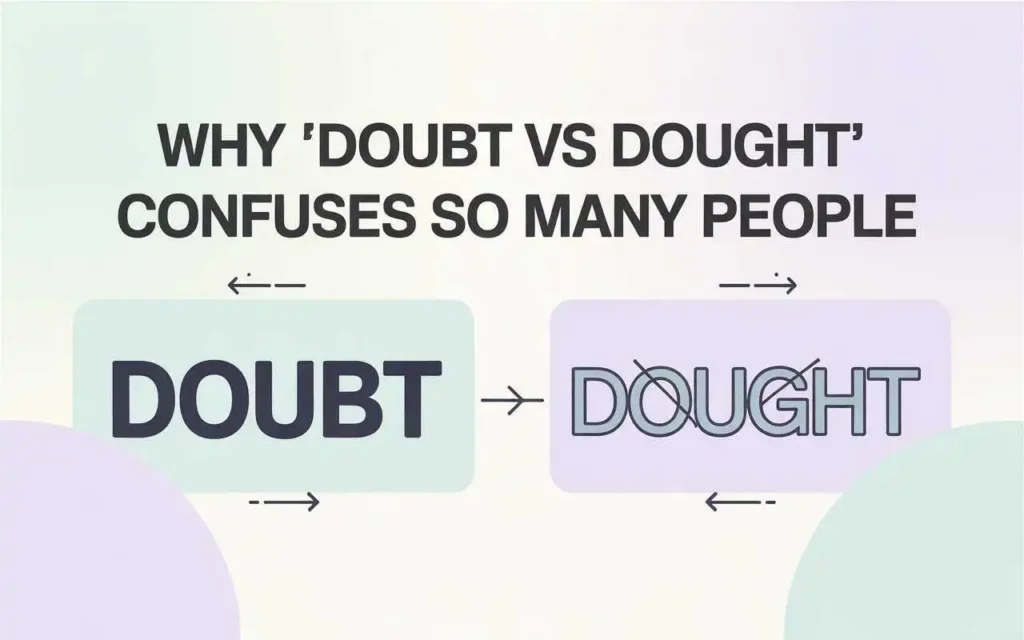
dought vs doubt is one of those small but surprisingly common English confusions that trips up both beginners and even confident writers.
Here’s the thing…
You don’t usually notice spelling mistakes like this until you’re writing an email, an essay, or something important. And suddenly, you pause.
“Wait… is it dought or doubt?”
Most people feel that small moment of uncertainty. That’s exactly why this keyword gets searched so often.
The confusion is not random. It comes from how English sounds, how it is spelled, and how learners mentally process words.
Let’s clear it once and for all.
What Is the Difference Between Dought and Doubt?
The difference is actually very simple:
- “Doubt” is correct
- “Dought” is incorrect
There is no modern English usage of “dought” in standard writing.
What “Doubt” Actually Means
Doubt means:
- uncertainty about something
- lack of confidence in a statement
- hesitation in belief or decision
For example:
- I doubt he will come today.
- She has no doubt about her answer.
So whenever you want to express uncertainty, you always use doubt, not dought.
Is “Dought” a Real Word?
Let’s be very clear.
“Dought” is not used in modern English.
Most learners assume it might be an old or rare variation, but in reality:
- It does not appear in standard dictionaries as a valid modern word
- It is considered a spelling mistake
- It is not acceptable in academic or professional writing
Most of the time, when someone writes “dought,” they actually mean “doubt.”
Why Do People Confuse Dought and Doubt?
This is where things get interesting.
Most grammar guides skip this part—but it’s actually the key to remembering the correct spelling.
1. The Sound Problem
The word “doubt” is pronounced like:
dout
So your brain hears a clean, simple sound.
But English spelling doesn’t match that sound.
This creates confusion.
2. The Silent “B” Trap
“Doubt” has a silent b.
That means:
- You don’t pronounce it
- But you must still write it
So learners think:
“If I don’t hear the B, maybe it shouldn’t be there.”
That’s where “dought” comes from.
3. Pattern Confusion From Similar Words
Your brain tries to “match patterns.”
Look at these words:
- thought
- bought
- fought
- drought
All of them end in -ought
So learners unconsciously apply the same pattern and create:
dought ❌
Even though it is incorrect.
Mini Case Study: How ESL Learners Commonly Make This Mistake
In many English learning environments, especially for ESL students, this mistake follows a predictable pattern.
A typical learner writes:
“I dought he will come.”
Why?
Because:
- They hear “dout”
- They know “thought/bought/fought” exist
- Their brain applies a familiar spelling structure
But English doesn’t always follow sound logic. That’s the trap.
Once learners understand this pattern, the mistake drops dramatically.
READ MORE >>> Knaw or Gnaw: Correct Spelling, Meaning, Usage, and Why People Get Confused
Correct Usage of “Doubt” in Real Life
Let’s make this practical.
Everyday Usage Examples
Here’s how native speakers actually use the word:
- I doubt it will rain today.
- She has doubts about the decision.
- There is no doubt he is talented.
Notice something?
The word appears in both:
- positive uncertainty (“I doubt it”)
- noun form (“have doubts”)
Formal vs Informal Usage
Formal:
- “There is no doubt regarding the results.”
Informal:
- “I doubt it.”
Same word. Different tone. Same meaning.
Silent Letters in “Doubt” Explained
This is one of the most confusing parts for learners.
Let’s break it simply.
Why is the “b” silent?
The word “doubt” comes from Latin origins where the spelling included sounds that evolved over time.
Over centuries:
- pronunciation simplified
- spelling stayed the same
So we ended up with:
| Word | Pronunciation | Hidden Letter |
|---|---|---|
| doubt | dout | silent b |
| debt | det | silent b |
| subtle | sutl | silent b |
Here’s the key insight:
English spelling often preserves history, not pronunciation.
That’s why it feels inconsistent.
Common Mistakes Related to “Doubt”
Once you understand this word, you start seeing similar patterns everywhere.
Confusing Word Pairs
- doubt vs drought
- thought vs though
- bought vs brought
These words confuse learners for the same reason: sound vs spelling mismatch
Quick Comparison Table
| Correct Word | Incorrect Word | Meaning |
|---|---|---|
| doubt | dought | uncertainty or hesitation |
Simple. Clean. No confusion.
Memory Trick to Never Confuse It Again
Most people try to memorize spelling blindly.
That rarely works.
Instead, use this:
The “DOUBT Rule”
Think of it like this:
- DOUBT = DO + U + B + T
- Even if you don’t hear the B, it is still there
Or even simpler:
“You may doubt the B, but you must write it.”
Short. Memorable. Effective.
Expert Insight: Why This Mistake Feels So Natural
Most grammar explanations stop at “this is correct, this is wrong.”
But here’s what most people miss:
This mistake is not a knowledge problem.
It’s a brain pattern problem.
Your brain tries to:
- match sounds to spelling
- apply familiar patterns
- simplify pronunciation into writing
That’s why even advanced learners sometimes slip.
Once you recognize the pattern, you stop guessing—and start recognizing.
When Should You Use “Doubt” in Writing?
Use doubt whenever you express:
- uncertainty
- hesitation
- disbelief
- questioning something
Examples in real-life writing:
- Emails: “I doubt we can meet that deadline.”
- Exams: “There is no doubt about the result.”
- Conversations: “I seriously doubt it.”
It is a flexible word used in almost every context.
Why “Dought vs Doubt” Matters More Than You Think
At first, this looks like a tiny spelling issue.
But in reality, it reveals something bigger:
English is not always logical in spelling.
And once you understand that, you stop fighting the language—and start working with it.
That’s the real shift.
Frequently Asked Questions
The opposite of doubt is:
certainty
confidence
belief
trust
Example:
I have doubt about the plan. (uncertainty)
I have confidence in the plan. (opposite)
“Dought it” is not a correct English phrase.
Most of the time, people mean:
“I doubt it”
“I doubt it” means:
I don’t think so
I am not sure it is true
I have strong disbelief about it
Example:
Will he win the match? → I doubt it.
Since “dought” is incorrect, the question usually refers to “doubt.”
Synonyms for doubt include:
uncertainty
hesitation
suspicion
mistrust
disbelief
Example:
I have uncertainty about the result. (instead of “doubt”)
“Dought” does not have a meaning in modern standard English.
It is generally considered a misspelling of “doubt.” In some very old or rare historical texts, similar forms may appear, but they are not used in modern communication.
Yes, “doubt” is the correct spelling in English.
It is used in both formal and informal writing to express uncertainty or disbelief. Even though the “b” is silent in pronunciation, it must still be written in spelling.
Example:
I have no doubt about his ability.
The correct word is “doubt.” It means uncertainty, hesitation, or lack of confidence about something. For example: I doubt he will come today.
The word “dought” is not a standard English word in modern usage. It is usually a spelling mistake made when people try to write “doubt.”
Final Thoughts
The confusion between dought vs doubt is one of the most common spelling traps in English, especially for learners who rely on sound-based writing.
But the fix is simple:
- Doubt is always correct
- Dought is always incorrect
Once you understand the sound pattern, silent letters, and mental shortcuts your brain makes, this mistake disappears naturally.
Here’s the real takeaway:
You don’t need to memorize harder. You need to understand smarter.
And once you do, words like this stop being confusing—and start becoming obvious.