
Quick Answer
“Ingrained or Engrained” Ingrained is the correct and modern standard spelling in English. Engrained is an older, less common variant that carries the same meaning but is rarely used today. In professional, academic, and formal writing, “ingrained” is preferred because it is supported by modern dictionaries and current usage patterns.
AI Overview Summary
- Ingrained is the standard spelling used in modern English
- Engrained is a historical variant with the same meaning
- Both refer to something deeply fixed, like habits or beliefs
- Modern dictionaries strongly favor “ingrained”
- “Engrained” may appear outdated in professional writing contexts
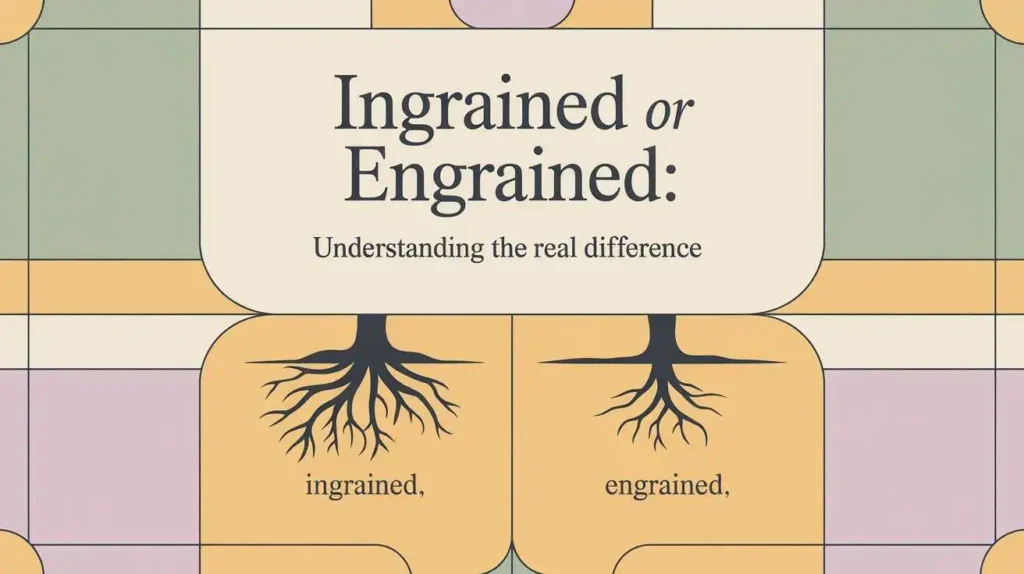
Ingrained or Engrained: Understanding the Real Difference
Let’s clear this up quickly.
If you’ve ever paused mid-sentence wondering whether it’s “ingrained or engrained”, you’re not alone. This is one of those English questions that looks simple on the surface but quietly confuses even confident writers.
Here’s the thing — the confusion doesn’t come from meaning. It comes from spelling history.
Both words point to the same idea: something deeply fixed or firmly established. But only one is the modern standard.
Let’s break it down properly so you never second-guess it again.
What Does “Ingrained” Mean in Simple Terms?
Ingrained means something deeply fixed in your mind, behavior, or character that is very difficult to change.
It’s not just “a habit.” It’s a habit that has become part of you.
Think of things like:
- How you react under stress
- Your cultural beliefs
- Long-term habits you don’t even notice anymore
Real-life examples:
- “He has an ingrained habit of waking up early.”
- “There is an ingrained belief in hard work in that culture.”
- “Fear of failure became deeply ingrained in her thinking.”
Most people miss this subtle point: Ingrained doesn’t just describe behavior — it describes automatic behavior.
That’s what makes it powerful in writing.
READ MORE >>> Camouflage or Camoflauge: Correct Spelling, Meaning, and Why People Get It Wrong
Is “Engrained” Correct or Wrong?
Here’s where things get interesting.
Engrained is not “wrong” in meaning, but it is not the preferred modern spelling.
Both words originally carried the same idea, but over time, English standardized the spelling to “ingrained.”
So what’s happening here?
- “Ingrained” → modern, standard, widely accepted
- “Engrained” → older, rare, mostly historical usage
Important insight:
If you use “engrained” today in formal writing, it may look outdated or less polished.
That’s why most style guides quietly avoid it.
Ingrained vs Engrained: Key Differences Explained
Let’s make this crystal clear.
| Feature | Ingrained | Engrained |
|---|---|---|
| Modern usage | Yes | Rare |
| Dictionary preference | Standard | Variant |
| Formal writing | Recommended | Not recommended |
| Meaning | Deeply fixed habit or belief | Same meaning |
| Frequency | Very high | Very low |
Direct truth:
There is no meaning difference. Only usage difference.
That’s it.
Why Do People Get Confused Between Them?
This is one of the most important parts.
Most competitors skip this — but it’s actually the real reason people search this keyword.
1. They sound identical
Both are pronounced the same way, so your brain assumes they should be interchangeable.
2. Prefix confusion
English has many similar-looking word patterns:
- in- (inside, into)
- en- (to cause, to put into)
Your brain mixes them up naturally.
3. Online inconsistency
You might see both versions in older articles or informal writing. That creates doubt.
Here’s what most people get wrong:
They assume if both exist online, both are equally correct.
That’s not true in modern writing standards.
Which Spelling Should You Use?
Let’s keep this simple.
Always use “ingrained” in modern writing.
That includes:
- Academic essays
- Business communication
- Professional content writing
- Exams and formal documents
When (if ever) is “engrained” used?
Only in rare cases like:
- historical text reproduction
- stylistic or literary writing
- older publications
Practical rule:
If you’re unsure, choose ingrained. Every time.
No exceptions needed.
How Common Is “Ingrained” vs “Engrained” in Modern English?
Ingrained is overwhelmingly more common in modern English writing, while engrained appears rarely and mostly in older or non-standard texts.
In real-world usage (books, articles, academic writing), “ingrained” dominates because it aligns with standardized spelling conventions used in modern dictionaries and publishing systems.
Key insight:
Most professional writing systems treat “engrained” as a variant that has not survived modern standardization.
Regional English Clarity (US vs UK Gap Fill)
Is There a Difference Between British and American English?
No meaningful difference exists between British and American English for this word.
Both regions overwhelmingly use “ingrained” as the standard spelling today.
“Engrained” is not a regional variant (like color/colour).
Instead, it is simply an older spelling that has fallen out of modern usage in both dialects.
Key insight:
This is NOT a UK vs US difference it’s a modern vs outdated usage difference.
Error Severity Scale (Decision Clarity Gap)
How Wrong Is Using “Engrained”?
Here’s how it is perceived in real-world writing:
In academic writing:
❌ Clearly incorrect or outdated
→ may reduce credibility
In business writing:
⚠️ Noticeable and non-standard
→ may look unpolished
In casual writing:
⚪ Understood but unnecessary
→ no major issue, but still uncommon
In historical/literary context:
✔ Acceptable
→ can be used for stylistic authenticity
Key insight:
The issue is not meaning — it is modern writing credibility level.
What Do Style Guides Say About It?
Modern writing standards consistently prefer “ingrained” over “engrained.”
- Academic writing guidelines (APA-style conventions) align with standardized dictionary spelling
- Editorial style systems in publishing favor consistency with modern dictionary headwords
- Professional editors default to “ingrained” to maintain clarity and correctness
Key insight:
Style guides don’t treat this as a “choice” — they treat “ingrained” as the default standard.
Where Did the Word Come From? (Etymology Insight)
Now this is where things get more interesting.
The word traces back to Old French roots related to “grain” or “dying something into fabric.”
Originally, it meant something literally “dyed in” or permanently fixed into material.
Over time, the meaning shifted from physical embedding → mental and behavioral embedding.
Simple evolution:
- Physical marking (old usage)
- Mental habit formation (modern usage)
That’s how “ingrained” became a psychological word rather than a physical one.
Why “Ingrained” Became the Standard
Language doesn’t stay random forever.
It gets standardized through:
- dictionaries
- publishing norms
- education systems
- editorial guidelines
Key shift:
Dictionaries like Merriam-Webster and Cambridge settled on “ingrained” as the primary form.
Once that happens, usage naturally follows.
Important insight:
Language doesn’t become correct because people use it. It becomes standard when authoritative systems accept it.
READ MORE >>> Natzi or Nazi: Which Spelling Is Correct, Why It Gets Confused, and How to Use It Safely
Common Mistakes People Make
Let’s fix a few real-world errors.
Mistake 1: Thinking both spellings are interchangeable
They are not equal in modern writing.
Mistake 2: Assuming engrained changes meaning
It doesn’t. Same meaning, different acceptance level.
Mistake 3: Overthinking usage in casual writing
In reality, only one choice is needed today: ingrained.
Mini Case Study: How Writers Get It Wrong
Let’s look at a realistic scenario.
A freelance writer working on a blog uses the phrase:
“Her engrained habits shaped her personality.”
The client rejects it.
Why?
Because:
- “engrained” feels outdated
- editors default to modern grammar standards
- SEO tools flag it as low-frequency variant
After switching to:
“Her ingrained habits shaped her personality.”
The sentence becomes:
- cleaner
- more professional
- more aligned with modern usage
Key takeaway:
Even when both are “understood,” only one passes modern editorial standards.
Expert Tip: How to Never Get Confused Again
Here’s a simple rule professionals use:
The Dictionary Rule
If a word has multiple spellings, always choose the one listed as the primary headword in modern dictionaries.
For this case:
- ingrained → primary
- engrained → secondary/rare
Quick mental trick:
If you ever hesitate, ask:
“Which one would a modern editor use?”
The answer is always ingrained.
Frequently Asked Questions
Yes. Ingrained is the correct and widely accepted modern spelling.
It exists historically, but it is rarely used in modern writing.
Yes, both refer to something deeply fixed, like habits or beliefs.
Because English evolved over time and standardized one form for consistency.
Always use “ingrained” for modern academic and professional contexts.
Final Thoughts
Here’s the real takeaway most people don’t notice.
This isn’t just a spelling question.
It’s a confidence question in writing.
You’re not just asking “which is correct?” You’re really asking: “How do I sound right and professional when I write this?”
And the answer is simple.
Use ingrained.
It’s the modern standard, the safe choice, and the one that aligns with how English is actually used today.
Once you lock that in, you’ll never hesitate on this again.