
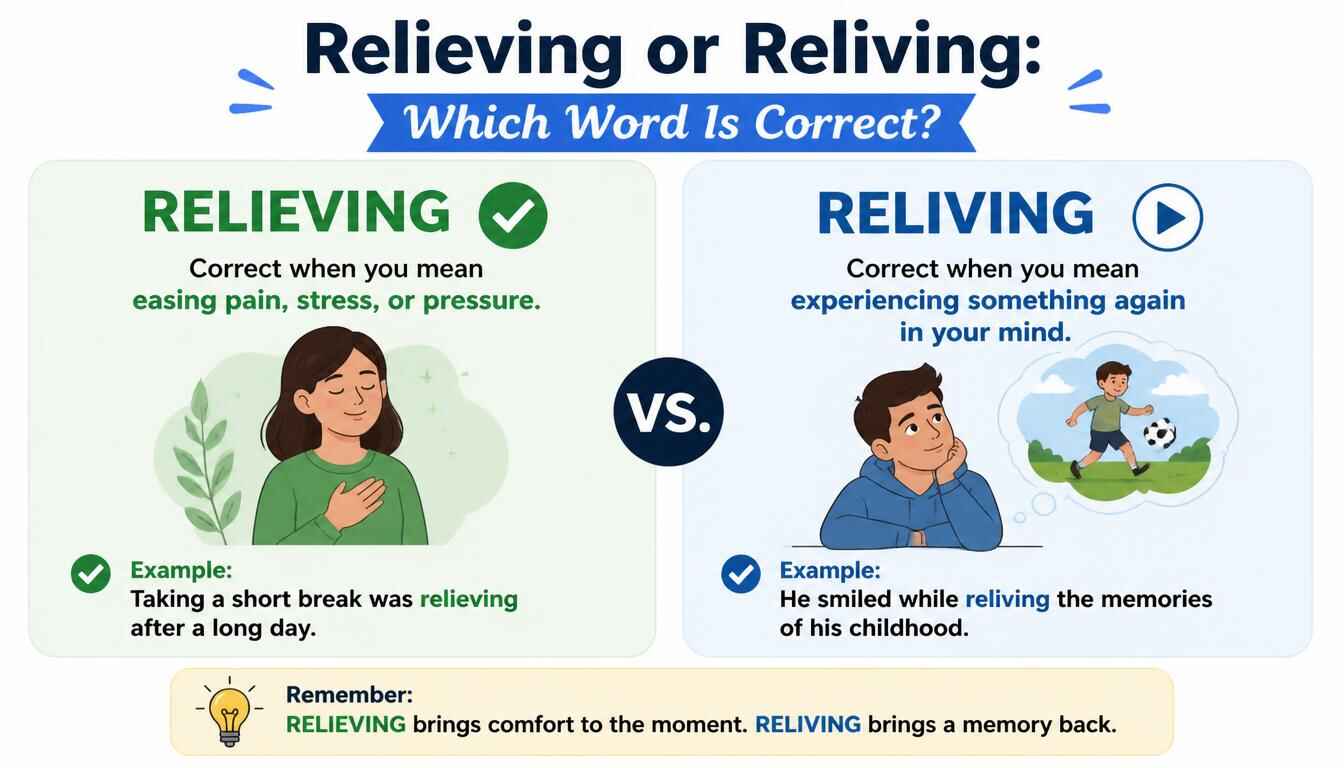
Relieving or reliving—which word is correct? Both are correct English words, but they have different meanings because they come from two different verbs.
Relieving comes from relieve and generally means easing, reducing, or removing something unpleasant. It can also mean taking over someone’s duty or shift. Reliving comes from relive and means experiencing something from the past again.
Compare these examples:
The medicine is relieving my headache.
Looking at old photos made me relive my childhood.
The first sentence is about reducing pain. The second is about experiencing a past event again.
There is one important detail, though: context determines which word you need. For example, both relieving pain and reliving pain can be correct when they express different meanings.
Quick Answer: Relieving or Reliving?
Use “relieving” when you mean easing, reducing, or removing pain, stress, pressure, discomfort, or a burden. It can also mean taking over another person’s duty. Use “reliving” when you mean experiencing a past event, memory, feeling, or moment again.
| Word | Base verb | Main meaning | Example |
|---|---|---|---|
| Relieving | relieve | Easing something or taking over a duty | The treatment is relieving my pain. |
| Reliving | relive | Experiencing something again | She is reliving the experience. |
A simple memory aid is:
Relieving → relief Reliving → living again
Relieving vs. Reliving: What Is the Difference?
The easiest way to distinguish these words is to ask what is happening in the sentence.
Relieving is about making something easier or less severe. It can also involve taking over someone’s responsibility.
Reliving is about experiencing something that happened before.
| If you mean… | Use |
|---|---|
| Making pain less severe | relieving |
| Reducing stress | relieving |
| Reducing pressure | relieving |
| Easing discomfort | relieving |
| Removing a burden | relieving |
| Taking over someone’s shift | relieving |
| Experiencing a memory again | reliving |
| Experiencing a past event again | reliving |
| Mentally returning to a past moment | reliving |
| Experiencing an old feeling again | reliving |
So the central distinction is:
Relieving = providing relief or taking over a responsibility. Reliving = experiencing something again.
The two words may look almost identical, but they describe different actions.
What Does “Relieving” Mean?
Relieving is the -ing form of the verb relieve. In common use, relieve can mean making pain, worry, pressure, or another unpleasant condition less severe. It can also mean taking another person’s place or responsibility.
Relieving Pain or Discomfort
When something reduces pain or discomfort, relieving is the appropriate word.
The medication is relieving my headache.
The ice pack is relieving some of the swelling.
This cream is relieving the irritation.
In each example, the unpleasant condition is becoming less severe.
Relieving Stress or Pressure
The same idea applies to stress and pressure.
The extra staff are relieving some of the pressure on the team.
Exercise can help with relieving stress.
The new schedule is relieving some of the pressure on employees.
Here, relieving means reducing or easing the problem.
Relieving a Burden or Responsibility
The word can also describe removing part of someone’s responsibility.
Hiring an assistant is relieving her of some of her workload.
The new system is relieving employees of repetitive paperwork.
The expression relieve someone of something can mean freeing someone from a responsibility, duty, or burden.
What Does “Relieving Someone on Duty” Mean?
Relieving has another useful meaning in workplace and duty-related situations.
When one person relieves another person, they take over that person’s position, shift, or responsibility.
For example:
The night nurse is relieving the day nurse at 7 p.m.
The second guard arrived to relieve the first guard.
I’m relieving my coworker after lunch.
In these sentences, relieving does not mean reducing pain. It means taking someone’s place so they can stop working or take a break.
This meaning is related to the broader idea of giving someone relief from a duty or responsibility.
What Does “Reliving” Mean?
Reliving is the -ing form of the verb relive.
To relive something means to experience a past event, moment, memory, or experience again. The experience can be pleasant, unpleasant, exciting, embarrassing, or simply meaningful.
Reliving a Memory
She enjoys reliving memories of her childhood.
Looking through the photo album had them reliving old memories.
The song brought back memories and had him reliving his college years.
Reliving a Past Event
Reliving is not limited to memories in the narrow sense. You can also relive an event or moment.
He kept reliving the conversation in his mind.
The documentary allowed fans to relive the championship.
She was reliving the moment she received the news.
The important idea is that the person is mentally or emotionally experiencing something from the past again.
Reliving Can Be Positive
A common misconception is that reliving always refers to something painful or traumatic. It does not.
You can relive:
- a great vacation
- a childhood memory
- a wedding
- a championship
- a funny moment
- a favorite concert
- an exciting adventure
For example:
We spent the evening reliving our favorite vacation memories.
The word itself does not indicate whether the experience is positive or negative. The context tells you that.
READ MORE >>> Gluing or Glueing: Which Spelling Is Correct?
Relieve vs. Relive: Why Are They Spelled Differently?
The spelling becomes much easier when you look at the two base verbs.
Relieve → Relieving
The base verb is:
relieve
Its -ing form is:
relieving
Example:
The medication is relieving my pain.
Relive → Reliving
The base verb is:
relive
Its -ing form is:
reliving
Example:
She is reliving the experience.
The spelling difference reflects the fact that these are two different verbs, not two spellings of the same word.
| Base verb | -ing form | Meaning |
|---|---|---|
| relieve | relieving | Ease, reduce, or take over |
| relive | reliving | Experience again |
If you first identify whether your sentence means relieve or relive, the correct -ing form follows naturally.
Relieving Pain vs. Reliving Pain
This is one of the trickiest cases because both expressions can be grammatically meaningful.
“Relieving Pain”
Relieving pain means reducing pain that someone is experiencing.
The medicine is relieving my pain.
The pain is becoming less severe.
“Reliving Pain”
Reliving pain means experiencing pain from a previous event again, usually through memory or mental re-experience.
She was reliving the pain she felt after the accident.
This does not mean the pain is being reduced. It means the person is experiencing an earlier painful experience again.
Compare the Meanings
| Phrase | Meaning |
|---|---|
| relieving pain | Reducing current pain |
| reliving pain | Experiencing previous pain again |
| relieving stress | Reducing current stress |
| reliving a stressful experience | Experiencing an earlier stressful event again |
This is why you should not choose between these words based only on the noun that follows them.
Instead, ask:
Is the problem becoming less severe, or is someone experiencing something from the past again?
That question usually gives you the answer.
Relieving Stress vs. Reliving a Stressful Experience
Consider these two sentences:
The vacation is relieving my stress.
Here, the stress is becoming less intense.
Now compare:
Talking about the accident made her feel as though she were reliving the stressful experience.
Here, she is mentally experiencing an earlier event again.
The distinction is:
Current stress becoming lighter → relieving.
Past stressful experience happening again → reliving.
The same principle works with other words such as pressure, pain, fear, and experience. Context determines the meaning.
Relieving vs. Relieved: What Is the Difference?
Relieving, relieved, and relief are related words, but they serve different grammatical purposes.
Relieving
Relieving describes an action or something that provides relief.
The treatment is relieving the pain.
The treatment is reducing the pain.
Relieved
Relieved commonly describes a person’s feeling after worry, uncertainty, pain, or another unpleasant situation decreases.
I felt relieved after hearing the good news.
She was relieved to find her wallet.
Relief
Relief is a noun.
The news brought a sense of relief.
Finishing the exam was a huge relief.
Side-by-Side Comparison
| Word | Function | Example |
|---|---|---|
| relieving | Action/process | The medicine is relieving the pain. |
| relieved | Feeling/state | I felt relieved. |
| relief | Noun | The news brought relief. |
This distinction is especially useful when describing your own feelings. If you mean that you feel better after worry or difficulty has decreased, relieved is generally the natural choice.
Reliving vs. Remembering: Are They the Same?
No. Remembering and reliving are related, but they do not necessarily mean the same thing.
Remembering
To remember something can simply mean recalling it.
I remember our first apartment.
The speaker is recalling information about the past.
Reliving
To relive something suggests experiencing that past event or moment again, often in a more vivid or emotionally involving way.
Looking at the old photographs made me relive our first year there.
The person is not merely recalling the information. The wording suggests mentally returning to the experience.
Other Related Words
Depending on what you mean, you might use:
- remembering — recalling something
- recalling — bringing something back to mind
- reminiscing — thinking or talking about past experiences
- replaying — repeatedly going over something mentally
- re-experiencing — experiencing something again
These words overlap, but they are not always interchangeable.
If you simply want to say “I remember what happened,” use remember.
If you want to express the idea of experiencing the past again, relive may be more precise.
Can “Relieving” and “Reliving” Be Used in the Same Sentence?
Yes. In fact, using both words together is a useful way to see their difference.
Reliving the experience was surprisingly relieving.
Here, the first word means experiencing the past event again, while the second means providing relief.
Another example:
Reliving those happy memories was emotionally relieving.
Again, the meanings are different even though the words look similar.
This is a good reminder that relieving and reliving are not alternate spellings of one word.
When Neither Word Is the Best Choice
Sometimes a writer knows the two words but neither one expresses the intended meaning naturally.
When You Mean “I Feel Better”
Use relieved rather than relieving.
I felt relieved when the test was over.
Not:
I felt relieving when the test was over.
The first sentence describes the person’s emotional state.
When You Mean “Comforting”
Depending on the context, another word may be more precise:
Her message was reassuring.
The familiar voice was comforting.
The warm bath was soothing.
You do not need to use relieving simply because something makes you feel better.
When You Mean Simple Recall
If you are only recalling information, remembering or recalling may be better.
I’m trying to remember his name.
Using reliving would suggest that you are experiencing a previous event again, which is not the intended meaning.
The Relief–Replay–Replacement Test
If you still have trouble choosing between these words, use this three-part test.
1. Relief → Relieving
Ask:
Is something becoming less painful, stressful, difficult, or burdensome?
If yes, use relieving.
The medicine is relieving the pain.
The extra workers are relieving pressure on the team.
2. Replay → Reliving
Ask:
Is someone experiencing something from the past again?
If yes, use reliving.
She is reliving her childhood.
He keeps reliving that conversation in his mind.
3. Replacement → Relieving
Ask:
Is someone taking another person’s place or duty?
If yes, use relieving.
The night guard is relieving the day guard.
The Shortcut
Relief → relieving Replay → reliving Replacement → relieving
This gives you a practical way to solve the problem without memorizing long definitions.
Common Mistakes With Relieving and Reliving
1. Using “Reliving” for Pain Relief
If you mean that something is reducing pain:
The medication is relieving my headache.
Not:
The medication is reliving my headache.
2. Using “Relieving” for a Past Experience
If you mean experiencing childhood again:
She was reliving her childhood.
Not:
She was relieving her childhood.
3. Assuming “Pain” Always Means “Relieving”
Both forms can appear with pain when the meanings differ.
The treatment is relieving his pain.
He is reliving the pain of the accident.
Always look at the action described by the sentence.
4. Confusing “Relieving” With “Relieved”
I was relieved when the problem was solved.
Not:
I was relieving when the problem was solved.
Relieved describes the person’s feeling.
5. Using “Reliving” for Simple Memory
I remember her name.
This is simple recall.
I keep reliving our final conversation.
This suggests mentally experiencing that conversation again.
Common Phrases With “Relieving”
Some common combinations include:
| Phrase | Meaning |
|---|---|
| relieving pain | Reducing pain |
| relieving stress | Reducing stress |
| relieving pressure | Reducing pressure |
| relieving symptoms | Making symptoms less severe |
| relieving discomfort | Easing discomfort |
| relieving a burden | Making a burden lighter |
| relieving someone of a duty | Freeing someone from a responsibility |
| relieving someone on duty | Taking over their work or shift |
The exact meaning depends on the surrounding sentence, but the central idea is providing relief or taking over a burden or responsibility.
Common Phrases With “Reliving”
Common combinations include:
| Phrase | Meaning |
|---|---|
| reliving the past | Experiencing past events again |
| reliving a memory | Experiencing a memory again |
| reliving the moment | Mentally experiencing a past moment again |
| reliving childhood | Experiencing childhood memories again |
| reliving an experience | Experiencing an earlier event again |
| reliving an ordeal | Experiencing a difficult past event again |
| reliving a victory | Experiencing a past success again |
The experience can be positive or negative. The word itself does not determine the emotional tone.
Grammar Tip: “Made Me Relive,” Not “Made Me Reliving”
There is another useful grammar distinction involving relive.
After make + object, English uses the base form of the verb.
Correct:
The photo made me relive my childhood.
Not:
The photo made me reliving my childhood.
The same pattern appears in:
The movie made me cry.
The news made her laugh.
The song made them remember the past.
So although reliving is a correct word, it is not correct in every sentence where the idea of reliving something appears.
Relieving or Reliving: Practice Quiz
Choose relieving or reliving in each sentence.
- The medicine is ___ my headache.
- She kept ___ the conversation in her mind.
- The night guard is ___ the day guard.
- Looking at the photos had them ___ their childhood.
- The additional employees are ___ some of the pressure on the team.
- He was ___ the excitement of his first championship.
Answers
- Relieving — the medicine is reducing the headache.
- Reliving — she is mentally experiencing the earlier conversation again.
- Relieving — the night guard is taking over the other guard’s duty.
- Reliving — they are experiencing memories of childhood again.
- Relieving — the pressure is being reduced.
- Reliving — he is experiencing the past excitement again.
Frequently Asked Questions
Is “relieving” or “reliving” correct?
Both are correct. Relieving means easing, reducing, or taking over a duty, while reliving means experiencing something from the past again.
Is “relieving” a real word?
Yes. Relieving is the -ing form of relieve. It can refer to reducing pain, stress, pressure, discomfort, or a burden, or taking over someone’s duty.
Is “reliving” a real word?
Yes. Reliving is the -ing form of relive. It means experiencing a past event, memory, feeling, or moment again.
What is the difference between relieving and reliving?
Relieving is associated with relief, reduction, or taking over a responsibility. Reliving means experiencing something from the past again.
Is it “relieving pain” or “reliving pain”?
Both can be correct, but they have different meanings. Relieving pain means reducing pain. Reliving pain means experiencing previous pain again.
Is it “relieving stress” or “reliving stress”?
Relieving stress means reducing current stress. Reliving stress would mean experiencing previous stress again and needs a context that makes that meaning clear.
Can you say “relieving someone on duty”?
Yes. It can mean taking over someone’s duty or shift.
Is reliving the same as remembering?
No. Remembering can simply mean recalling something. Reliving suggests experiencing a past event again, often more vividly.
Can reliving be positive?
Yes. You can relive happy memories, vacations, celebrations, childhood experiences, victories, and other enjoyable moments.
Can relieving and reliving be used in the same sentence?
Yes.
Reliving the memory was surprisingly relieving.
The first word means experiencing the memory again, while the second means providing relief.
What is the difference between relieve and relive?
Relieve means to ease, reduce, or remove something unpleasant or to take someone’s place. Relive means to experience something from the past again.
Why does “relieve” become “relieving”?
Relieving is the -ing form of relieve. It comes from the base verb relieve, not relive.
What is the easiest way to remember relieving and reliving?
Think of three words:
Relief → relieving Replay → reliving Replacement → relieving
Conclusion
Relieving and reliving are both correct words, but they are not interchangeable.
Use relieving when something is being eased, reduced, or made less severe, or when one person takes over another person’s duty.
The medication is relieving her pain.
The night guard is relieving the day guard.
Use reliving when someone experiences a past event, memory, feeling, or moment again.
She is reliving her childhood.
He keeps reliving the conversation in his mind.
When you’re unsure, use the Relief–Replay–Replacement test:
Relief → relieving Replay → reliving Replacement → relieving
Most importantly, don’t choose the word simply because of the noun that follows it. Look at the meaning of the entire sentence. A phrase such as relieving pain describes reducing pain, while reliving pain can describe experiencing previous pain again. Context is what makes the difference.