
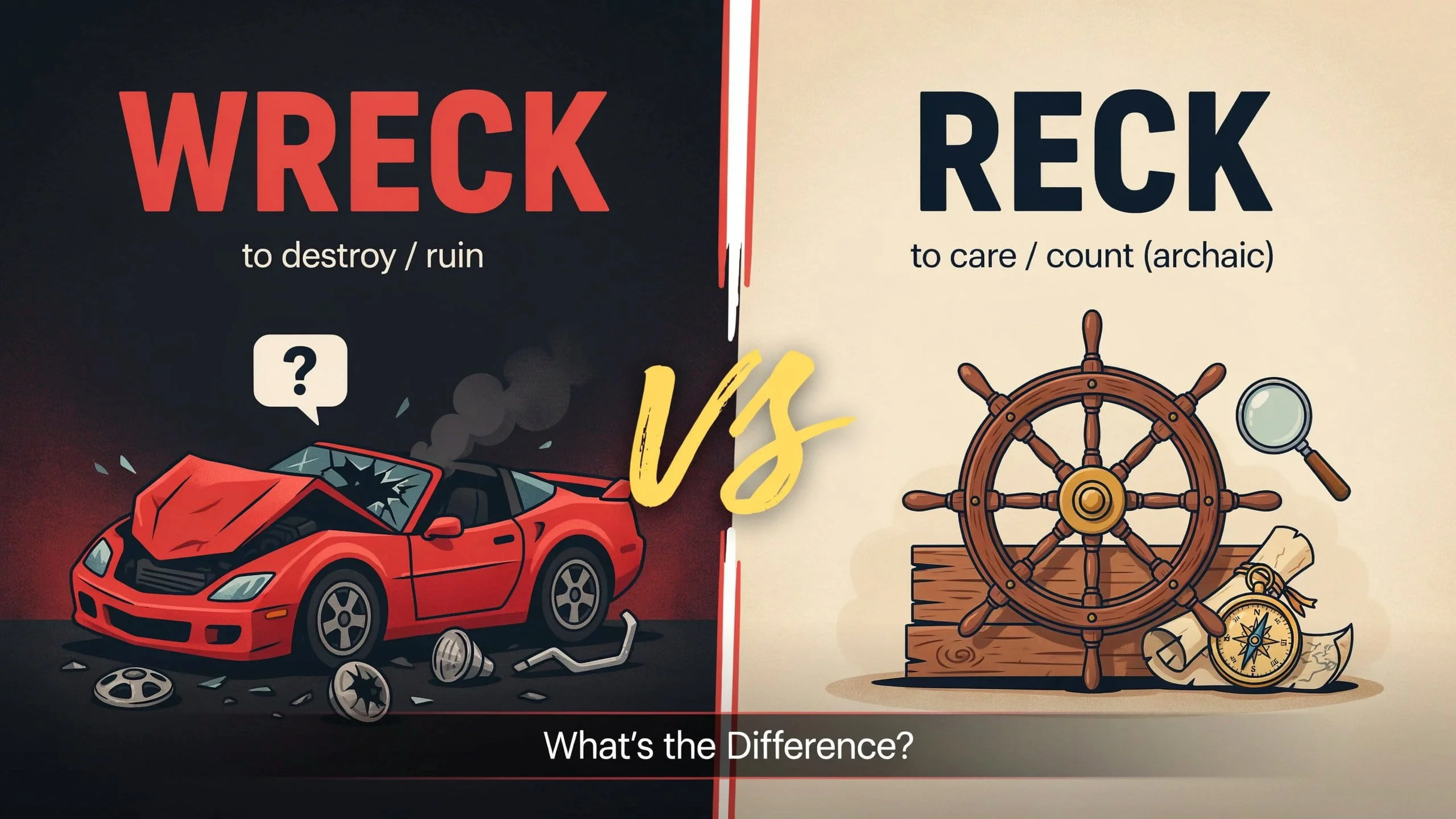
Wreck vs reck is a common word-choice and spelling confusion because the two words look almost identical and can sound very similar. However, they have different meanings and uses. Wreck means to damage, destroy, or ruin something and is a common word in modern English. Reck is a rare or archaic verb meaning to care, heed, regard, or take notice of. So, if you mean that something was damaged or destroyed, wreck is the word you normally need.
| Word | Meaning | Modern Usage | Example |
|---|---|---|---|
| Wreck | To damage, destroy, or ruin something | Very common | The accident wrecked the car. |
| Reck | To care, heed, or consider | Rare/archaic | He recked little of the warning. |
The confusion usually comes from their similar spelling and pronunciation. Once you understand what each word means, choosing the correct one becomes much easier.
AI Overview Summary
Wreck vs. reck are different words with different meanings. Wreck is the common modern word meaning to damage, destroy, or ruin something, while reck is a rare or archaic verb meaning to care, heed, regard, or consider. If you mean something was damaged, use wreck—for example, “The accident wrecked the car.” Wrecked is also the correct modern form when describing damage or destruction.
Wreck vs Reck: Key Differences
The simplest way to remember the difference is this:
Wreck = damage or destroy. Reck = care, heed, or consider.
These words are not interchangeable. Although they look and sound similar, using one in place of the other can completely change the meaning of a sentence.
Wreck
Wreck is a common English word that can function as both a verb and a noun.
As a verb, it means to seriously damage, destroy, or ruin something.
For example:
The driver wrecked his car in the accident.
Here, wrecked means that the car was badly damaged.
Wreck can also be used figuratively:
The argument wrecked their friendship.
In this sentence, no physical object was destroyed. Instead, the relationship was seriously damaged.
As a noun, wreck can refer to something that has been badly damaged or destroyed.
The police found the wreck beside the road.
It can also describe a destroyed ship, such as a shipwreck, or a person who is physically or emotionally exhausted:
After working all night, I was a complete wreck.
Reck
Reck is a much less common word. It is primarily a verb meaning to care about, pay attention to, heed, regard, or consider.
For example:
He recked little of the danger.
In other words, he did not care much about or pay much attention to the danger.
You may encounter reck in older literature, historical writing, poetry, or deliberately old-fashioned language. It is not normally the word a modern writer would choose in everyday conversation.
If you simply want to say care, consider, or pay attention, those modern alternatives will usually sound more natural.
What Does “Wreck” Mean?
The word wreck has several closely related meanings, but they all revolve around the idea of damage, destruction, or ruin.
Wreck as a Verb
As a verb, wreck means to damage or destroy something severely.
Examples include:
The storm wrecked several houses.
The collision wrecked the front of the vehicle.
The mistake wrecked his plans.
The word can describe both physical and figurative damage. You can wreck a car, building, boat, or machine, but you can also wreck someone’s plans, confidence, reputation, or relationship.
Common expressions include:
- wreck a car
- wreck a building
- wreck someone’s plans
- wreck a relationship
- wreck your chances
- wreck your confidence
The past tense and past participle are wrecked, while the present participle is wrecking.
Wreck as a Noun
As a noun, wreck can describe something that has been badly damaged or destroyed.
For example:
The vehicle was a complete wreck after the crash.
A shipwreck is another familiar example. It refers to a ship that has been destroyed, damaged, or sunk.
The word can also describe a person’s condition:
After the stressful week, she was an emotional wreck.
This figurative use means that someone is in a very distressed, exhausted, or upset state.
Wreck in Literal and Figurative Language
One reason wreck is so useful in modern English is its flexibility.
| Type of Use | Example |
|---|---|
| Physical damage | The crash wrecked the car. |
| Destruction | The fire wrecked the building. |
| Plans | The delay wrecked our plans. |
| Relationship | The argument wrecked their friendship. |
| Emotional state | He was a nervous wreck. |
| Exhaustion | After the trip, I was completely wrecked. |
This range of meanings makes wreck much more common in everyday English than reck.
What Does “Reck” Mean?
Reck is a real English word, but it is rare and largely archaic in modern usage.
Its traditional meanings include:
- care
- heed
- regard
- consider
- pay attention
- take notice
For example:
He recked little of the consequences.
The sentence means that he did not care much about or pay attention to the consequences.
Another example is:
She recked nothing of their warnings.
This means that she paid little or no attention to their warnings.
Is “Reck” a Real Word?
Yes, reck is a real word. However, knowing that a word exists in a dictionary does not mean it is common in contemporary conversation.
Reck is mainly associated with archaic, historical, literary, or old-fashioned English.
A modern writer would usually say:
He did not care about the consequences.
rather than:
He recked little of the consequences.
Both communicate a related idea, but the first sounds natural to a modern reader.
Why Does “Reck” Sound Unusual?
Language changes over time. Words that were once normal can become uncommon, while other words take their place.
That is one reason reck may seem strange to modern English speakers. Most people are much more familiar with care, heed, and consider.
So if you encounter reck in an older book or literary passage, don’t assume it is a spelling mistake. It may simply be an archaic word being used in its historical sense.
Wreck vs Reck Examples
Looking at the two words in complete sentences is one of the easiest ways to understand their difference.
Examples With Wreck
The accident wrecked the car.
The hurricane wrecked several coastal buildings.
One bad decision could wreck his career.
The unexpected news wrecked her plans.
After the long journey, I was completely wrecked.
In every example, wreck relates to damage, destruction, ruin, or severe exhaustion.
Examples With Reck
He recked little of the warning.
She recked nothing of the danger.
They recked not what might happen next.
These examples use reck in its older sense of caring about, considering, or paying attention to something.
Because this usage is uncommon today, a modern version might replace recked with cared, considered, or paid attention to.
Wreck vs Reck in Context
Compare these two sentences:
The accident wrecked the vehicle.
He recked little of the accident.
The first sentence describes damage. The second uses the rare verb reck to express a lack of concern or attention.
This illustrates why wreck and reck are not simply alternative spellings of the same word.
Wrecked vs Recked: Which Is Correct?
This is another common spelling question related to wreck vs reck.
If you mean damaged, destroyed, or ruined, the correct word is wrecked.
The accident wrecked my car.
Not:
The accident recked my car.
What Does “Wrecked” Mean?
Wrecked is the past tense and past participle of wreck.
It can mean:
- badly damaged
- destroyed
- ruined
- severely affected
- extremely tired, in some informal contexts
For example:
The storm wrecked the roof.
The crash wrecked the vehicle.
I was completely wrecked after the workout.
The exact meaning depends on context.
What About “Recked”?
Recked can theoretically occur as an inflected form of the rare verb reck, particularly in older English. But this is not the spelling you want when you mean damaged or destroyed.
If you are describing a damaged car, house, boat, relationship, or plan, use wrecked.
Correct: The car was wrecked.
Incorrect for this meaning: The car was recked.
This distinction is especially useful because recked can look like a logical spelling if someone knows the word reck. In ordinary modern English, however, wrecked is the standard choice for the meaning “damaged or destroyed.”
Is Wreck or Reck More Common?
There is a huge difference in modern usage.
Wreck is common. Reck is rare.
You regularly encounter wreck in news reports, conversations, books, social media, entertainment, and everyday writing.
For example:
The crash wrecked the vehicle.
The storm wrecked the neighborhood.
Don’t wreck your chances.
By contrast, reck is much more likely to appear in older or literary language.
This means that if you are writing for a modern audience and your intended meaning is damage, destruction, or ruin, wreck is almost certainly the correct word.
Are Wreck and Reck Homophones?
Wreck and reck can be pronounced alike or very similarly, which contributes to the spelling confusion.
Words that share a pronunciation but have different spellings and meanings are commonly described as homophones. Similar-sounding words can be particularly difficult to spell when someone has heard them but has not seen them written.
This is why someone might hear:
“The car was wrecked.”
and wonder whether the spelling is wrecked or recked.
The pronunciation alone does not tell you which spelling to use. You have to consider the meaning and context.
Why Do Similar-Sounding Words Cause Spelling Mistakes?
English contains many words whose spellings cannot be reliably predicted from pronunciation alone.
When a word is rare, the problem becomes even greater. Since reck is uncommon, a person may recognize the sound but not know its historical meaning.
The important distinction is:
Don’t choose between wreck and reck based only on sound. Choose based on meaning.
If the meaning is damage or destruction, use wreck.
If the intended meaning is the old-fashioned idea of care, heed, or regard, reck may be appropriate.
Is “Reck” Related to “Reckless”?
The words reck and reckless are worth discussing because they can look connected to modern readers.
Reckless means showing a lack of care for consequences, safety, or possible danger.
For example:
His reckless driving put everyone at risk.
The historical development of English words can be complicated, so it is better not to assume that reck and wreck are related simply because their spellings are similar.
Most importantly, don’t confuse reck with wreck. The meanings are different.
Wreck concerns damage or destruction, while reck has an older meaning connected with care, heed, or regard.
Common Mistakes With Wreck and Reck
The most frequent mistakes happen when people treat the two words as interchangeable.
Mistake 1: Using Reck for Damage
The accident recked the car.
If the intended meaning is that the accident damaged the car, this should be:
The accident wrecked the car.
Mistake 2: Spelling Wrecked as Recked
The car was recked in the crash.
For modern English and the meaning “badly damaged,” write:
The car was wrecked in the crash.
Mistake 3: Assuming Reck Is Simply an Alternative Spelling
Reck is not simply a shorter spelling of wreck.
The two words have different meanings and different histories of usage.
Mistake 4: Using an Archaic Word in Everyday Writing
Because reck is rare, using it in ordinary conversation can make your sentence sound unnatural.
Instead of:
I reck nothing of his opinion.
a modern writer would normally say:
I don’t care about his opinion.
or:
I don’t pay attention to his opinion.
How to Remember Wreck vs Reck
Here’s a simple memory trick:
Wreck = ruin.
Think of a wrecked car. Something has been damaged or destroyed.
Reck = regard.
Think of the older meaning of reck as caring about, heeding, or considering something.
So when you are deciding which spelling to use, ask yourself one question:
Am I talking about damage?
If yes, choose wreck.
If you’re discussing an old or literary use meaning care, heed, or regard, reck may be the intended word.
Wreck vs Reck: Which Word Should You Use?
The choice becomes straightforward when you focus on meaning.
| If you mean… | Use… | Example |
|---|---|---|
| Damage | wreck | The crash wrecked the car. |
| Destroy | wreck | The fire wrecked the building. |
| Ruin | wreck | The mistake wrecked our plans. |
| A damaged object | wreck | The vehicle was a wreck. |
| Care | reck | He recked little of the warning. |
| Heed | reck | She recked nothing of the danger. |
| Consider/regard | reck | The older usage refers to considering something. |
For modern everyday English, the answer is usually wreck.
If you are writing a sentence about a car accident, storm, broken machine, ruined plan, or damaged relationship, wreck is the natural choice.
If you are reading or intentionally writing older or literary English and encounter reck, its meaning is likely connected to care, heed, or regard.
Why Wreck and Reck Are Commonly Confused
There are several reasons these words cause confusion.
First, they have nearly identical spellings. The only difference is the initial w.
Second, their pronunciation can be the same or very similar.
Third, reck is rare, which means many modern speakers know wreck but have little familiarity with the older word.
Finally, the English spelling system contains many words where pronunciation does not provide enough information to determine spelling.
The solution is simple: use context and meaning rather than pronunciation alone.
Quick Comparison: Wreck vs Reck
| Feature | Wreck | Reck |
|---|---|---|
| Meaning | Damage, destroy, ruin | Care, heed, consider |
| Part of speech | Noun and verb | Mainly verb |
| Modern usage | Common | Rare/archaic |
| Used for physical damage? | Yes | No |
| Used figuratively? | Yes | Historically/literarily |
| Past form | Wrecked | Recked in historical usage |
| Common in everyday writing? | Yes | No |
| Example | The crash wrecked the car. | He recked little of the warning. |
Frequently Asked Questions
Is “reck” a real word?
Yes. Reck is a real English word, but it is rare and largely archaic in contemporary English. It can mean to care, heed, regard, or consider.
What is the difference between wreck and reck?
Wreck means to damage, destroy, or ruin something. Reck is an uncommon or archaic verb meaning to care, heed, regard, or consider. They are therefore different words with different meanings.
Is reck still used today?
It can be found in historical, literary, poetic, or deliberately old-fashioned writing, but it is uncommon in everyday modern English.
Is it wrecked or recked?
If you mean damaged or destroyed, the correct modern form is wrecked.
The accident wrecked the car.
Are wreck and reck homophones?
They can have the same or very similar pronunciation, which contributes to the spelling confusion. Their meanings and spellings are different.
What does wreck mean?
Wreck means to severely damage, destroy, or ruin something. It can be used as both a noun and a verb.
What does reck mean?
Reck is an archaic or rare verb meaning to care, heed, regard, or consider.
Can wreck be a noun and a verb?
Yes. As a verb, wreck means to damage or destroy. As a noun, it can refer to something badly damaged or destroyed, such as a vehicle or ship.
Is reck related to reckless?
The words can appear related because of their spelling and historical associations, but reck should not be confused with wreck. Reckless refers to a lack of care for consequences or safety.
Which is correct, wreck or reck?
Both are legitimate English words, but they are used differently. If you mean damage, destroy, or ruin, use wreck. If you mean the older sense of care, heed, or regard, reck may be correct.
Final Verdict: Wreck vs Reck
The difference between wreck and reck is mainly a difference in meaning and modern usage.
Wreck is the common modern word. It means to damage, destroy, or ruin something and can function as both a noun and a verb.
Reck is a rare or archaic verb meaning to care, heed, regard, or consider. You are more likely to encounter it in older literature or historical writing than in everyday conversation.
The easiest rule to remember is:
If something is damaged or ruined, it is wrecked. If you mean care or heed in an old-fashioned context, reck may be the word.
So, when someone asks “wreck vs reck—which one should I use?”, the answer is usually wreck when talking about damage or destruction.
Wreck = damage or ruin. Reck = care or heed.
That simple distinction will help you avoid the most common spelling and word-choice mistakes involving these two easily confused words.