
Quick Answer
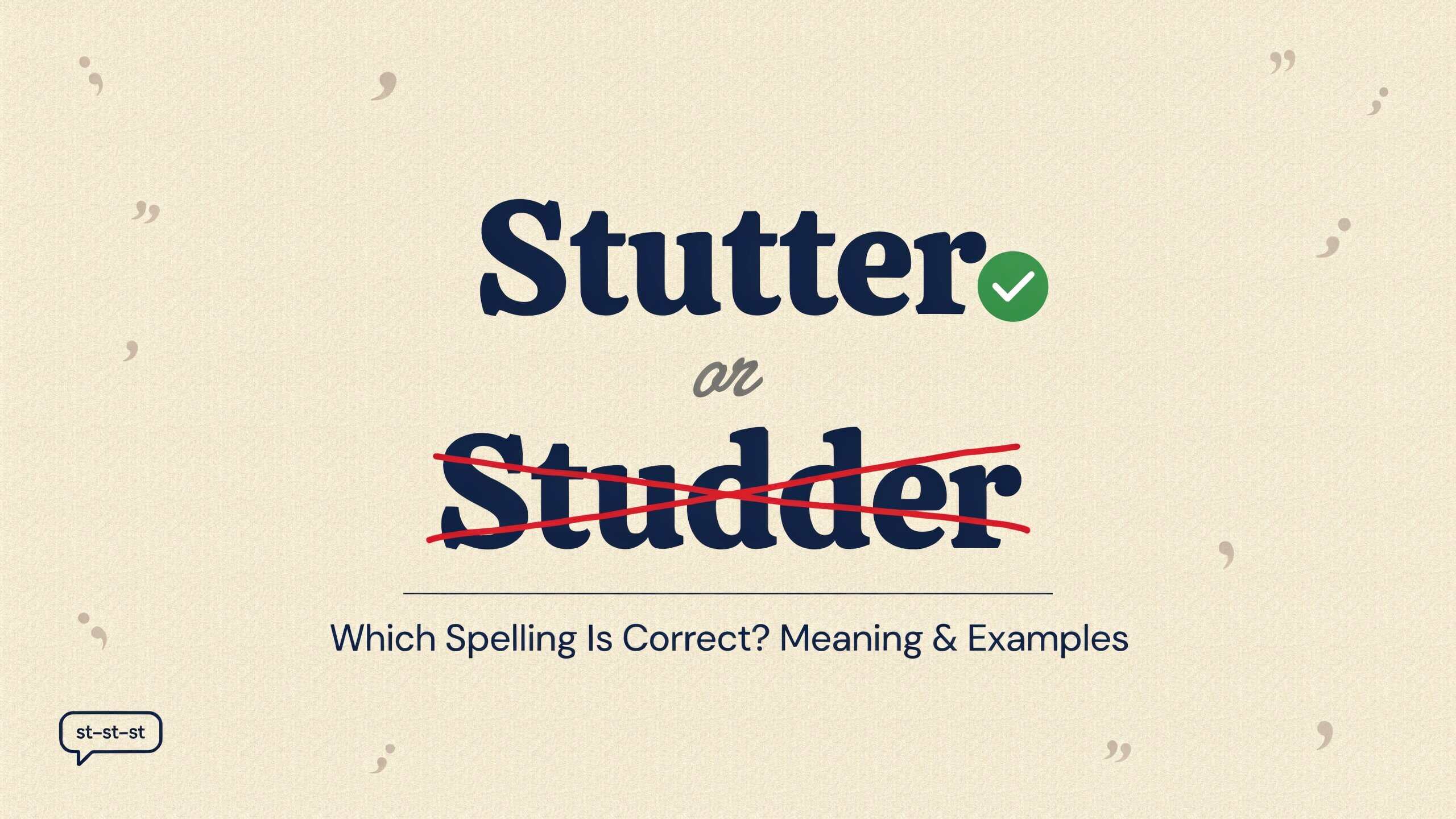
Stutter or studder? The correct spelling is stutter. Studder is a common misspelling and is not recognized as the standard word in modern English dictionaries. Use stutter whenever you are referring to repeated sounds, syllables, words, or interruptions in speech. Whether you’re writing an essay, email, or professional document, stutter is always the correct choice.
Stutter or Studder – Which One Is Correct?
Stutter or studder is a question many English learners and native speakers search online because both words look similar. However, only one of them is considered correct.
The standard English spelling is stutter.
The spelling studder appears because many people pronounce the word quickly, making it sound as if it contains a “d.” This leads to a frequent typing and spelling mistake, but dictionaries and style guides recognize only stutter as the correct form.
| Word | Correct? | Dictionary Word? | Standard English? |
|---|---|---|---|
| Stutter | ✅ Yes | ✅ Yes | ✅ Yes |
| Studder | ❌ No | ❌ No | ❌ No |
Whenever you’re unsure, remember this simple rule:
Always write “stutter,” never “studder.”
Why Is “Stutter” the Correct Spelling?
The word stutter has been part of the English language for centuries. It is used as both a verb and a noun.
As a verb, it describes speaking with involuntary pauses, repetitions, or prolonged sounds.
Example:
“He began to stutter when speaking in front of the audience.”
As a noun, it refers to the speech pattern itself.
Example:
“She has a mild stutter that becomes more noticeable when she feels nervous.”
Major dictionaries, including Merriam-Webster, Cambridge Dictionary, and the Oxford English Dictionary, recognize only stutter as the correct spelling.
Is “Studder” a Real Word?
In standard English grammar, studder is not considered a correct word.
You may occasionally see it:
- in social media posts
- in online comments
- in typing errors
- in informal conversations
These examples don’t make it an accepted spelling.
Instead, they simply show how common this spelling mistake has become.
If you’re writing professionally, academically, or even casually, avoid using studder.
Why Do People Spell It as “Studder”?
There are several reasons why this confusion happens.
1. Pronunciation
When people say stutter quickly, the middle sound may seem similar to a “d.”
2. Double-Consonant Confusion
English contains many words with double letters, making it easy to guess the wrong spelling.
3. Typing Mistakes
Fast typing often results in accidental spellings like:
- studder
- studering
- studdered
- studders
4. Learning English
Many English learners rely on pronunciation instead of dictionary spelling, increasing the chance of writing studder instead of stutter.
Stutter or Studder Meaning
Understanding the stutter or studder meaning begins with knowing that only stutter has a recognized definition.
A stutter is a speech pattern in which a person experiences involuntary interruptions while speaking. These interruptions may involve repeating sounds, stretching certain letters, or pausing unexpectedly during conversation.
Although many people associate the word only with a speech disorder, it also has a broader meaning.
For example, engines, computers, music, and even internet connections can “stutter” when they stop and start repeatedly.
Dictionary Definition
As a verb, stutter means:
To speak with involuntary repetitions or pauses.
As a noun, it refers to:
The speech interruption itself.
This broader usage explains why the word appears in both medical discussions and everyday conversations.
Stutter or Studder in English
When discussing stutter or studder in English, the answer is straightforward.
Only stutter follows the spelling rules of standard English.
Whether you write in:
- American English
- British English
- Canadian English
- Australian English
…the accepted spelling remains stutter.
There is no regional variation that makes studder correct.
Formal Writing
Use stutter in:
- research papers
- business emails
- school assignments
- books
- blogs
- news articles
Informal Writing
Even in casual writing, stutter remains the preferred spelling.
Choosing the correct spelling improves readability and demonstrates strong language skills.
Stutter or Studder Speech
The phrase stutter or studder speech often appears in online searches because users want to know whether the speech condition itself is called a stutter or a studder.
The correct medical and grammatical term is stutter.
A stutter is a speech fluency disorder that affects the natural flow of speaking. People who stutter may repeat sounds, prolong words, or experience brief blocks where no sound comes out.
Common characteristics include:
- repeating sounds or syllables
- stretching certain sounds
- pauses during speech
- difficulty starting words
- physical tension while speaking
Many children experience temporary stuttering during language development, while others may continue to stutter into adulthood. Speech-language pathologists can help individuals improve fluency through assessment and therapy.
“Stuttering does not reflect intelligence or ability. It is simply a difference in speech fluency.”
Stutter or Studder Examples
Looking at stutter or studder examples is one of the easiest ways to remember the correct spelling. Seeing the word used in real sentences helps you understand both its meaning and proper usage.
Remember, stutter is always correct, while studder is considered a misspelling in standard English.
Correct Sentence Examples
Here are some examples using stutter correctly:
- He began to stutter when he introduced himself to the class.
- She didn’t stutter during her presentation because she had practiced well.
- The little boy developed a slight stutter after a stressful event.
- My laptop started to stutter while playing a high-resolution video.
- The old engine continued to stutter before finally stopping.
- The singer’s microphone made the audio stutter for a few seconds.
- She overcame her stutter through years of speech therapy.
- His speech occasionally stutters when he feels nervous.
- The internet connection caused the video to stutter repeatedly.
- Although he has a stutter, he is an excellent public speaker.
Incorrect Examples
These examples contain the common spelling mistake:
❌ He began to studder during the interview.
❌ She has a noticeable studder.
❌ His speech studders whenever he is anxious.
Each sentence becomes correct by replacing studder with stutter.
Correct and Incorrect Forms
The table below makes it easy to identify the standard forms of the word.
| Correct Form | Incorrect Form |
|---|---|
| stutter | studder |
| stutters | studders |
| stuttered | studdered |
| stuttering | studdering |
| stutterer | studderer |
Whenever you write or edit content, double-check these forms to avoid common spelling mistakes.
How to Pronounce “Stutter”
Many spelling errors happen because of pronunciation. Understanding how to say the word correctly can help you remember its spelling.
Pronunciation: STUT-er
IPA (International Phonetic Alphabet):
/ˈstʌtər/
The middle sound is a soft “t”, not a “d.” In fast speech, the pronunciation may sound slightly softer, which explains why some people mistakenly type studder.
Pronunciation Tips
- Break it into two parts: stut + ter
- Emphasize the first syllable.
- Keep the double “t” in mind when writing.
A simple trick is to say the word slowly before typing it.
Why Do People Confuse Stutter and Studder?
The confusion between these spellings is surprisingly common. Fortunately, the reason is easy to understand.
1. Similar Pronunciation
In everyday conversation, the t sound can seem softer, especially in some accents. As a result, people may assume the word contains a d.
2. Phonetic Spelling
Many people spell words exactly as they hear them. Since stutter can sound like studder, the incorrect version often appears in online searches.
3. Fast Typing
Typing quickly increases the likelihood of accidental misspellings.
4. Lack of Dictionary Verification
Instead of checking a trusted dictionary, some writers rely on memory or autocomplete suggestions, which may reinforce incorrect spellings.
Common Misspellings Related to Stutter
Besides studder, there are several other spelling mistakes that appear online.
| Incorrect | Correct |
|---|---|
| studder | stutter |
| studders | stutters |
| studdered | stuttered |
| studdering | stuttering |
| stuter | stutter |
| stutering | stuttering |
If you notice any of these forms while proofreading, replace them with the correct spelling.
Using “Stutter” as a Verb and a Noun
One reason stutter appears in many contexts is that it functions as both a verb and a noun.
As a Verb
A verb describes an action.
Examples:
- He stuttered during the interview.
- She sometimes stutters when speaking on the phone.
- The child began to stutter after becoming nervous.
As a Noun
A noun names a person, place, thing, or idea.
Examples:
- His stutter has improved significantly.
- She has a mild stutter that doesn’t affect her confidence.
- The therapist helped reduce his stutter over time.
Understanding this difference helps you use the word correctly in different types of writing.
Stutter vs. Stammer
Many people also wonder whether stutter and stammer mean the same thing.
The answer depends partly on the variety of English being used.
| Feature | Stutter | Stammer |
|---|---|---|
| American English | More common | Less common |
| British English | Used | More common |
| Meaning | Speech fluency disorder | Speech fluency disorder |
| Correct Word | ✔ | ✔ |
In American English, stutter is the preferred term.
In British English, stammer is also widely accepted and often used in everyday conversation.
Although the two words generally describe the same speech condition, it’s best to follow the terminology expected by your audience.
Memory Trick to Remember the Correct Spelling
If you often forget whether to write stutter or studder, this simple memory trick can help.
Think of “stutter” as “stop and talk.” Both words begin with the letter “T.”
Another easy reminder is:
S-T-U-T-T-E-R
Notice the double T, not a double D.
Repeating the correct spelling a few times while writing can help build long-term memory.
Editor’s Tips for Using “Stutter” Correctly
Professional writers, students, and editors often use a few simple habits to avoid spelling errors.
- Check the spelling in a trusted dictionary if you’re unsure.
- Read your writing aloud to catch mistakes.
- Use spell-check tools, but don’t rely on them completely.
- Proofread carefully, especially in academic or professional documents.
- Remember that “studder” is not the standard English spelling.
Even small spelling mistakes can affect the credibility of your writing, so taking an extra moment to review your work is worthwhile.
Quick Grammar Checklist
Use this checklist whenever you’re unsure which spelling to choose.
| Word | Correct? |
|---|---|
| Stutter | ✅ Yes |
| Stuttering | ✅ Yes |
| Stuttered | ✅ Yes |
| Stutters | ✅ Yes |
| Studder | ❌ No |
| Studdered | ❌ No |
| Studdering | ❌ No |
If you can remember one rule, make it this:
Whenever you’re writing about a speech fluency disorder or interrupted speech, the correct spelling is always “stutter.”
The Origin and History of the Word “Stutter”
Understanding the history of a word often makes it easier to remember its correct spelling.
The word stutter has been part of the English language for centuries. It originated from older Germanic words that imitated broken or repeated speech. Linguists describe this as onomatopoeic origin, meaning the word itself reflects the sound or action it describes.
Over time, stutter became the standard term used in dictionaries, literature, education, and medicine.
Today, the spelling stutter appears consistently in trusted sources such as:
- Merriam-Webster
- Cambridge Dictionary
- Oxford English Dictionary
- Collins Dictionary
The spelling studder has never become an accepted standard in modern English.
Synonyms and Related Words
Although stutter is the correct term, there are several related words that may appear in conversations or writing.
| Word | Meaning |
|---|---|
| Stammer | Another term for stutter, especially common in British English |
| Hesitate | To pause before speaking |
| Falter | To lose smoothness or confidence while speaking |
| Pause | A temporary stop during speech |
| Repeat | To say something again |
While these words are related, they are not exact replacements. For example, someone may hesitate without having a stutter, and a speaker may pause naturally without experiencing a speech disorder.
Real-Life Uses of the Word “Stutter”
The word stutter isn’t limited to discussions about speech. It also describes anything that moves, functions, or progresses with repeated interruptions.
Speech
“The child began to stutter when speaking in front of unfamiliar people.”
Technology
“The video continued to stutter because of a slow internet connection.”
Automobiles
“The engine started to stutter before stopping completely.”
Gaming
“The game would stutter whenever too many effects appeared on the screen.”
These examples show that stutter has both literal and figurative uses, making it a versatile word in everyday English.
Common Mistakes to Avoid
Many writers make small but avoidable mistakes when using this word.
Here are the most common ones:
| Mistake | Correct Version |
|---|---|
| Writing studder | Write stutter |
| Using studdering | Use stuttering |
| Using studdered | Use stuttered |
| Assuming “studder” is British English | It is not |
| Mixing stammer and stutter without context | Use the term most appropriate for your audience |
Avoiding these mistakes will make your writing clearer and more professional.
Quick Tips to Remember the Correct Spelling
If you’re still unsure whether to write stutter or studder, these simple tips can help:
- Remember the double “T.” The correct spelling always contains TT, never DD.
- Think of trusted dictionaries. Every major English dictionary lists stutter, not studder.
- Practice with example sentences. The more often you use the correct spelling, the easier it becomes to remember.
- Proofread your writing. A quick review can catch common spelling mistakes before you publish or submit your work.
Frequently Asked Questions
Is studder a real word?
No. Studder is not recognized as the standard spelling in modern English dictionaries. It is considered a common misspelling of stutter.
Is it stutter or studder?
The correct spelling is stutter. Whether you’re writing about a speech disorder, interrupted speech, or a machine that hesitates, stutter is the only standard form.
What is the meaning of stutter?
A stutter is an interruption in the normal flow of speech, often involving repeated sounds, syllables, or pauses. The word can also describe irregular or jerky movement in things such as engines, videos, or computer programs.
Why do people spell stutter as studder?
Most people spell it as studder because of pronunciation. In fast speech, the t sound may seem softer, leading some writers to assume the word contains a d.
Is stuttering a speech disorder?
Yes. Stuttering is a recognized speech fluency disorder. It affects the natural flow of speech and can vary from mild to severe. Many people benefit from guidance provided by a speech-language pathologist.
Can adults stutter?
Yes. Although stuttering often begins during childhood, some adults continue to stutter throughout life, while others may develop it due to neurological or medical conditions.
Is stammer the same as stutter?
In most situations, yes. Both words describe the same speech condition. Stutter is more common in American English, while stammer is frequently used in British English.
How do you pronounce stutter?
The standard pronunciation is /ˈstʌtər/, with emphasis on the first syllable.
Is “studder” ever correct?
No. In standard English, studder is not an accepted spelling. You should always use stutter in academic, professional, and everyday writing.
Final Verdict: Stutter or Studder?
If you’ve been wondering whether to write stutter or studder, the answer is simple: stutter is the correct spelling, while studder is a common misspelling.
Throughout this guide, we’ve explored the stutter or studder meaning, how the word is used in English, its connection to speech, and several stutter or studder examples to reinforce the correct usage. We’ve also compared stutter with stammer, explained why people often confuse the spelling, and shared practical tips to help you remember the correct form.
Whenever you write about a speech fluency disorder, interrupted speech, or even a machine or video that pauses repeatedly, always choose stutter. Using the correct spelling improves clarity, demonstrates strong writing skills, and ensures your communication aligns with standard English.
By remembering the simple rule double “T,” never double “D” you can confidently avoid one of the most common spelling mistakes and use stutter correctly in every context.