
Cubical vs Cubicle. If you’ve ever paused while writing and thought, “Wait… is it cubical or cubicle?” — you’re not alone. This is one of those English confusion pairs that trips up even confident writers.
Here’s the thing: the confusion makes sense. The words sound almost identical, look similar, and often show up in everyday writing. But their meanings are completely different.
Let’s clear it up properly so you never second-guess it again.
Quick Answer: Cubical vs Cubicle
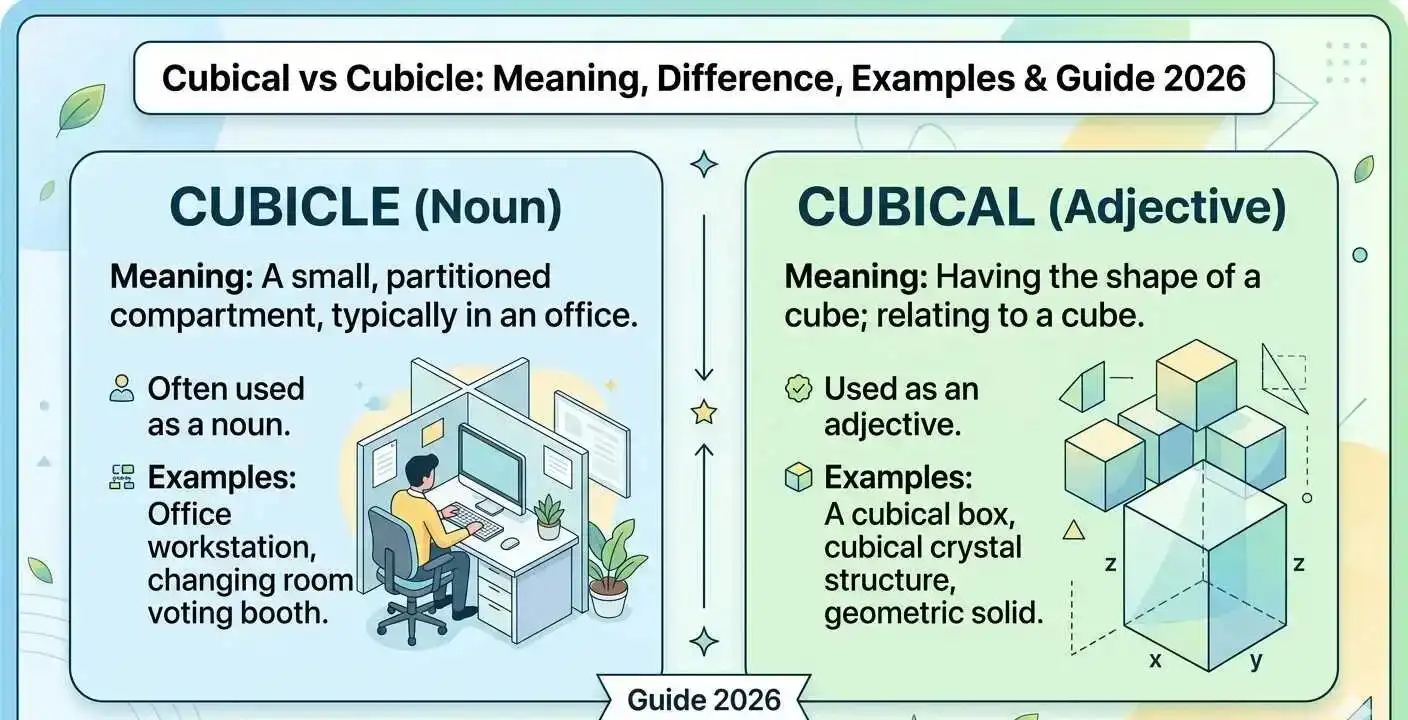
Cubical means something shaped like a cube — it describes form or geometry. Cubicle refers to a small enclosed workspace, usually found in offices.
So simply:
- Cubical = shape (cube-like)
- Cubicle = space (office partition)
Most people confuse them because they sound almost the same, but in real usage, they belong to totally different contexts.
AI Overview Summary
Cubical is an adjective used to describe something with a cube-like shape, often in geometry or physical description. Cubicle is a noun referring to a small enclosed area, commonly an office workspace separated by partitions. The confusion arises due to similar pronunciation, but their usage differs significantly in grammar and context.
What Does Cubical Mean?
Let’s start with cubical, because this is where most confusion begins.
Cubical is an adjective
It describes the shape of something — specifically something that looks like a cube or has equal dimensions.
Think of it like this:
- A cubical structure is box-shaped
- A cubical object looks like a cube
Real examples:
- A cubical storage box
- A cubical block of ice
- A cubical design in geometry problems
👉 Most people miss this: cubical is not about offices or rooms at all. It’s purely about shape.
So if you’re talking about structure or geometry, this is your word.
What Does Cubicle Mean?
Now let’s move to the word you’ve probably seen more often: cubicle.
A cubicle is a small enclosed space — usually found in offices — where employees work.
Simple definition:
A cubicle is a semi-private workspace separated by panels or partitions.
Real-world meaning:
- Office cubicles in corporate environments
- Study cubicles in libraries
- Workstations in shared offices
Examples:
- “She works in a cubicle near the window.”
- “The office was filled with identical cubicles.”
- “His cubicle has photos and notes pinned on the wall.”
Here’s the thing cubicles are not just physical spaces. They also represent modern office culture: structured, partitioned, and semi-private.
Cubical vs Cubicle Key Differences
Let’s break it down clearly so it sticks.
| Feature | Cubical | Cubicle |
|---|---|---|
| Word Type | Adjective | Noun |
| Meaning | Cube-shaped | Small office space |
| Context | Geometry, shape | Workplace, office |
| Usage | Physical form description | Work environment |
| Example | Cubical block | Office cubicle |
This table alone is enough for most readers to understand the difference instantly.
But let’s go deeper because context is everything.
READ MORE >>> Encorporate or Incorporate: Which Spelling Is Correct?
Why People Confuse Cubical and Cubicle
Most people think this is just a spelling mistake. It’s actually more interesting than that.
1. They sound almost identical
When spoken aloud, both words blend into similar sounds. That creates automatic confusion.
2. Autocorrect doesn’t always help
Sometimes typing “cubical office” doesn’t get flagged immediately, so the mistake slips through.
3. ESL learners mix shape vs object meaning
English learners often associate “cube” with both words, creating overlap in memory.
4. Visual similarity adds to confusion
Both words start with “cubi-”, so the brain treats them as related — even though they aren’t.
👉 Most people miss this: it’s not just grammar confusion — it’s a cognitive similarity issue.
Cubical vs Cubicle Examples in Real Sentences
Let’s make it practical.
Cubical in sentences:
- The scientist observed a cubical crystal structure under the microscope.
- The box has a cubical shape.
Cubicle in sentences:
- He works in a cubicle in a large office.
- Each employee has their own cubicle workspace.
- The library has silent study cubicles.
Notice something? Cubical describes things. Cubicle describes places.
Cubical vs Cubicle vs “Double Cubical”
Now here’s a term people sometimes stumble across: “double cubical.”
Let’s clear this up.
Does “double cubical” exist?
Not as a standard grammar term.
It is sometimes mistakenly used when people try to describe:
- a larger cube-like structure
- or a repeated geometric shape
But in real English usage:
- It’s not a recognized noun or grammar category
- It’s not used in professional writing
Case Study (Real-world confusion)
A student once wrote:
“The office had double cubical spaces for workers.”
The correct version should be:
“The office had larger cubicle spaces for workers.”
👉 This shows how shape-based misunderstanding can incorrectly shift into workplace terminology.
Is Cubical a Real Word?
Yes — but it is rarely used in everyday conversation.
When it is correct:
- Geometry descriptions
- Scientific or technical writing
- Shape-based explanations
When it is NOT correct:
- Office spaces
- Workplace descriptions
- Room or partition references
👉 Simple rule: If it’s about shape → cubical If it’s about workspace → cubicle
Real-Life Workplace Context
Let’s make this feel more real.
Imagine you walk into a modern office.
You see rows of small workspaces divided by walls. Those are cubicles.
Now imagine someone says:
“This is a cubical office setup.”
That sounds wrong because offices are not described by shape — they are described by structure and layout.
In workplace language:
- HR documents always say cubicle
- Office design discussions use cubicle layout
- Productivity studies refer to cubicle environments
This is why precision matters in professional writing.
Memory Trick to Never Confuse Them Again
Here’s a simple trick that actually works:
“Cubical = Cube”
- Think geometry
- Think shape
- Think mathematics
“Cubicle = Office Desk Space”
- Think workplace
- Think employees
- Think partitions
Or even simpler:
Cubical = cube Cubicle = desk
Short. Easy. Sticky.
Etymology Insight (Why This Word Exists)
The word cubicle comes from the Latin word cubiculum, meaning “sleeping chamber.”
Over time, it evolved into:
- small private space
- then modern office partition
This is why cubicles are designed as individual work chambers, even though they are open-plan in structure.
Cubical, on the other hand, simply comes from cube + -ical, meaning “having the form of a cube.”
Common Mistakes People Make
Let’s quickly fix the most common errors:
❌ “cubical office” ✔ “cubicle office”
❌ “He sits in a cubical” ✔ “He sits in a cubicle”
❌ “cubicle shape box” ✔ “cubical shape box”
These small changes make your writing instantly more accurate and professional.
Expert Insight (Why This Confusion Matters More Than You Think)
Most grammar confusion like this isn’t just about spelling.
It affects:
- clarity in communication
- professional perception
- writing credibility
Here’s the truth:
Small word mistakes can change how polished your writing feels.
That’s why understanding differences like cubical vs cubicle matters — especially in academic, SEO, and workplace writing.
FAQs
Is cubical or cubicle correct?
Both are correct, but in different contexts. Cubical is for shape, cubicle is for office spaces.
What is cubicle used for?
Cubicle refers to small enclosed workspaces, usually in offices or libraries.
Is cubical a real word in English?
Yes, but it is mainly used in technical or geometric contexts.
Why do people confuse cubical and cubicle?
Because they sound almost identical and share similar spelling patterns.
Final Thoughts
At first glance, cubical vs cubicle feels like a minor grammar confusion. But once you understand it deeply, it becomes a great example of how English separates shape-based meaning from object-based meaning.
Here’s the takeaway you should remember:
- Cubical = describes shape (cube-like structure)
- Cubicle = describes a workspace or enclosed area
Most confusion disappears once you anchor it to real-life context.
And honestly, that’s how English becomes easier — not by memorizing rules, but by connecting words to real situations you actually see every day.
So next time you’re writing and pause at this pair, you won’t hesitate anymore.