Gem or jem if you’ve ever paused mid-sentence, wondering which one is right, you’re not alone. They sound exactly the same. But here’s the catch: only one of them is correct in real-world writing.
Let’s clear this up properly so you never second-guess it again.
Quick Answer
“Gem” is the correct spelling in English. “Jem” is almost always incorrect, except when used as a proper name. The confusion happens because both words sound identical, but English spelling does not always match pronunciation. In writing, always use “gem” when referring to something valuable, rare, or admirable.
AI Overview Summary
“Gem” is the correct spelling used for a precious stone or something highly valuable, including people or ideas. “Jem” is not a standard English word and appears only as a name or in rare cases. The confusion comes from identical pronunciation, but in almost all writing situations, “gem” is the correct choice.
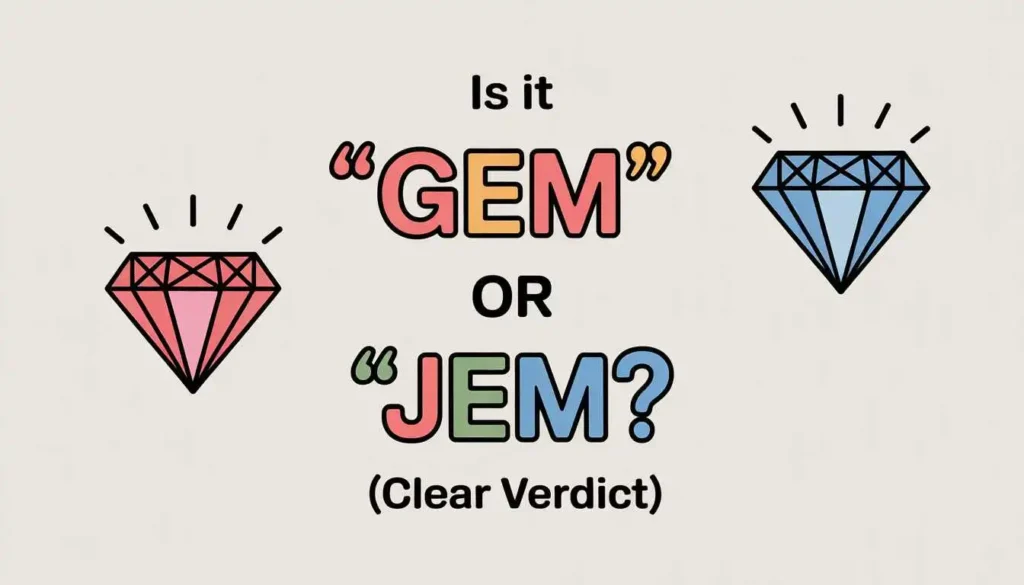
Is It “Gem” or “Jem”? (Clear Verdict)
Here’s the thing…
“Gem” is correct. “Jem” is wrong in standard English.
That’s the simple answer.
You should use “gem” in:
- Writing
- Speaking
- Social media
- Professional communication
“Jem” only works as a name. Nothing else.
What Does “Gem” Mean in English?
A “gem” is something valuable — either literally or figuratively.
Let’s break that down.
Literal Meaning (Stones and Jewelry)
A gem is a precious or semi-precious stone, like a diamond or ruby.
Examples:
- “She wore a necklace with a rare gem.”
- “This ring contains a beautiful gemstone.”
Figurative Meaning (Compliment or Praise)
Now this is where most people use it daily.
A “gem” can describe a person or thing that is special, kind, or valuable.
Examples:
- “You helped me so much — you’re a gem.”
- “That café is a hidden gem.”
Quick Comparison
| Type | Meaning | Example |
|---|---|---|
| Literal | Stone/jewel | “A rare gem” |
| Figurative | Valuable person/thing | “You’re a gem” |
Is “Jem” a Real Word?
“Jem” is not a standard English word.
But there’s a small twist.
When “Jem” Is Actually Correct
It can be correct in very limited cases, such as:
- A person’s name
- A fictional character
- A brand name
Examples:
- “Jem is my friend’s nickname.”
Why It’s Not Used in Writing
Outside of names, “jem” has no valid use.
So if you’re writing:
- Emails
- Essays
- Captions
- Messages
👉 You should never use “jem”
READ MORE >>> Merked or Murked: Meaning, Spelling Difference, and How to Use It Correctly
Why Do People Confuse “Gem” and “Jem”?
Because they sound exactly the same.
But that’s only part of the story.
Here’s what most people miss…
Your brain prefers sound over spelling.
The Sound vs Spelling Trap Model
This is where things get interesting.
Step 1: Sound Bias
You hear the word as “jem”
Step 2: Brain Shortcut
Your brain says: “Just write what you hear”
Step 3: English Conflict
English doesn’t follow strict phonetic rules
Step 4: Memory Anchor
G = Gem = Gold = Valuable
That last step is key.
Once you connect “G” with value, the confusion disappears.
Gem vs Jem: Key Differences Explained
The difference is simple: one is correct, the other is not.
But let’s make it crystal clear.
| Feature | Gem | Jem |
|---|---|---|
| Correct spelling | Yes | No |
| Meaning | Valuable object/person | Name only |
| Usage | Common | Rare |
| Professional writing | Accepted | Not accepted |
| Risk of mistake | Low | High |
Real-Life Examples: Correct vs Incorrect Usage
Using the wrong spelling can make you look careless.
Let’s see how this plays out.
Correct Usage:
- “That movie is a hidden gem.”
- “You’re such a gem for helping me.”
Incorrect Usage:
- “That movie is a hidden jem.”
- “You’re such a jem.”
See the difference?
It’s subtle — but it matters.
Mini Case Study: One Small Mistake, Big Impact
Scenario: Job Application Email
You’re applying for a job and write:
❌ “Your company is a jem in the industry.”
Now imagine the recruiter reading that.
Even if everything else is perfect, that one mistake can:
- Lower credibility
- Signal poor attention to detail
Now compare:
✅ “Your company is a gem in the industry.”
Clean. Professional. Confident.
That’s the power of getting small things right.
When Should You Always Use “Gem”?
You should use “gem” whenever you’re describing something valuable, rare, or admirable.
Common Situations:
- Professional emails
- Social media captions
- Everyday conversation
- Reviews and recommendations
Examples:
- “This app is a hidden gem.”
- “She’s a real gem of a person.”
The 3-Second Decision Rule
Here’s a simple trick.
If the word means something valuable → use “gem.”
That’s it.
No overthinking.
No confusion.
Common Mistakes to Avoid
Most mistakes happen because of habits, not knowledge.
Top Errors:
- Writing based on sound (“jem”)
- Typing too fast
- Ignoring spellcheck
- Copying incorrect usage online
Expert Tips to Never Misspell “Gem” Again
Want to lock this in permanently?
Use these.
1. The Gold Trick
G = Gold = Gem Both represent value.
2. Visual Memory
Picture a shiny gemstone with a big “G” on it
Sounds silly — but it works.
3. Practice in Context
Use it in real sentences:
- “This book is a gem.”
- “That place is a hidden gem.”
Frequently Asked Questions
Is it gem or jem correct?
“Gem” is correct. “Jem” is incorrect unless it’s used as a name.
Why is gem spelled with a G?
Because English uses soft “G” sounds, which can sound like “J.” That’s why “gem” is pronounced like “jem.”
Is jem ever correct in English?
Only in names or rare proper nouns. It’s not used in normal writing.
What does gem mean in slang?
It means a valuable or kind person. For example: “You’re a gem” is a compliment.
How do I remember the spelling of gem?
Use this: G = Gold = Gem Both represent something valuable.
Final Thoughts
Here’s the truth…
This isn’t really about spelling.
It’s about confidence in communication.
Small words. Small choices. But they shape how people see you.
Now you know:
- “Gem” is always the correct choice
- “Jem” is almost always wrong
And more importantly — you know why.
So next time you type it, you won’t hesitate.
You’ll just write it right.