
Quick Answer
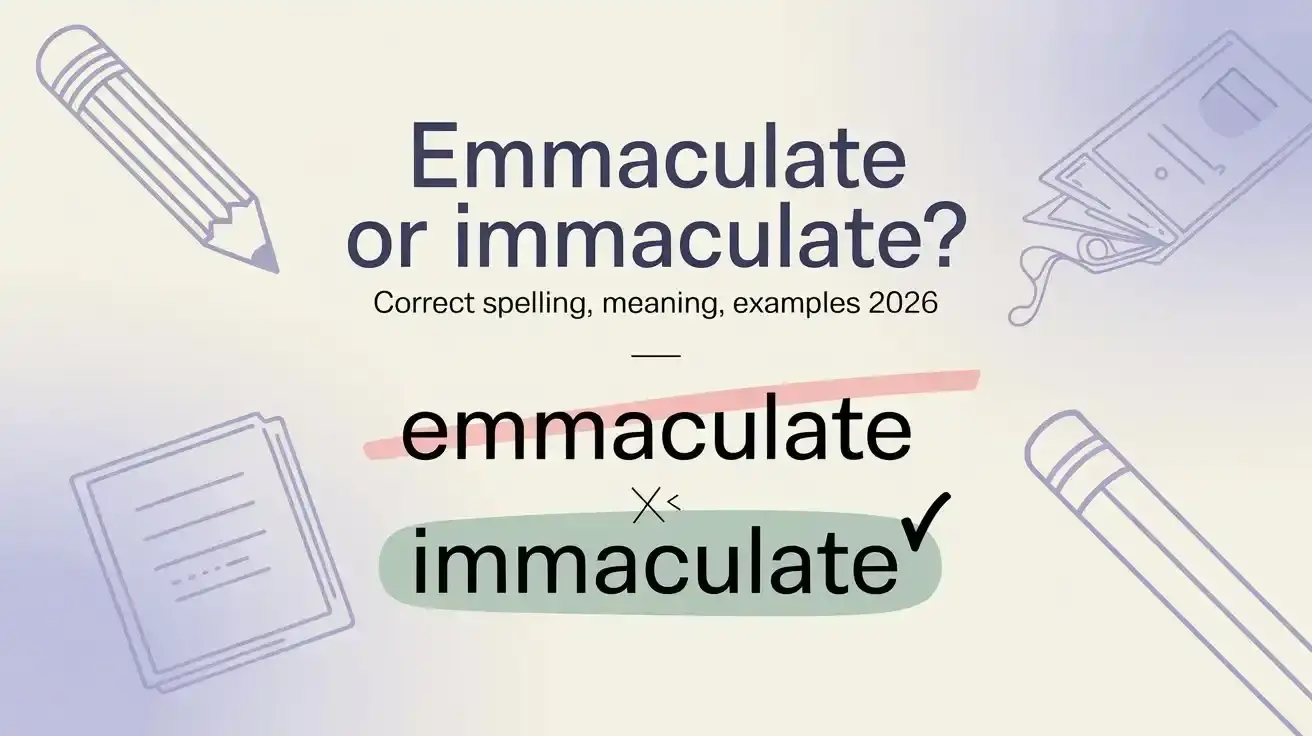
The correct spelling is “immaculate.” “Emmaculate” is incorrect and not used in modern English. “Immaculate” means perfectly clean, flawless, or without mistakes. Example: Her room was immaculate.
AI Overview–Style Summary
- Correct word: Immaculate
- Incorrect form: Emmaculate
- Meaning: Spotless, flawless, or error-free
- Origin: Latin immaculatus (“not stained”)
- Common issue: People confuse spelling due to pronunciation
- Best usage: Cleanliness, perfection, and precision
Emmaculate vs Immaculate (Clear Comparison)
| Word | Correct? | Meaning | Usage |
|---|---|---|---|
| Immaculate | Yes | Perfectly clean or flawless | Correct in all contexts |
| Emmaculate | No | Not a valid modern word | Incorrect spelling |
Key takeaway: If you’re choosing between emmaculate or immaculate, the answer is always immaculate.
What Does “Immaculate” Mean?
Simple Definition
“Immaculate” is an adjective that means:
- Perfectly clean
- Without flaws
- Free from mistakes
It is often used when something looks or feels perfect in every way.
Real-Life Meaning (Context-Based Examples)
Let’s look at how meaning changes slightly depending on context:
- Cleanliness: “Her kitchen is always immaculate.” (Very clean, no dirt)
- Work quality: “His assignment was immaculate.” (No errors at all)
- Appearance: “He arrived in an immaculate suit.” (Perfectly neat and clean)
- Performance: “She gave an immaculate performance.” (Flawless execution)
Insight: The word always connects to perfection, but the type of perfection depends on the situation.
Is “Emmaculate” a Real Word?
Short Answer
No, “emmaculate” is not a correct word in modern English.
Why “Emmaculate” Is Incorrect
- It is not found in standard dictionaries
- It is considered a spelling mistake
- It appears due to confusion in pronunciation
Hidden Confusion (Information Gain Section)
Some users mix “emmaculate” with similar-looking or sounding words:
- Emaciate → to become very thin
- Emasculate → to weaken or reduce strength
These are real words—but completely different in meaning.
Important: Even though they look similar, they are not related to “immaculate.”
Why Do People Spell “Immaculate” as “Emmaculate”?
Understanding this helps you avoid the mistake forever.
Pronunciation Confusion
The word is pronounced:
ih-MAK-yuh-lit
The starting sound “ih” can sound like “eh,” which leads people to write “em” instead of “im.”
Sound vs Spelling Problem
English is not a fully phonetic language. That means:
We don’t always write words the way they sound.
Example:
- “immaculate” sounds like “emmaculate” → leads to wrong spelling
Pattern Recognition Mistake
Many English words start with “em-”:
- empower
- embrace
- emotion
So the brain assumes:
“emmaculate must be correct”
But in this case, the correct prefix is “im-”, not “em-”.
READ MORE >>> Steller vs Stellar: Meaning, Difference, Usage, and Common Confusion Explained
How to Spell “Immaculate” Correctly
Step-by-Step Breakdown
Break the word into parts:
- im + macula + te
This makes it easier to remember and write.
Easy Memory Tricks
Here are simple ways to lock it in your memory:
- “Immaculate = no macula (no spots)”
- “Im = not, macula = stain”
So:
Immaculate = not stained
Visual Learning Trick
Imagine a perfectly clean white shirt.
No stains. No marks. Nothing wrong.
That is immaculate.
Now connect that image with the spelling.
Word Origin (Etymology Made Simple)
Latin Root Explanation
“Immaculate” comes from Latin:
- immaculatus → meaning “unstained”
Prefix + Root Meaning
- im = not
- macula = spot or stain
So:
Immaculate literally means “without a spot.”
Why This Matters
Understanding word roots helps you:
- Spell correctly
- Remember meaning easily
- Recognize related words
How to Use “Immaculate” in Sentences
Everyday Usage
- “The house looked immaculate.”
- “Her desk is always immaculate.”
Professional Context
- “The report was immaculate and well-structured.”
- “His presentation was immaculate.”
Academic Context
- “She submitted an immaculate essay.”
- “His answers were immaculate.”
Micro-Examples (Quick Learning)
- Clean shoes → immaculate
- Perfect notes → immaculate
- Error-free code → immaculate
Common Mistakes to Avoid
Incorrect Spellings
Avoid these:
- emmaculate
- immacculate
- emaculate
Wrong Usage Context
Don’t use “immaculate” for average things.
Example:
- Incorrect: “This normal burger is immaculate”
- Correct: “This perfectly cooked burger is immaculate”
Overuse Problem
Using the word too often can weaken its impact.
Use it only when something is truly perfect or flawless.
Immaculate vs Similar Words (Expanded Understanding)
| Word | Meaning | Key Difference |
|---|---|---|
| Immaculate | Spotless, pure, flawless | Focus on cleanliness |
| Impeccable | Without mistakes | Focus on performance |
| Perfect | No flaws | General term |
| Pristine | Fresh and untouched | Focus on condition |
When to Use Each Word
- Use immaculate → for clean or pure perfection
- Use impeccable → for behavior or work quality
- Use perfect → for general situations
Mini Case Study (Real-Life Impact)
Student Example
Before:
“My homework is emmaculate.”
This creates:
- Wrong impression
- Possible loss of marks
After:
“My homework is immaculate.”
This shows:
- Strong vocabulary
- Correct English usage
Content Writer Example
A blog post includes:
- “emmaculate design”
Result:
- Readers lose trust
- Looks unprofessional
Correct version:
- “immaculate design”
Key Lesson
Small spelling errors can:
- Damage credibility
- Reduce trust
- Affect academic or professional results
Expert Tips to Never Misspell “Immaculate”
Learn the Root Meaning
Understanding “macula = stain” helps you remember spelling.
Practice Writing
Write the word a few times:
- Immaculate
- Immaculate
- Immaculate
Repetition builds memory.
Use Spell-Check Tools
Modern tools can catch mistakes instantly.
Read More
The more you see correct words, the easier it becomes to remember them.
FAQs (People Also Ask)
Is emmaculate a correct word?
No. It is a spelling mistake. The correct word is immaculate.
What is the correct spelling of immaculate?
The correct spelling is: I-M-M-A-C-U-L-A-T-E.
Why do people spell immaculate wrong?
Because of pronunciation confusion and similar spelling patterns in English.
How do you pronounce immaculate?
It is pronounced as:
ih-MAK-yuh-lit
What is the difference between immaculate and impeccable?
- Immaculate = perfectly clean or pure
- Impeccable = without mistakes
Final Verdict
If you’re deciding between emmaculate or immaculate, the answer is simple:
- Immaculate is correct
- Emmaculate is incorrect
There is no situation where “emmaculate” should be used in modern English.
The word “immaculate” is powerful. It expresses cleanliness, perfection, and precision in a single term.
Use it when something is truly flawless—and make sure you spell it correctly every time.
Final Thought: Good writing is not just about ideas—it’s also about accuracy. And sometimes, fixing just one word can make your entire sentence look more professional.